

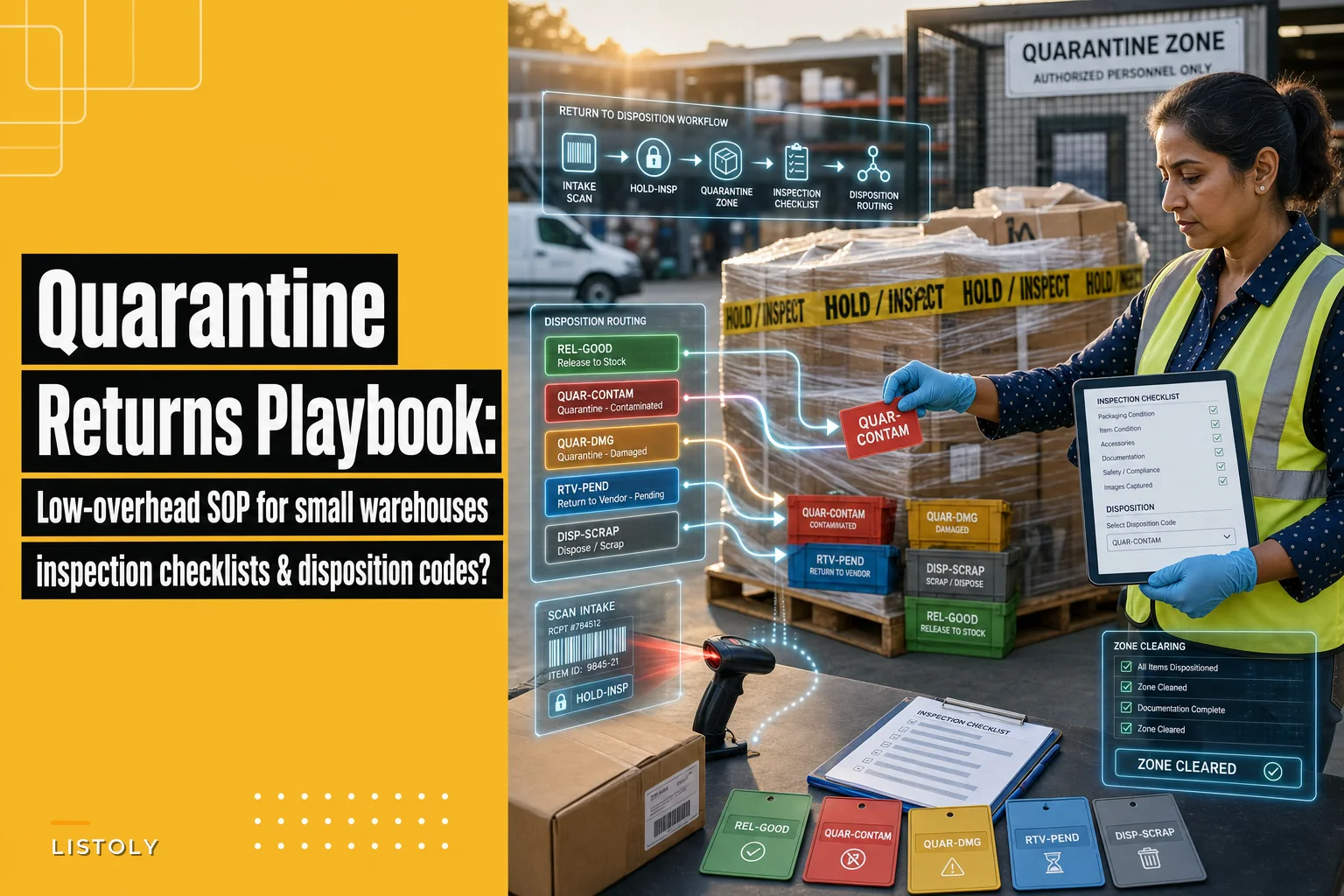

Contaminated or damaged stock rarely causes a dramatic disaster. It leaks. A returned box gets scanned back into available inventory before anyone checks it, a leaking chemical bottle gets shelved next to clean units, or a customer return with a hairline crack goes right back on the pick face. Then three weeks later you ship it to someone who leaves a one-star review or files a complaint, and you spend an afternoon tracing how it happened.
Most of these incidents come down to one gap: there's no formal hold between "arrived at the dock" and "available to sell." Small warehouses skip quarantine because it feels like enterprise overhead. But a lightweight quarantine and returns workflow doesn't require a QA department or a separate building. It requires a physical hold zone, a short disposition vocabulary, and a system flag that actually blocks the stock from being picked.
Below is how contaminated stock re-enters inventory, and how to build the smallest possible SOP that stops it.
How contaminated stock sneaks back into available inventory
The re-entry problem almost never happens at receiving of new POs. It happens at returns and at "found" stock.
A return comes in. The person processing it wants to close the RMA fast, so they scan the SKU, the system increments available quantity, and the physical unit goes back on the shelf without inspection. Nobody decided it was good. The system just assumed it was, because a return event defaults to "restock."
The second common path is damage that gets discovered but not flagged. A picker finds a crushed carton, sets it aside to deal with later, and it sits on a cart or a floor spot with no label. End of shift, someone tidies up, sees product, and puts it back on the shelf. The damage note never made it into the system, so the unit is fully sellable again.
The third path is contamination bleed. One leaking container, one pest-exposed pallet, one temperature-abused lot — and the question becomes how far does the contamination spread? Without a defined hold zone, the answer is wherever someone happened to put the affected units, which usually means mixed in with good stock.
The common thread: the physical product and its status live in two different places, and they drift apart. The fix is to force every questionable unit through a single choke point before it can rejoin available inventory.
The three things a minimal quarantine SOP actually needs
You don't need a policy binder. You need three components that reinforce each other.
Never run out of stock or overorder again.
Listoly streamlines inventory workflows to keep your business stocked and profitable.
- Real-time stock tracking
- Automated reorder alerts
- Supplier and purchase management
No credit card required
1. A physical quarantine zone that isn't a suggestion. This is a defined, labeled area — a shelf section, a taped-off floor square, a rolling cage — physically separate from pick faces. The rule is absolute: if a unit is under review, it lives here and nowhere else. The moment quarantine becomes "that corner where we sort of put damaged stuff," it fails, because good and bad units start mixing.
2. A short disposition vocabulary. Most small warehouses over-complicate this with fifteen categories nobody remembers. You need maybe six codes. More on the exact set below, but the principle is simple: every code maps to one clear next action.
3. A system flag that blocks picking. This is the piece people skip, and it's the one that matters most. The quarantined quantity has to be invisible to order allocation. If your system just shows it as "on hand" with a note, someone will eventually sell it. The flag has to move the quantity out of the available-to-promise pool entirely.
Use high-visibility tape or signage so the quarantine zone is unmistakable to every picker.
If any one of these three is missing, the other two don't hold. A physical zone with no system flag means the numbers still say it's sellable. A system flag with no physical separation means the product is still sitting where a picker will grab it.
A disposition code set that small teams will actually use
The codes below cover the vast majority of real situations. The key is keeping the list short enough to memorize and mapping each code to a single, unambiguous action.
| Code | Meaning | Blocks picking? | Default next action |
|---|---|---|---|
| HOLD-INSP | Awaiting inspection (returns, found stock) | Yes | Inspect within 48 hrs, then recode |
| QUAR-CONTAM | Suspected contamination / leak / pest | Yes | Isolate, assess spread, likely destroy |
| QUAR-DMG | Physical damage, not contamination | Yes | Grade: refurb, discount, or scrap |
| RTV-PEND | Return to vendor pending | Yes | Route to RMA-to-vendor process |
| REL-GOOD | Inspected, confirmed sellable | No | Return to available inventory |
| DISP-SCRAP | Approved for destruction/disposal | Yes | Document, dispose, write off |
Two things worth noting. First, HOLD-INSP is the default landing state for every return and every found unit. Nothing goes straight to REL-GOOD without passing through inspection. That single rule kills most re-entry incidents on its own.
Second, only one code — REL-GOOD — allows a unit back into the sellable pool, and reaching it requires a human decision. Everything else keeps the stock locked out. That asymmetry is intentional. The easy default should always be "held," and releasing should require an affirmative check.
The inspection checklist that decides disposition
The inspection step is where the code gets assigned. A checklist keeps it fast and consistent, so the newest person on shift disposition-codes the same way you would. Keep it to what you can scan in under a minute per unit.
-
Seal / packaging intact? Any tampering, opening, or reseal signs → not REL-GOOD.
-
Signs of leak or residue on the unit or neighboring units? → QUAR-CONTAM, and check adjacent stock.
-
Physical damage — cracks, dents, crushed cartons, broken components? → QUAR-DMG, then grade severity.
-
Odor, moisture, discoloration, or pest evidence? → QUAR-CONTAM.
-
Temperature-sensitive item — any indication of a broken cold chain or heat exposure? → QUAR-CONTAM or HOLD for lot review.
-
Lot/expiry legible and within window? Expired or illegible → not REL-GOOD.
-
Return reason on the RMA — was it "defective," "wrong item," or "changed mind"? A "defective" reason should raise the bar for release, not lower it.
The most common mistake is treating "customer changed their mind" returns as automatically good. Those units still traveled, got handled, sometimes got opened. They still go through HOLD-INSP. The return reason informs how carefully you look — it doesn't let you skip the look.
For contamination specifically, the checklist has a spread question built in: when you find one contaminated unit, you inspect its neighbors. A single leaking bottle on a shelf means everything within splash range gets pulled to QUAR-CONTAM until proven clean. Same containment logic behind a solid lot-traceability and recall runbook — treat contamination as a potential cluster, not an isolated defect.
The receiving-to-disposition workflow, step by step
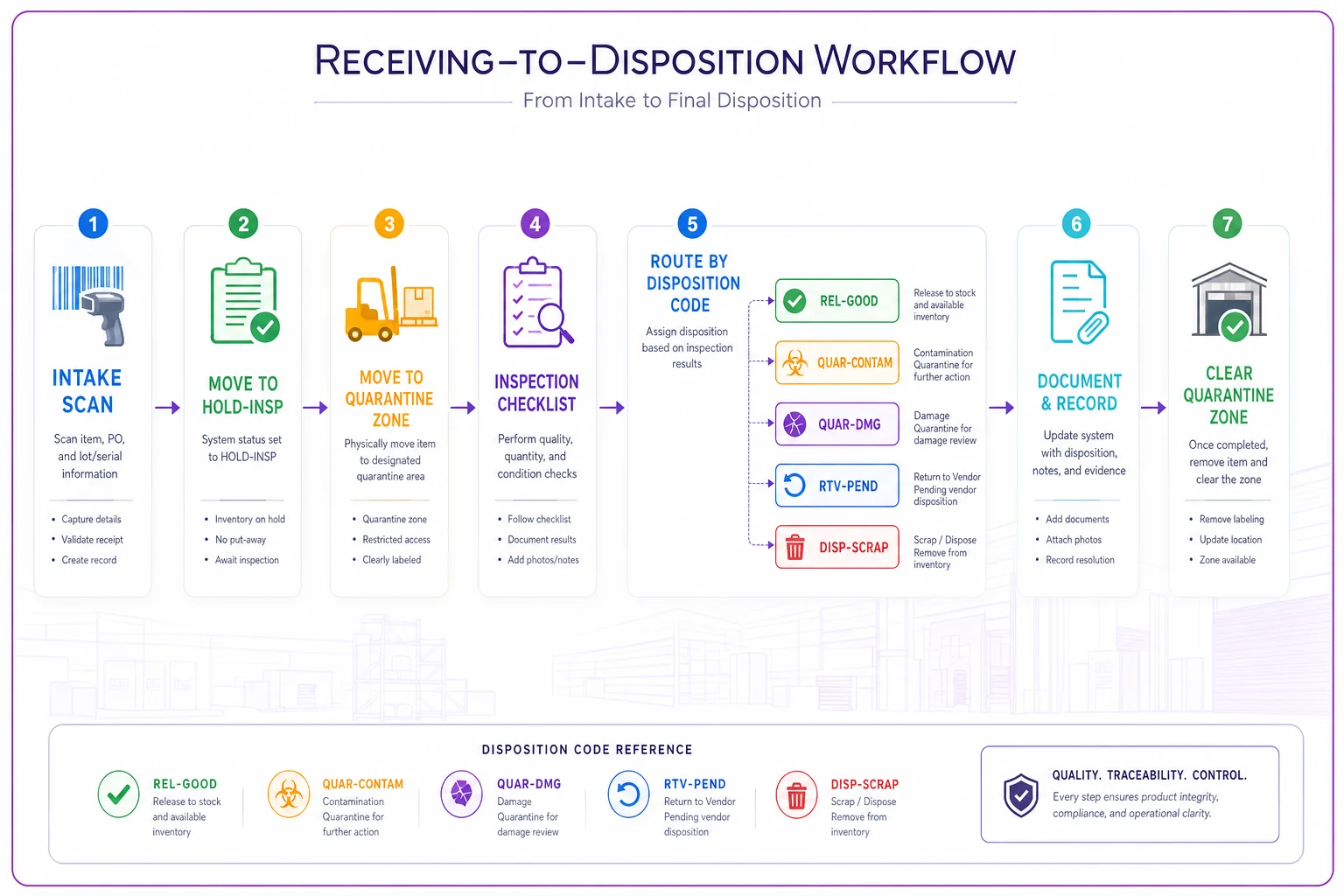
Here's the full path a questionable unit takes, from arrival to resolution. Simple enough to tape to the wall near the returns station.
-
1. Intake. Any return, found unit, or damage-flagged item is scanned into HOLD-INSP immediately. The system flag moves that quantity out of available-to-promise the moment it's scanned.
-
2. Physical move. The unit goes to the quarantine zone. Not a cart, not "later" — the zone.
-
3. Inspect. Within a set window (48 hours works for most small operations), someone runs the checklist and assigns a disposition code.
-
4. Route by code. REL-GOOD goes back to the pick face and back into available quantity. QUAR-CONTAM and QUAR-DMG stay in the zone pending final decision. RTV-PEND routes to your vendor return process. DISP-SCRAP goes to disposal.
-
5. Resolve and document. Every code change gets logged — who, when, why. For scrap and contamination, note the quantity and reason so the write-off is defensible.
-
6. Clear the zone. Nothing lingers in quarantine indefinitely. Anything past the inspection window gets escalated, not ignored.
The single most important line in that whole flow is step 1: the flag moves quantity out of available-to-promise at scan time. If your system does that automatically, the human doesn't have to remember anything for the stock to stay safe. If it doesn't, you're relying on discipline — and discipline fails at 4:45 on a Friday.
Here's a visual you can post near the returns station.
This is exactly where a workflow platform earns its keep. When your inventory system treats a HOLD-INSP scan as an automatic block — not a note somebody has to read — the quarantine holds even when the warehouse is slammed. AI-assisted operational software can also surface the patterns humans miss: the same SKU landing in QUAR-DMG repeatedly, a spike in contamination holds tied to one lot, or units sitting in HOLD-INSP past the inspection window. Those alerts turn quarantine from a manual chore into something the system actively watches for you, without anyone having to remember to check.
When a full quarantine SOP makes sense — and when it's overkill
This full setup makes sense when you handle food, cosmetics, supplements, chemicals, electronics, or anything where contamination or defects carry real safety or liability exposure. It also makes sense if you have meaningful return volume, or if you've already had one contaminated-shipment complaint. One incident usually costs more than a year of running the process.
A lighter version works when you sell durable, low-risk goods with low return rates — hardware, non-perishable dry goods, apparel with simple defect grading. You might collapse the codes to three (HOLD, GOOD, SCRAP) and skip the contamination-specific handling.
Who can skip the heavy version: a micro-operation moving a handful of returns a week can run a "returns table + inspect before reshelf" habit and get most of the benefit. The full disposition vocabulary only pays off once volume makes informal handling unreliable — usually somewhere around a few dozen returns or damage events a week.
The failure mode at both ends is the same: building a process too heavy to follow, or too light to catch anything. The right size is the smallest process your team will actually execute every single time.
Real scenario: a supplements reseller
A small supplements and wellness reseller running out of a roughly 4,000 sq ft space was reshelving customer returns on the same day they came in, no inspection. Return volume ran around 60–80 units a week. Most were fine — but every so often a heat-exposed or opened bottle went straight back to available and shipped to the next customer.
Over a stretch of a few months they got two contamination complaints and a handful of "this was clearly used" reviews. The real cost wasn't the refunds — it was one lot they had to pull and partially scrap because they couldn't tell which returned units had been mixed back in. That write-off ran somewhere in the $2k–$3k range, plus the time spent untangling it.
They put in the minimal version: a taped-off quarantine shelf, six disposition codes, and a system flag that dropped HOLD-INSP quantity out of available at scan. Every return now landed in HOLD-INSP by default and got a 30-second checklist before release. Nothing dramatic changed about their day — inspection added maybe a few minutes per return batch.
Contamination complaints stopped. When a questionable lot showed up, they could isolate it instead of scrapping the whole thing. The next time they had a suspect batch, the quarantine flag contained it to under a dozen units instead of an entire shelf. That's a pretty direct return on a process that took an afternoon to set up.
The one habit that holds the whole thing together
Default every return and every found unit to a held state, and make release the only step that requires a decision. Everything else — the codes, the checklist, the zone — is just infrastructure supporting that one rule.
Contaminated stock re-enters inventory because the system quietly assumes questionable product is good. Flip that assumption. Assume it's held until someone confirms otherwise, back that assumption with a flag that actually blocks picking, and give your team a short, memorable vocabulary for what happens next. That's the whole SOP. It fits on a wall, it takes a minute per unit, and it keeps the stock that shouldn't ship from shipping.
Default every return and every found unit to a held state, and make release the only step that requires a decision. Everything else — the codes, the checklist, the zone — is just infrastructure supporting that one rule.
Contaminated stock re-enters inventory because the system quietly assumes questionable product is good. Flip that assumption. Assume it's held until someone confirms otherwise, back that assumption with a flag that actually blocks picking, and give your team a short, memorable vocabulary for what happens next. That's the whole SOP. It fits on a wall, it takes a minute per unit, and it keeps the stock that shouldn't ship from shipping.
Ready to optimize your inventory operations?
Join 2,000+ businesses using Listoly to reduce stockouts, save time, and improve order accuracy.