


Most inventory management formulas assume your products sell regularly. They expect predictable patterns where you can calculate standard deviations and forecast with confidence. But what happens when half your SKUs sell three units one month, zero the next, then suddenly twelve?
Traditional reorder point calculations break down for slow-moving and intermittent demand items. The math stops working when you have months of zero sales followed by random spikes. Yet these SKUs often represent 60-70% of most small business catalogs—specialty items, replacement parts, seasonal products, or niche variations that customers occasionally need but don't buy regularly.
The standard approach tells you to multiply average daily usage by lead time, add safety stock based on service level targets, done. Try that with a product that sold twice in January, nothing until May, then eight units in June. Your "average" becomes meaningless. Your safety stock calculation produces nonsense. You either overstock massively or constantly run out when someone actually wants the item.
The hybrid approach that handles unpredictable SKUs
After watching dozens of businesses struggle with slow movers, one pattern becomes clear: you need different rules for different demand patterns. Not everything fits into neat statistical models, and forcing square pegs into round holes leads to expensive inventory mistakes.
The most effective approach combines multiple decision methods based on SKU characteristics. Some items work fine with modified statistical formulas. Others need simple min/max rules. Some require regular human review. The key is matching the method to the demand pattern instead of forcing one approach on everything.
Here's how this looks in practice:
Statistical methods (when they work): Use for items with at least 6-12 months of consistent demand data, even if volumes are low. A product selling 2-4 units monthly can still use statistics if the pattern stays relatively stable.
Min/max rules (simple but effective): Set for items with highly irregular patterns. Minimum = what you need on hand to avoid stockouts during typical order cycles. Maximum = the most you're willing to hold based on space and capital constraints.
Review cadences (human judgment): Schedule regular reviews for items that defy both statistics and rules. Monthly or quarterly, depending on importance and variability.
Manual overrides (essential flexibility): Build in the ability to override any calculation based on specific knowledge—upcoming promotions, known customer projects, supplier issues, or market changes the system can't predict.
Building your decision tree for slow movers
The first step is categorizing your SKUs based on demand patterns and business importance. Not all slow movers deserve the same attention or inventory investment.
Never run out of stock or overorder again.
Listoly streamlines inventory workflows to keep your business stocked and profitable.
- Real-time stock tracking
- Automated reorder alerts
- Supplier and purchase management
No credit card required
Start with this classification:
| Demand Pattern | Annual Velocity | Variability | Method |
|---|---|---|---|
| Intermittent Regular | 12-50 units | Low-Medium | Modified Statistics |
| Sporadic | 5-20 units | High | Min/Max Rules |
| Lumpy | 10-100 units | Extreme | Manual Review |
| Dead/Dying | <5 units | Any | Hold/Delist Decision |
For intermittent regular items, you can still use reorder points, but calculate them differently. Instead of using all historical data, focus on periods with actual demand. If an item sold in 4 of 12 months, calculate your average based only on those 4 active months, then adjust for the probability of demand occurring.
Focus your averages on active months rather than the full time series for intermittent items.
Sporadic items work better with simple min/max rules. Set your minimum at 1-2 units if the item is critical for certain customers, or at zero if you can wait for customer orders. Your maximum depends on shelf life, storage cost, and how much capital you're willing to tie up.
Lumpy demand—where you get occasional large orders—requires human judgment. A part that usually sells 1-2 units but occasionally gets ordered in batches of 25 can't be managed by formulas. You need to understand why those large orders happen and whether they'll repeat.
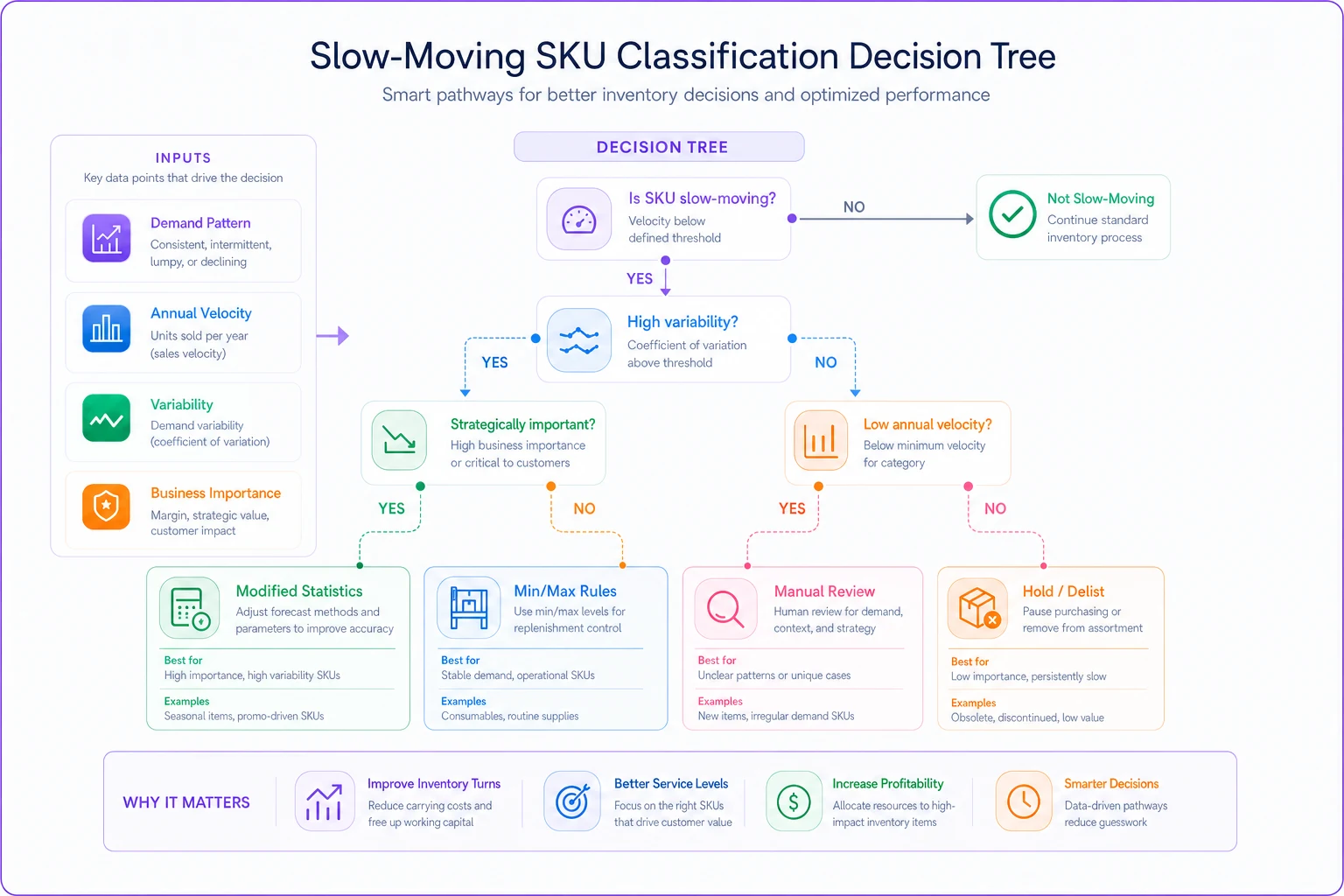
This flowchart shows the steps to classify SKUs and pick the appropriate management method.
When to hold, delist, or switch to make-to-order
Not every slow-moving SKU deserves shelf space. The decision to keep, remove, or change how you handle an item depends on more than just sales velocity.
Consider this decision framework:
Keep as stock item when:
-
Customer relationships depend on availability
-
Profit margins exceed 40% despite low velocity
-
It drives sales of faster-moving items
-
Storage costs are minimal
-
You have reliable supplier relationships
Switch to make-to-order when:
-
Lead times are acceptable to customers (under 2-3 weeks)
-
The item is customizable anyway
-
Storage or obsolescence risk is high
-
Demand is project-based rather than continuous
Delist completely when:
-
No sales in 12+ months
-
Multiple substitutes exist
-
Carrying costs exceed annual profit
-
Supplier minimums force excessive inventory
-
Quality issues create more problems than sales value
A specialty hardware store found that around 200 of their 800 slow-moving SKUs could switch to make-to-order without losing sales. Customers buying unusual fasteners or specialized tools expected to wait anyway. Eliminating stock on these items freed up roughly $35,000 in working capital while maintaining the same service level.
Practical examples with real numbers
Three different slow-moving SKUs, and how to handle each:
Example 1: Replacement gasket for commercial equipment
-
Sells 0-3 units monthly, averaging around 18 per year
-
Each costs $12, sells for $45
-
Lead time
2 weeks from supplier
-
Customer impact if out of stock
High (equipment down)
Solution: Min/max rule with min=2, max=6. Always keep at least two on hand for emergency repairs. Reorder when you hit 2, bringing stock back to 6. Simple, effective, no complex calculations needed.
Example 2: Specialty craft supply
-
Sells in bursts around holidays
-
October
15 units, December: 22 units, other months: 0-2
-
Cost
$3, Price: $8.99
-
Lead time
4 weeks
Solution: Seasonal adjustment with manual override. Set base stock at 2 units January through August. Manually increase to 20 units for September delivery, 25 for November delivery. After holidays, let it sell down naturally.
Example 3: Industrial chemical in 5-gallon containers
-
Sporadic large orders from 2-3 regular customers
-
Order pattern
10 units, nothing for 3 months, 5 units, nothing for 2 months, 15 units
-
Cost
$85, Price: $140
-
Lead time
1 week
-
Storage
Requires special handling
Solution: Contact the regular customers and arrange planned ordering. Move to make-to-order with scheduled deliveries. Keep a maximum of 5 units as a buffer for unexpected orders.
The safety stock problem with intermittent demand
Traditional safety stock formulas use standard deviation to protect against variability. But when half your data points are zero, standard deviation becomes meaningless or dramatically overstated. You end up with safety stock recommendations of 20 units for items that sell 15 per year.
Instead of statistical safety stock, these practical approaches tend to work much better:
-
Time-based coverage Instead of calculating units, think in terms of coverage period. For a slow mover selling 2-4 monthly, one month of coverage might mean 4 units of safety stock.
-
Customer count method If you have three customers who occasionally buy this item, keep enough for one typical order from each. This prevents one customer from cleaning you out.
-
Lead time multiplier For critical items with long lead times, keep 1.5-2x your typical order quantity. Less critical items might need just 0.5x or none at all.
-
Stepped safety stock Rather than a smooth calculation, use steps. Items selling 1-5 annually might get 1 unit safety stock. Items selling 6-12 get 2 units. Items selling 13-24 get 3 units. Simple rules that make operational sense.
Simple rules that make operational sense.
Building fallback rules when statistics fail
Every slow-moving SKU needs a fallback plan for when formulas produce nonsense. These rules prevent the absurd situations where calculations tell you to stock 50 units of something that sells twice a year.
Create maximum inventory caps based on:
-
Annual usage (never stock more than 6-12 months of average demand)
-
Dollar value (limit investment in any single slow-moving SKU)
-
Storage space (physical constraints matter)
-
Obsolescence risk (shorter limits for items with shelf life or version changes)
Also establish minimum service rules:
-
Critical items always have at least one unit
-
Items with contractual obligations maintain agreed minimums
-
New items get a trial period before applying slow-mover rules
One electronics parts distributor implemented a simple override: no slow-moving SKU could have a suggested order quantity exceeding 50% of annual usage, regardless of what formulas said. That one rule eliminated roughly $200,000 in excess inventory within six months.
Review cadences that prevent dead stock accumulation
Static rules eventually fail because demand patterns change. What sold steadily two years ago might be obsolete now. Regular reviews catch these shifts before you're stuck with dead inventory.
Structure your reviews based on SKU importance and risk:
Monthly reviews:
-
High-value slow movers (over $100 per unit)
-
Items with shelf life under one year
-
SKUs with declining sales trends
Quarterly reviews:
-
Moderate-value items ($20-100)
-
Stable slow movers with consistent patterns
-
Items approaching delist thresholds
Annual reviews:
-
Low-value stable items (under $20)
-
Established slow movers with predictable demand
-
Category-wide assessments
During reviews, examine:
-
Recent demand changes
-
Customer feedback
-
Substitute product availability
-
Supplier minimum changes
-
Competitive landscape shifts
Document decisions and reasoning. When you decide to keep a non-selling SKU for customer relationship reasons, write it down. This prevents repeatedly questioning the same decisions and helps train new team members on judgment calls.
Manual overrides and exception handling
No matter how good your rules, exceptions will come up. Building in override capabilities from the start prevents workarounds that break data integrity.
Common override scenarios:
-
Customer pre-orders
A customer tells you they'll need 20 units next quarter. Your system says stock 3. Override to ensure availability.
-
Supplier discontinuation
Your vendor announces this is the last production run. Override to stock up or to stop reordering entirely.
-
Promotional planning
Marketing plans a campaign featuring slow movers. Temporarily override normal stocking levels.
-
Quality issues
A batch has problems but you need to maintain some inventory. Override to limit exposure while maintaining availability.
Track all overrides with:
-
Who made the decision
-
Why they overrode the system
-
Expected duration
-
Review date to reassess
This tracking helps identify patterns. If you're constantly overriding certain SKUs, their rules need adjustment. If one person overrides excessively, they might need training—or their overrides might reveal actual blind spots in your rules.
Technology and tools that support hybrid approaches
Managing slow movers with multiple methods requires flexible systems. Spreadsheets work initially but break down as complexity grows. You need tools that handle different calculation methods simultaneously while maintaining audit trails and override capabilities.
The challenge is finding systems that don't force everything into statistical models. Many inventory management platforms assume normal demand distributions and offer limited options for rule-based management. This is where operational software with AI assistance helps bridge the gap between pure statistics and human judgment.
Modern platforms can identify when statistical methods are failing and automatically suggest switching to min/max rules. They track override patterns to surface insights that are easy to miss manually. If overrides consistently happen before trade shows, for example, the system can learn to adjust automatically for those events.
AI automation helps most with the review process. Instead of manually checking hundreds of slow-moving SKUs, AI-powered platforms can flag items with changing patterns, unusual orders, or approaching decision points—letting your team focus on judgment calls rather than data gathering.
The key is maintaining human control while using technology for pattern recognition and routine decisions. Your team still decides whether to keep or delist a product, but having that context surfaced automatically makes a real difference.
Monitoring performance and adjusting approaches
The only way to know if your hybrid approach works is measuring outcomes. Track different metrics for different SKU categories since one-size-fits-all KPIs don't make sense for slow movers.
For statistically managed items:
-
Stockout frequency
-
Excess inventory occasions
-
Forecast accuracy (even if rough)
For min/max ruled items:
-
Times hit minimum before reorder arrives
-
Times sat at maximum for extended periods
-
Manual intervention frequency
For manually reviewed items:
-
Decision accuracy (did you predict correctly?)
-
Review time investment versus value
-
Pattern recognition improving over time
A building supplies distributor tracking these metrics discovered their min/max rules were too conservative. They were almost never hitting minimums but frequently sitting at maximum for months. By reducing maximums by about 30% and dropping minimums by one unit, they freed up $125,000 in working capital without increasing stockouts.
Also watch the overall mix. If items keep moving from statistical to manual categories, your data quality or calculation methods might need attention. If everything becomes exception-based, you probably need simpler base rules.
The real impact of getting slow movers right
Small businesses tend to focus on fast-moving products while slow movers quietly drain resources. But getting slow-mover management right can change things in ways that aren't immediately obvious.
Working capital improves when you're not overstocking hundreds of slow-moving SKUs. A specialty food distributor reduced slow-mover inventory by around 40% using hybrid approaches, freeing up close to $280,000 they reinvested in faster-moving products with better margins.
Customer satisfaction actually increases when you're honest about what you stock versus make-to-order. Customers prefer knowing they need to order specialty items in advance rather than assuming you'll have them and being disappointed.
Operational complexity drops when you have clear rules for different SKU types. Staff stop making arbitrary decisions and follow documented processes. That alone reduces training time and improves consistency across shifts.
And the psychological burden on inventory managers gets lighter. Instead of feeling overwhelmed by thousands of SKUs with unpredictable demand, there's a clear framework for handling each category. Decisions become logical rather than gut-feel guesses.
Perhaps most importantly, slow movers stop slowly killing your business. They no longer tie up disproportionate capital, space, and mental energy. You maintain the range customers expect while operating more efficiently than competitors who haven't solved this problem.
Making the transition to hybrid management
Switching from pure statistical or purely manual approaches to a hybrid system takes planning. You can't change everything overnight without creating chaos.
Start with classification. Spend a few weeks categorizing your slow movers using the framework above. This alone reveals a lot about the scale of your inventory challenge.
Pick one category for initial implementation. Min/max rules for sporadic items usually provide quick wins with minimal risk. Set conservative ranges initially—you can always tighten them later.
Document everything as you go. Create simple one-page guides for each method, with examples from your actual inventory so staff can see how rules apply to familiar products.
Run parallel for a transition period. Keep your old system running while testing new approaches on subsets of products. Compare outcomes before fully committing.
Gradually expand to other categories. Most businesses take 3-6 months to fully transition, though benefits start appearing within weeks of getting the first category right.
Train thoroughly and repeatedly. These hybrid approaches require more judgment than pure formula-based systems. Help your team understand not just what to do, but why.
The businesses succeeding with slow-moving inventory aren't the ones with perfect formulas. They're the ones who accepted that different products need different approaches and built systems flexible enough to handle that reality. Instead of forcing everything into statistical models that don't fit, they created practical frameworks that match their actual operational needs.
Your slow movers might never be predictable, but your approach to managing them absolutely can be.
Your slow movers might never be predictable, but your approach to managing them absolutely can be.
Ready to optimize your inventory operations?
Join 2,000+ businesses using Listoly to reduce stockouts, save time, and improve order accuracy.