

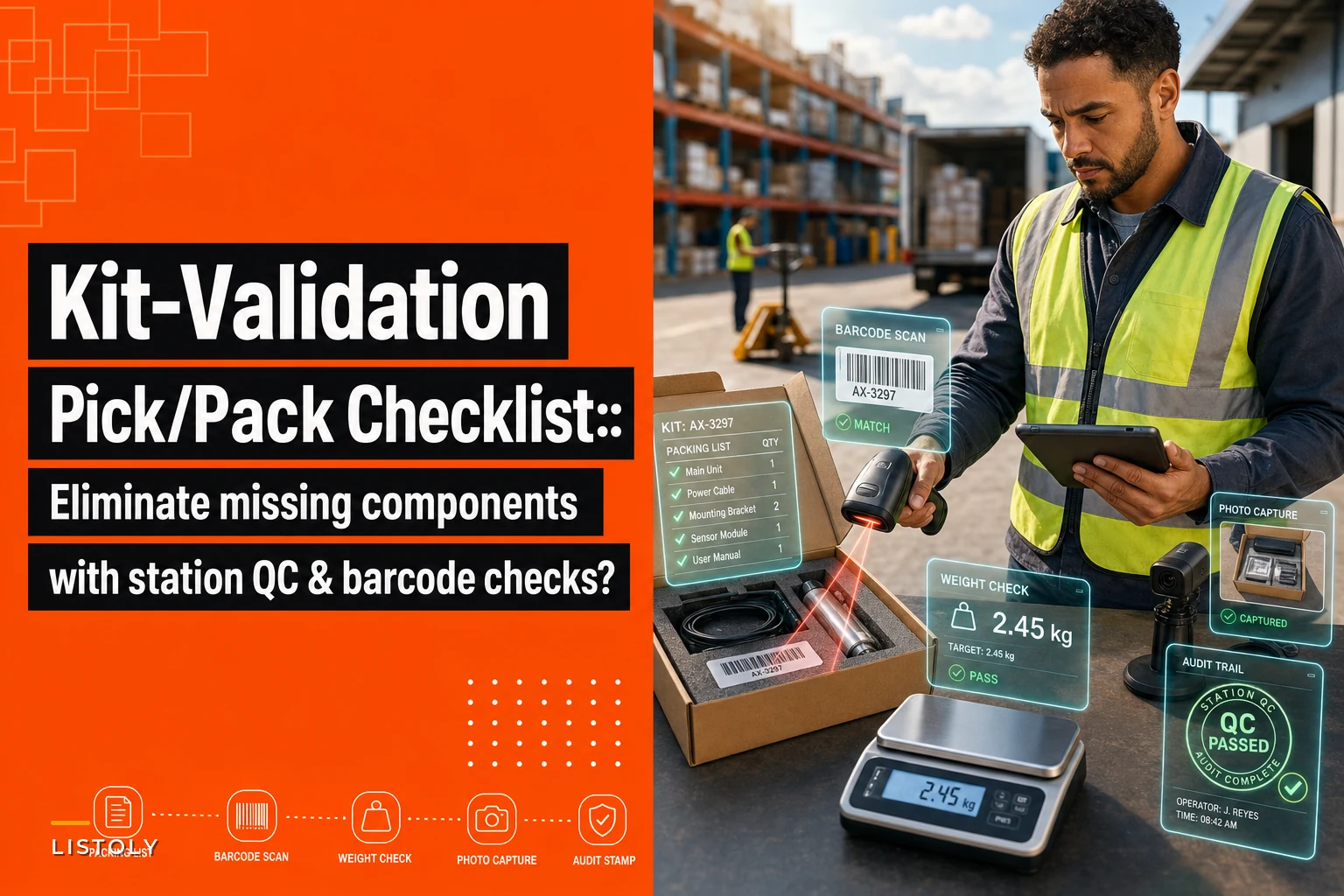

Kit assembly errors are brutal. One missing component turns your profitable $89 gift box into a customer service nightmare that costs you $127 after replacement shipping and refunds. But the real damage happens when your packer catches the error mid-shift, stops the line to hunt for the missing piece, and suddenly your 12-unit-per-hour station drops to 4.
The operational reality of kit assembly errors that destroy margins
Most businesses find out about kit problems through customer complaints. That feedback loop takes anywhere from 3 to 7 days minimum.
By then you've already shipped 40+ incorrect kits that all need fixing.
Station-level checks that actually work
Station-level quality control sounds obvious until you watch how a real packing operation moves. Packers aren't quality inspectors—they're throughput machines trying to hit quotas. They move fast, especially during peak periods.
Never run out of stock or overorder again.
Listoly streamlines inventory workflows to keep your business stocked and profitable.
- Real-time stock tracking
- Automated reorder alerts
- Supplier and purchase management
No credit card required
Your validation system needs to match that reality. Complex multi-step checks get skipped. And perfect-world processes fall apart the moment Sarah calls in sick and you're breaking in someone new during your busiest week.
Weight-based validation at the packing station
Weight checks catch the majority of kit errors without slowing operations. Every kit has an expected weight range. Missing a 4oz candle in a spa kit? The scale flags it instantly.
Here's the setup that works:
-
Target weight (all components present)
-
Missing lightweight item threshold
-
Missing heavy item threshold
Set your scale tolerance at ±2% of expected weight. Tighter tolerances create false positives from normal component variation. Looser tolerances miss single-item errors.
Set your scale tolerance at ±2% of expected weight to balance false positives and missed errors.
Packer places the completed kit on the scale. Green light means ship. Red light means check. No interpretation needed.
Weight validation does fall short for kits with similar-weight components. A kit with five 2oz items won't flag if you accidentally swap one for another. But for most kit compositions, weight works as your first line of defense.
Visual template boards that packers actually use
Template boards show exactly what belongs in each kit—not a printed list, but an actual physical board with component outlines or photos attached.
The board sits directly above the packing station. Packers build the kit on a matching template mat, placing each item in its designated spot. Empty spots are immediately visible.
This sounds kindergarten-simple. That's exactly why it works when a temp starts their shift with five minutes of training.
For operations running multiple kit variations, use color-coded templates. Blue board for standard, yellow for deluxe, red for holiday. The visual distinction prevents mix-ups better than any SKU numbering system.
Packers build faster when the visual cue removes decision fatigue.
Packing list design that prevents errors
Your packing list structure determines error rates more than packer skill does. Most businesses use text-heavy lists that require interpretation. That's where errors multiply.
Component grouping by pick location
Standard packing lists organize by SKU or alphabetically. Neither matches how packers actually move through a warehouse.
Reorganize your list by warehouse location:
-
Shelf A2 Lavender soap (1 unit) Rose bath bomb (1 unit)
-
Shelf B4 Small gift box (1 unit) Tissue paper white (2 sheets)
-
Cooler Section Fresh eucalyptus bundle (1 unit)
Packers move through zones systematically instead of bouncing around. Fewer location changes mean fewer missed items.
Visual confirmation boxes that force attention
Add physical checkboxes next to each component. Not for record-keeping—for psychological engagement.
When packers physically check off each item, error rates drop noticeably. The manual action creates a brief pause that breaks autopilot habits.
Size these boxes large enough for a quick mark. Tiny checkboxes slow the process and get ignored. Quarter-inch squares work well.
Print lists on colored paper for different kit types. White for standard, yellow for express, pink for gift orders. The color difference helps packers mentally switch between kit requirements without overthinking it.
Barcode and visual validation combinations
Barcode scanning seems like the obvious fix until you calculate the real cost. Scanner hardware, software integration, training, and maintenance can easily exceed $15k for a small operation. Scanning also adds 8 to 12 seconds per component, which kills throughput during peak periods.
When barcode validation makes sense
Barcode validation pays off for:
-
High-value kits ($200+) where a single error has real financial consequences
-
Regulated products requiring lot tracking
-
Operations processing 500+ kits daily
-
Kits with look-alike components that visual checks can't reliably catch
For these scenarios, implement two-point scanning: scan to pick, scan to pack. This double-verification catches errors at both stages.
Use batch scanning for efficiency. Instead of scanning each lipstick individually in a 5-piece makeup kit, scan one and confirm quantity. Maintains accuracy without killing speed.
Photo verification for high-risk kits
For your top 20% revenue-driving kits, add photo verification. Packers photograph completed kits before sealing.
-
Immediate visual check against the template
-
Proof for customer disputes
-
Training material for new staff
Store photos for at least 30 days. You'll pull them up more than you expect, especially during holiday rushes when error rates naturally climb.
Lightweight audit patterns that scale
Full inspection of every kit destroys profitability. Zero inspection guarantees problems. The answer is strategic sampling that catches systematic issues without killing throughput.
The 10-2-1 audit cadence
Start each shift with heavier inspection, then taper:
-
First 10 kits
100% inspection
-
Next 20 kits
Inspect every 10th
-
Remainder
Inspect every 20th
This front-loaded approach catches problems when they're most likely—at shift start, after breaks, with new products, or when someone new is on the line.
When you find an error, reset to 100% inspection for 5 kits, then resume the normal cadence. Immediate feedback without punitive oversight.
Track errors by packer (identifies training needs), by component (reveals picking issues), by time of day (shows fatigue patterns), and by kit type (highlights complexity problems). Keeping those four dimensions visible tells you pretty quickly where the real problem lives.
Component-specific spot checks
Certain components generate the majority of errors. Usually it's items that look similar, have confusing names, or come from awkward storage locations.
Daily verification list:
-
White vs. ivory items (easy confusion)
-
2oz vs. 2.5oz bottles (nearly identical)
-
Items from top-shelf locations (often skipped)
-
Newest products (unfamiliar to packers)
Rotate through one problem category each day. Monday check all white/ivory picks. Tuesday verify bottle sizes. This focused approach catches systematic errors without checking everything all the time.
Building validation into your operational flow
Validation works when it's built into natural workflow pauses, not bolted on as an extra step. Watch where your current process naturally stops—those are your validation points.
Pre-staging validation for batch picking
If you batch pick for multiple orders, validate at the staging point. After picking components for 20 kits, verify quantities before moving anything to packing stations.
Count total units picked versus required. Need 20 soaps for 20 kits? Quick count confirms. Need 60 bath bombs for mixed kits? The math forces attention.
One recount at staging prevents 20 incorrect kits at packing. It's worth the two minutes.
End-of-line weight and dimension check
Even with solid packing, shipping introduces its own errors. Carriers charge by weight and dimensions. Wrong kit in the wrong box triggers invoice adjustments.
-
Scan tracking number
-
Verify weight matches system record (±5%)
-
Confirm box dimensions are correct
-
Apply shipping label
Six seconds per package. Catches expensive shipping errors plus any remaining kit mistakes that slipped through.
Typical validation flow from pick to ship: Batch Pick → Pre-Stage Count → Packing Station (Weight + Template) → Photo Capture (high-value) → End-of-Line Check → Ship
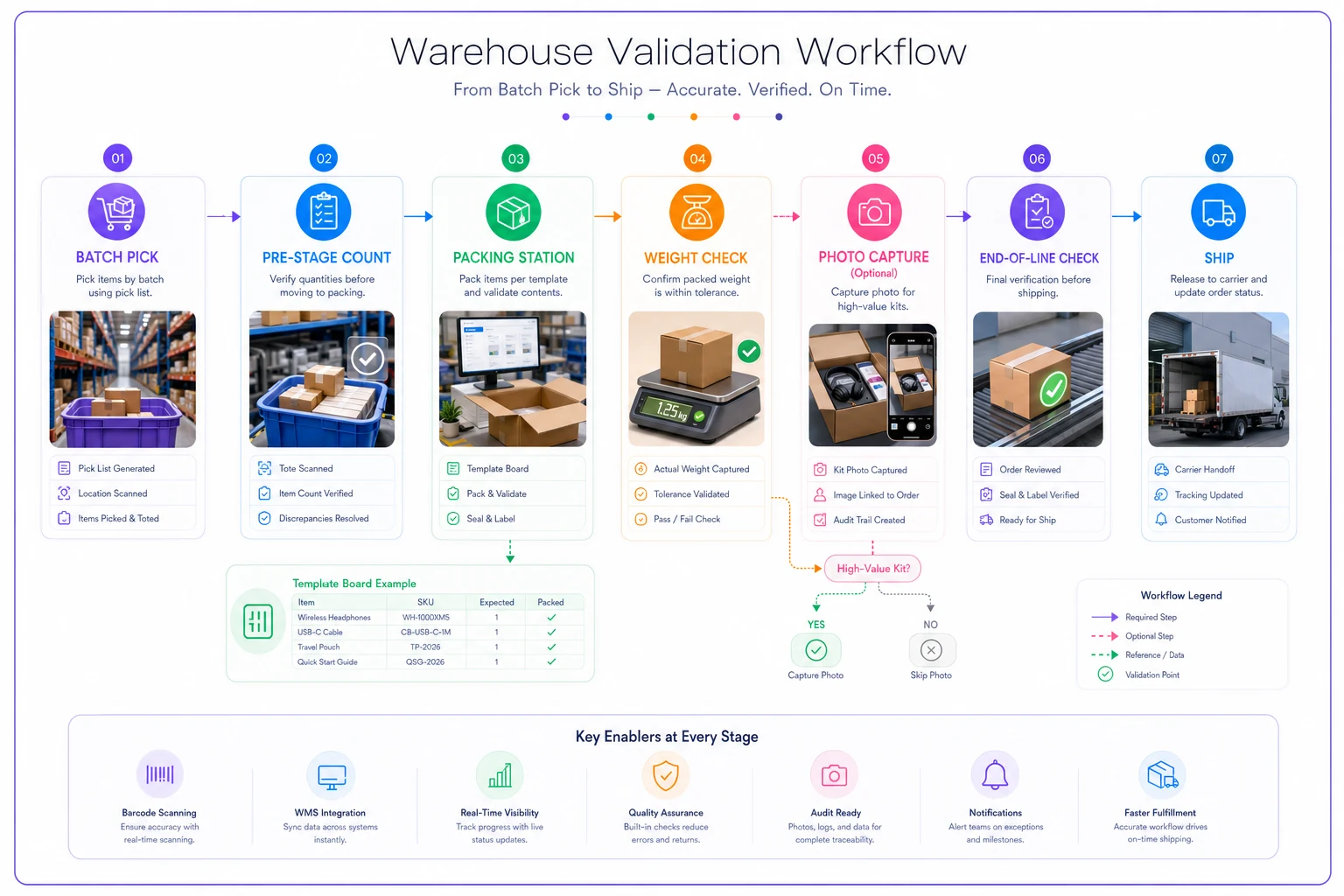
Each step is a natural pause in the process, not an added checkpoint layered on top of existing work.
When kit validation software makes sense
Manual validation works until you're somewhere around 200 kits daily. Beyond that, human checks become a bottleneck that either slows fulfillment or degrades accuracy—usually both.
Software validation makes sense for:
-
Multi-channel operations where kit contents vary by sales channel
-
Seasonal businesses with rotating kit compositions
-
Growing operations adding several new kit SKUs monthly
-
Teams with high turnover requiring constant onboarding
The automation approach for kit components and bundled SKUs extends naturally into validation. When your system already tracks component allocation for kits, adding validation rules is a logical next step.
Modern platforms handle validation through digital pick lists that confirm each component scan, weight verification integrated with packing stations, photo capture linked to order records, exception alerts for missing components, and real-time error tracking by packer, kit type, and component.
The real operational win isn't just fewer errors—it's removing the mental load from your team. Packers focus on speed while the software handles accuracy checks in the background.
A real scenario: gift box company fixes an 8% error rate
An online gift box company was shipping around 180 custom kits daily with an 8% error rate. Customer complaints were eroding their reputation and repeat purchase rate.
Their kits contained 8 to 12 items each, pulled from 200+ possible components. Packers used printed lists and visual inspection only.
They implemented weight-based validation at packing (caught roughly 70% of errors), color-coded template boards for their top 5 kit types, checkbox packing lists organized by pick location, and the 10-2-1 audit cadence with error tracking by packer and component.
| Metric | Before | After |
|---|---|---|
| Error rate | 8% | 1.2% |
| Packing speed | Baseline | +15% |
| Customer complaints (missing items) | Baseline | -85% |
| Monthly refund/replacement costs | $4,800 | $720 |
The weight scales ran about $400 each across three stations. Template boards and process changes cost nothing beyond setup time. The entire validation system paid for itself in under two weeks through reduced replacement shipping alone.
Common validation mistakes to avoid
Over-validating low-value kits. A $12 kit with 3 items doesn't need triple verification. Save intensive checks for orders where errors actually hurt.
Ignoring packer feedback. Your team knows which components cause confusion. When three different packers mention the same issue, fix the root cause instead of adding more checkpoints on top of it.
Validation theater without accountability. Checkboxes mean nothing if nobody reviews them. Audit procedures fail if errors don't trigger retraining. The system needs teeth.
Believing technology solves everything. Barcode scanners don't fix poor warehouse organization. Photo verification doesn't help if your kit designs change daily. Fix operational basics first, then layer technology on top.
Making kit validation stick
Perfect validation is unsustainable. Good-enough validation that actually happens beats a perfect system that gets skipped.
Start with weight checks and template boards. Minimal investment, immediate results. Add complexity only when your error patterns justify it.
Track your error rate weekly. You're aiming for under 2% for standard kits, under 0.5% for high-value orders. Anything better than that is probably overinvestment in validation.
Build validation into natural workflow pauses. Make it easier to validate than to skip. Recognize accuracy improvements, not just speed metrics.
Your kit validation checklist shouldn't slow fulfillment—it should let your team pack faster because they're confident in their accuracy. When packers trust the system to catch errors, they stop second-guessing themselves and focus on throughput.
Measure, improve, simplify, repeat. Don't chase perfect. Chase sustainable accuracy that protects margins without killing productivity.
Ready to optimize your inventory operations?
Join 2,000+ businesses using Listoly to reduce stockouts, save time, and improve order accuracy.