

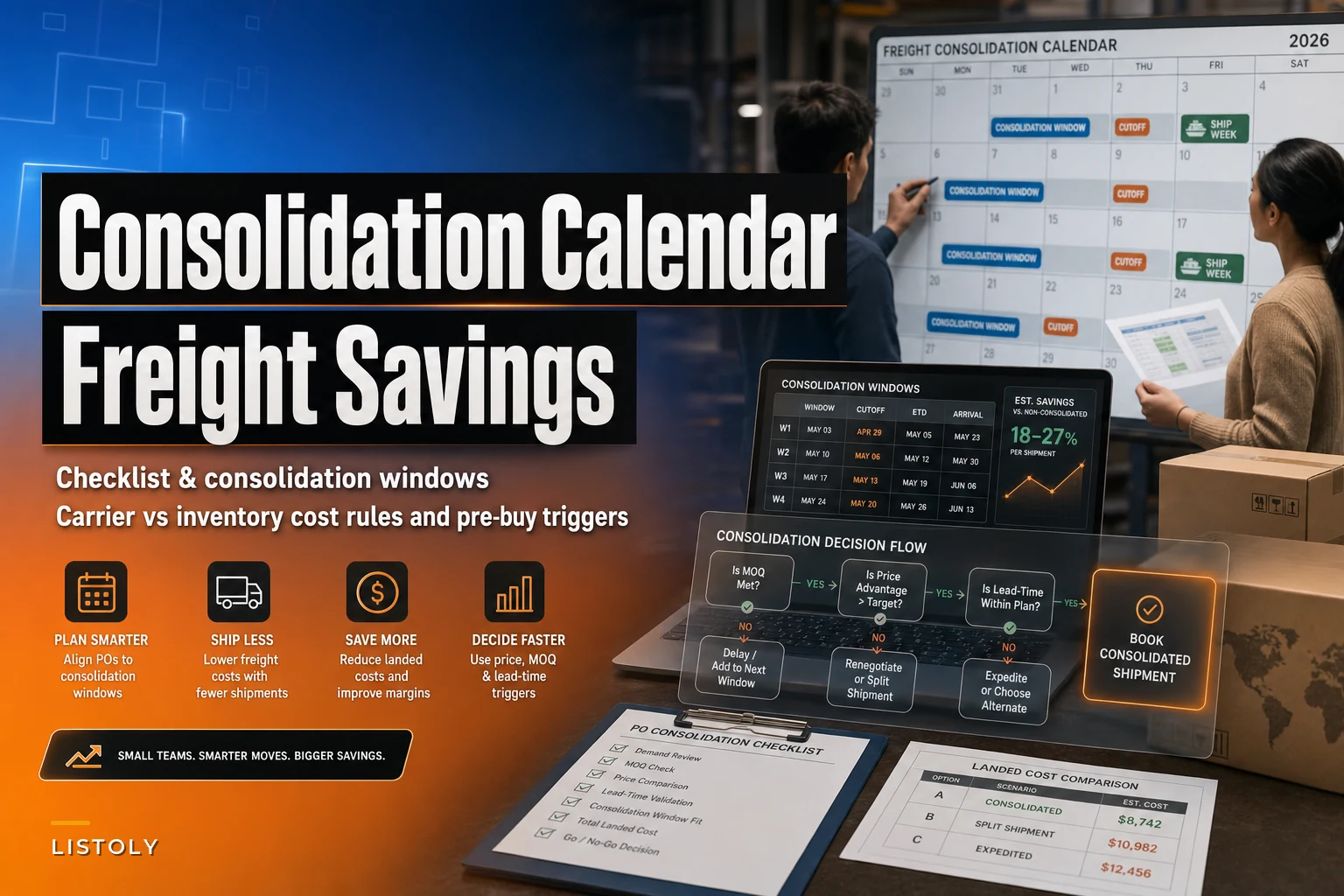

Most small teams treat consolidation as a gut-feel decision. Someone in purchasing notices two POs going to the same supplier in the same week, mashes them together, and calls it a win. Sometimes it is. Often it just moved cash out the door earlier for a freight saving that didn't actually cover the carrying cost.
The problem isn't that consolidation is bad. It's that nobody's built a calendar around it. So the decision gets made reactively, one PO at a time, and the trade-off between freight savings and inventory cost never gets checked. This post is a working PO consolidation checklist SMB teams can actually run, plus a sample calendar and the specific triggers that tell you when to pre-buy and when to hold.
We're keeping this narrow on purpose. This is about the timing and cost math of batching POs to a freight window — not general replenishment strategy.
The math nobody runs before consolidating
A freight quote comes in and consolidating two orders saves, say, $340 in shipping versus sending them separately. Looks obvious. Ship them together.
But consolidating usually means pulling one of those orders forward — buying inventory two or three weeks before you actually needed it, just to hit the same truck or container. That earlier inventory sits. And sitting inventory has a cost that almost nobody puts next to the freight quote.
The rough carrying cost most SMBs land on is somewhere around 20–30% annually when you fold in capital, storage, insurance, and shrink. Call it 25%. On a $12,000 order pulled forward three weeks, that's roughly:
$12,000 × 25% × (3 ÷ 52) ≈ $173 in carrying cost.
So your $340 freight saving is actually closer to $167 net. Still positive, but half of what it looked like. Flip the numbers — a $40,000 order pulled forward four weeks — and the carrying cost balloons past the freight saving entirely. You lost money to feel efficient.
The pattern you see constantly: consolidation looks like a freight decision, but it's really a timing decision, and the timing is where the money leaks.
When consolidation actually saves money
Consolidation earns its keep under a fairly specific set of conditions. Not always. Here's when the math tends to work.
Never run out of stock or overorder again.
Listoly streamlines inventory workflows to keep your business stocked and profitable.
- Real-time stock tracking
- Automated reorder alerts
- Supplier and purchase management
No credit card required
-
The orders were going out within the same natural window anyway. If PO A ships Tuesday and PO B was already due Thursday, you're pulling forward two days. Carrying cost is basically zero. Take the freight win every time.
-
You're below a carrier's break point. LTL and container pricing has cliffs. If combining gets you from LTL to a full truckload rate, or fills a container from 60% to 90%, the per-unit freight drop is large enough to swamp almost any carrying cost.
-
The supplier's MOQ or price break sits just above your combined need. If batching two POs gets you to a volume tier that drops unit cost 4–6%, that discount often dwarfs both freight and carrying.
-
The item is stable and cheap to hold. Slow-decay, low-value, small-footprint goods are forgiving. Pulling them forward barely moves carrying cost.
Most SMBs land on bi-weekly for domestic freight and monthly-plus for import/container lanes, because ocean freight break points are so large that longer batching pays off even with the extra holding cost.
When it's a bad idea
High-value or bulky items pulled forward more than two weeks. The carrying cost curve gets steep fast.
-
High-value or bulky items pulled forward more than two weeks. The carrying cost curve gets steep fast.
-
Perishable, dated, or fast-obsoleting stock. Any freight saving gets eaten by markdown or spoilage risk.
-
When you're already tight on cash. Consolidation front-loads spend. If it strains your ability to pay for the next cycle, the freight math is irrelevant — you've created a liquidity problem to save $300.
-
Volatile-demand SKUs. Buying ahead of a demand signal you don't trust yet is just guessing with a freight excuse attached. If lead times are the reason you're tempted to buy early, that's a replenishment-timing issue better handled with buffer logic — we walked through that in the replenishment playbook for variable lead times.
Volatile-demand SKUs. Buying ahead of a demand signal you don't trust yet is just guessing with a freight excuse attached. If lead times are the reason you're tempted to buy early, that's a replenishment-timing issue better handled with buffer logic — we walked through that in the replenishment playbook for variable lead times.
The consolidation window: the concept that makes the calendar work
The core idea is a consolidation window — a recurring, fixed slot where you deliberately release batched POs to a given supplier or lane. Instead of deciding order by order, you decide once: "Orders to Supplier X ship on the 1st and 15th."
Two things happen when you set fixed windows.
First, purchasing stops making one-off freight judgments under time pressure. The window is the default, and only exceptions need thinking about — a stockout risk that can't wait, or a rush order. Fewer decisions, fewer mistakes.
Second, you start naturally accumulating enough volume to hit break points without pulling anything forward artificially. The demand fills the window on its own.
The width of the window is the lever. A weekly window keeps inventory lean but consolidates less. A monthly window consolidates hard but forces more pre-buying. Most SMBs land on bi-weekly for domestic freight and monthly-plus for import/container lanes, because ocean freight break points are so large that longer batching pays off even with the extra holding cost.
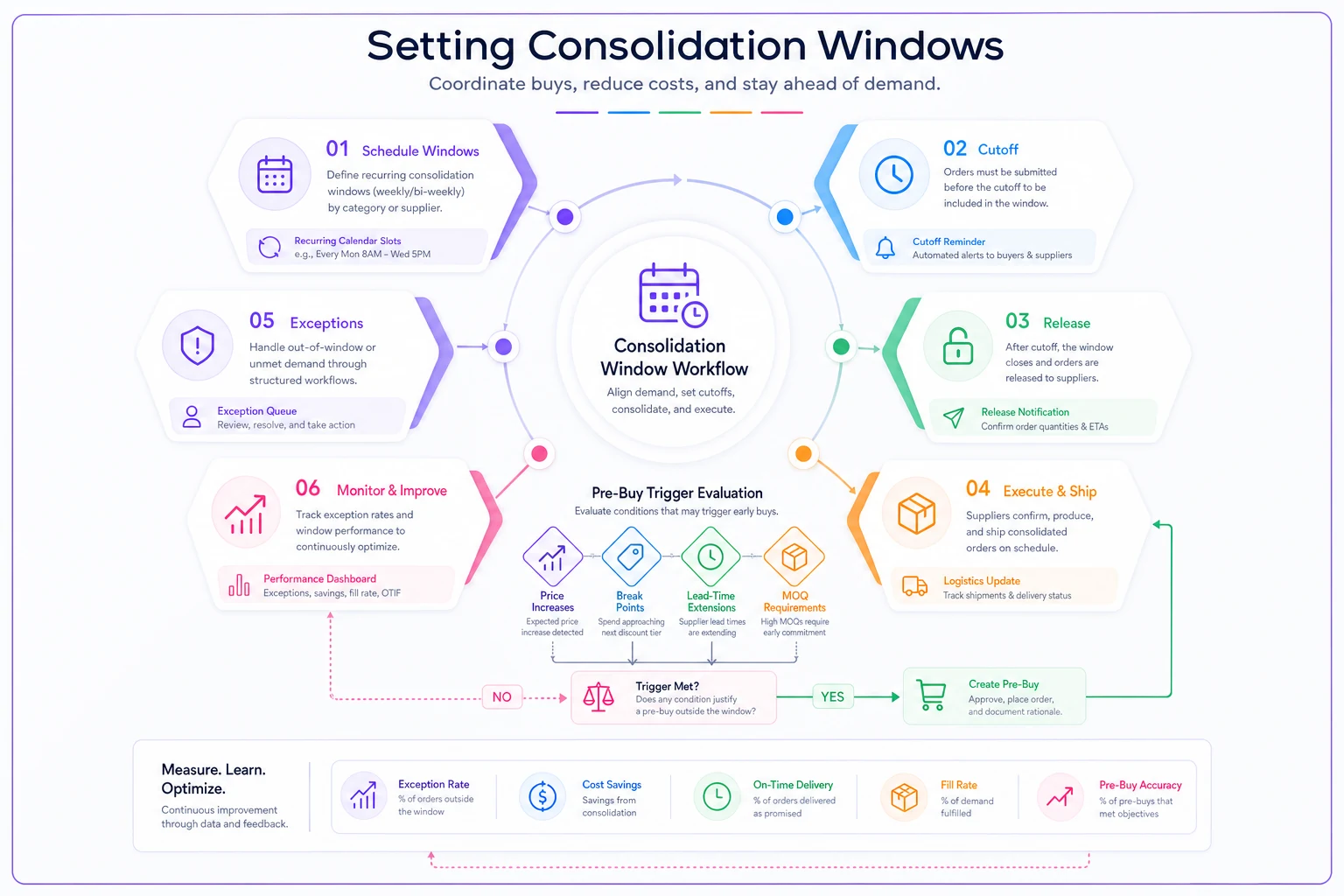
This visual shows the recurring decisions and exception flow for a consolidation window.
A sample consolidation calendar
Here's a workable template for a small team buying from a mix of domestic and overseas suppliers. Adjust the days to your own cutoffs.
| Window | Supplier / lane type | Cutoff for inclusion | Ship / release day | Notes |
|---|---|---|---|---|
| Weekly (Mon) | Local / regional, fast-moving | Fri EOD | Monday | Small footprint, cheap to hold |
| Bi-weekly (1st & 15th) | Domestic LTL suppliers | 2 days before | 1st, 15th | Target LTL→partial-TL break points |
| Monthly (last week) | High-MOQ domestic | 5 days before | Last Thu | Align with volume price tiers |
| Every 4–6 weeks | Overseas / container | 10 days before | Per booking | Batch to fill container ≥85% |
| Ad-hoc | Any (emergency only) | — | Same/next day | Requires sign-off; logged as exception |
The exception row matters more than it looks. If you don't have a formal "emergency" lane, every urgent order becomes a reason to break the window, and within a month you're back to reactive one-off shipping. Keeping emergencies as a tracked exception tells you whether your windows are actually sized right — if you're logging five emergencies a month, your window is too wide for that supplier.
Pre-buy triggers: when to break the calendar on purpose
Sometimes you should buy ahead of the window. The trick is having defined triggers instead of vibes. Here are the ones worth building rules around.
-
Announced price increase. Supplier confirms a 7% increase effective next month. If the pre-buy quantity clears in under ~3–4 months, the price lock usually beats the carrying cost. Do the same math as above before committing.
-
A real carrier break point is one order away. You're at 78% container fill and one more scheduled PO would push you to 90%+. Pull that PO forward into this booking.
-
Confirmed lead-time extension. Supplier warns of a factory shutdown or the lane is congesting. Pre-buying to cover the gap is a coverage decision, not a savings one — size it to the extended lead time, not to the freight.
-
MOQ or tier threshold within reach. Combined near-term demand sits just under a price break. Pull the next window's order forward if the discount exceeds the carrying cost of the gap.
Anything outside these four is probably not a real pre-buy reason. "Might as well while we're ordering" is the phrase that quietly builds dead stock.
The consolidation checklist
Run this before every consolidation or pre-buy decision. Takes about two minutes once it's a habit.
-
[ ] Are these orders already within the same natural window? (If yes, consolidate — skip the rest.)
-
[ ] How many weeks am I pulling the earlier order forward?
-
[ ] What's the carrying cost of that pull-forward? (Order value × ~25% × weeks ÷ 52)
-
[ ] What's the actual freight saving in dollars, not percent?
-
[ ] Does the freight saving clearly exceed the carrying cost?
-
[ ] Does consolidating cross a carrier break point (LTL→TL, container fill tier)?
-
[ ] Does it hit a supplier MOQ or volume price tier?
-
[ ] Can cash flow absorb the earlier spend without straining the next cycle?
-
[ ] Is the item stable to hold (not perishable, dated, or fast-obsoleting)?
-
[ ] If this breaks the calendar, does it match a defined pre-buy trigger?
If the freight saving doesn't beat carrying cost and you're not crossing a break point, MOQ tier, or a real trigger — ship separately and keep the cash.
A real scenario
A small outdoor-gear retailer, roughly $4M in annual revenue, was ordering from one domestic supplier three to four times a month, every time someone noticed a SKU getting low. Each shipment came in as LTL. Freight was running somewhere around $900–$1,100 a month on that one supplier, and half the orders were small enough to feel wasteful.
They set a bi-weekly window — cutoff Wednesday, release Friday, twice a month — and moved emergency orders to a logged exception lane requiring a quick sign-off.
The volume batched naturally. Two of the monthly shipments consistently crossed into a partial-truckload rate they'd never been hitting before. Freight on that supplier dropped to roughly $600–$700 a month. Inventory barely moved, because the pull-forward was only a few days in most cases. Net saving came out around $3,600–$4,800 a year on one supplier lane, plus far fewer scrambled small orders.
The part they didn't expect: purchasing got quieter. Instead of a dozen little "should we order now?" moments a month, there were two windows and a short exception log. The savings were nice. The reduction in decision noise was what actually stuck.
Keeping the calendar honest
A consolidation calendar decays if nobody watches it. Two lightweight habits keep it working.
Track your exception rate per supplier. If a supplier's emergency orders creep up, your window is too wide for that item's demand pace — tighten it. If a supplier never triggers exceptions and orders are always small, you can probably widen the window and consolidate harder.
Re-check your break points a couple times a year too. Carrier rate tiers and supplier MOQs move. A window that was perfectly tuned to hit a truckload rate in spring might be missing it after a rate revision.
This is the kind of recurring, rule-based decision that operational software handles well — cutoffs, release reminders, exception logging, flagging when an order is about to cross a break point. Whether you run it in a spreadsheet or a purchasing platform matters less than actually having the windows defined and the trade-off math baked into the decision. The teams that save money on freight aren't the ones chasing every quote. They're the ones who decided the rules once and stopped negotiating with themselves on every PO.
This is the kind of recurring, rule-based decision that operational software handles well — cutoffs, release reminders, exception logging, flagging when an order is about to cross a break point. Whether you run it in a spreadsheet or a purchasing platform matters less than actually having the windows defined and the trade-off math baked into the decision. The teams that save money on freight aren't the ones chasing every quote. They're the ones who decided the rules once and stopped negotiating with themselves on every PO.
Ready to optimize your inventory operations?
Join 2,000+ businesses using Listoly to reduce stockouts, save time, and improve order accuracy.