

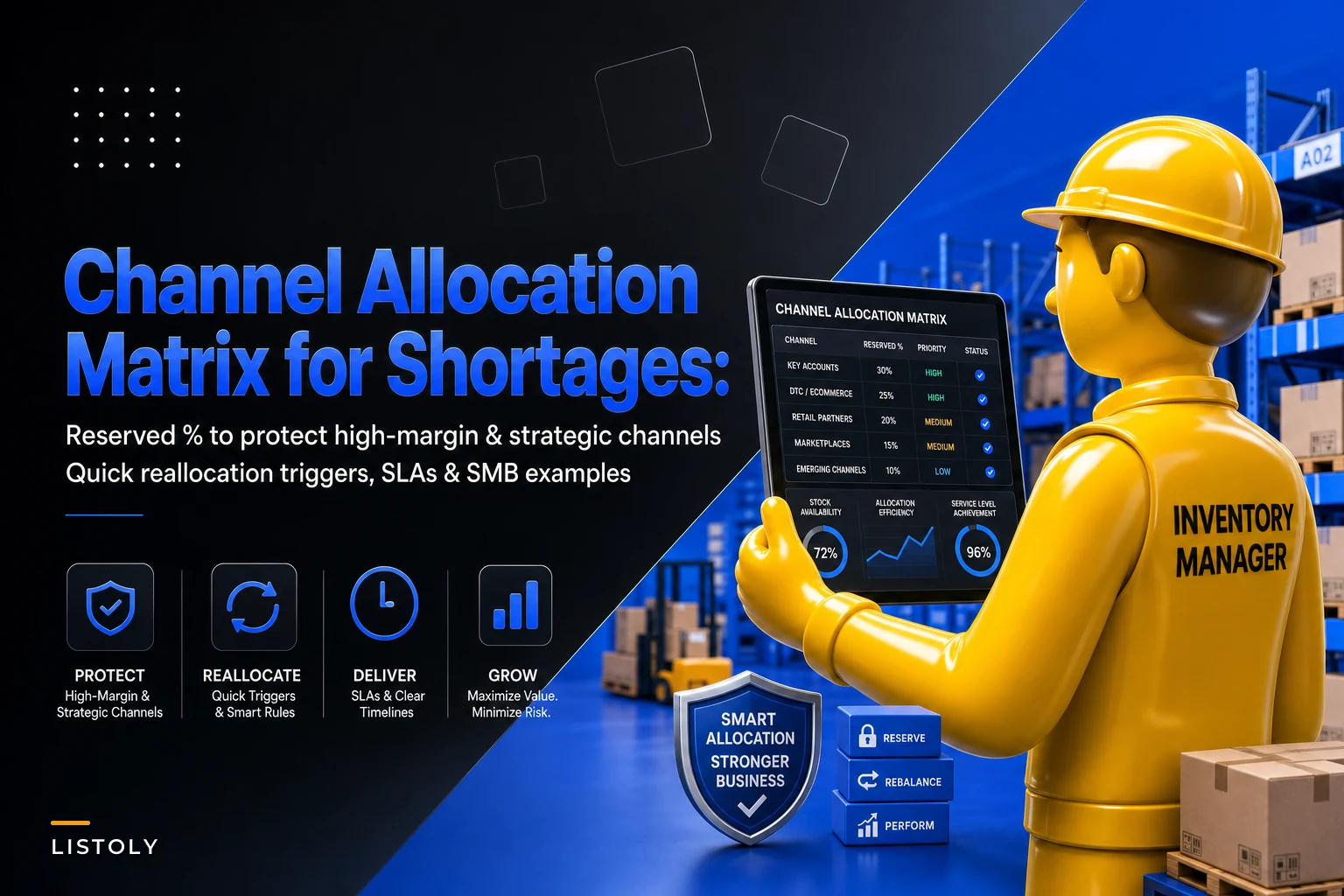

Stock shortages hit differently when you're selling through multiple channels. A furniture store owner showed me their allocation spreadsheet last month—they'd lost a $4,800 B2B order because they'd already shipped their last dining sets to retail customers who paid $600 less per unit. The wholesale buyer went elsewhere and hasn't returned.
The problem isn't just losing sales. It's losing the wrong sales.
Most SMBs allocate stock across channels using gut feel or first-come-first-served, which works fine until inventory runs tight. Then you're stuck choosing between disappointing your highest-margin wholesale accounts or leaving retail shelves empty. Neither option ends well.
Why channel allocation breaks during shortages
Channel allocation fails because businesses treat all demand equally when stock runs low. Your retail store needs 20 units, Amazon wants 15, and your B2B client ordered 30. You've got 40 units coming in next week. Who gets what?
The typical response is splitting inventory proportionally or fulfilling orders chronologically. Both methods ignore margin differences, relationship value, and channel-specific consequences.
A sporting goods distributor learned this the hard way. They split camping gear equally between their website, Amazon, and wholesale accounts during a supply crunch. Amazon's algorithm punished them for stockouts, dropping their listing rank. Wholesale buyers found new suppliers. Meanwhile, website customers just waited for restock emails. Equal allocation created unequal damage.
Different channels have completely different tolerance for delays. Amazon's inventory performance index doesn't care about your supplier problems. Your longtime B2B client might handle a two-day delay but not two weeks. Direct customers often show more patience if you communicate early and clearly.
Building your channel priority matrix
Start by mapping each channel against two factors: contribution margin and strategic value. Sounds obvious until you actually run the numbers.
Never run out of stock or overorder again.
Listoly streamlines inventory workflows to keep your business stocked and profitable.
- Real-time stock tracking
- Automated reorder alerts
- Supplier and purchase management
No credit card required
Here's what a basic priority matrix looks like for a company selling kitchen equipment:
| Channel | Avg Order Value | Contribution Margin | Annual Revenue | Strategic Score | Reserve % |
|---|---|---|---|---|---|
| Wholesale | $2,800 | 42% | $340k | High | 35% |
| Amazon FBA | $95 | 18% | $180k | Medium | 20% |
| Direct Website | $150 | 38% | $120k | High | 30% |
| Retail Partners | $450 | 25% | $95k | Low | 15% |
The strategic score captures factors beyond pure margin. Amazon might generate lower margins, but falling below their inventory thresholds triggers account restrictions. Wholesale relationships take years to build and minutes to destroy.
Your reserve percentages become allocation rules during shortages. If you receive 100 units when expecting 200, wholesale gets their 35 units first—not 35% of whatever's available. This protects critical channels while letting lower-priority ones absorb the shortage impact.
Setting up reallocation triggers
Reserve percentages provide structure, but rigid rules break down during extreme shortages. You need triggers that allow quick pivots when the situation changes.
A home goods retailer uses this trigger system:
Green Zone (80%+ of expected inventory)
-
Follow standard reserve percentages
-
All channels receive planned allocations
Yellow Zone (50–79% of expected inventory)
-
Wholesale and direct channels get full reserves
-
Secondary channels share remainder proportionally
-
Pause promotional activities on affected SKUs
Red Zone (Below 50% expected)
-
Protect only contractual commitments
-
Allocate to highest-margin confirmed orders
-
Implement backorder system for remaining demand
The triggers matter less than having clear decision authority. Operations managers need to reallocate without committee meetings when a shipment arrives 60% short. Every hour of debate means orders sitting unprocessed and customers growing frustrated.
One electronics distributor spent three days getting executive approval for emergency reallocation while $28,000 in orders aged past cancellation deadlines. They now give their inventory manager full reallocation authority during shortage events, with a simple notification requirement for moves over $10,000.
Channel-specific SLA frameworks
Service level agreements usually focus on shipping times, but shortage periods need different rules. You're essentially creating a degraded service mode for each channel.
Wholesale/B2B channels typically get guaranteed minimums or first-refusal rights. A craft supplies distributor guarantees their top five accounts will receive at least 70% of standard order quantities during shortages. Those accounts accept it because they know they're protected while competitors get nothing.
Marketplace channels need careful handling around platform metrics. If Amazon requires a 95% in-stock rate, you either maintain that level or temporarily remove listings. There's no middle ground that doesn't damage account health.
Direct channels offer the most flexibility. You control the entire experience—from inventory display to backorder messaging. A bike parts retailer shifts out-of-stock items to "accepting pre-orders" rather than hiding them. They capture demand while setting proper expectations.
The communication templates matter as much as the allocation rules. Here's what actually works:
"Your order for [X units] is confirmed with expected fulfillment by [date]. Current inventory constraints may extend this by 2–3 business days. We'll prioritize your order and confirm final shipping within 24 hours."
Compare that to: "Due to unprecedented demand, orders may experience delays."
The first message maintains trust while buying operational flexibility. The second creates anxiety and a wave of follow-up emails.
Practical reallocation workflows
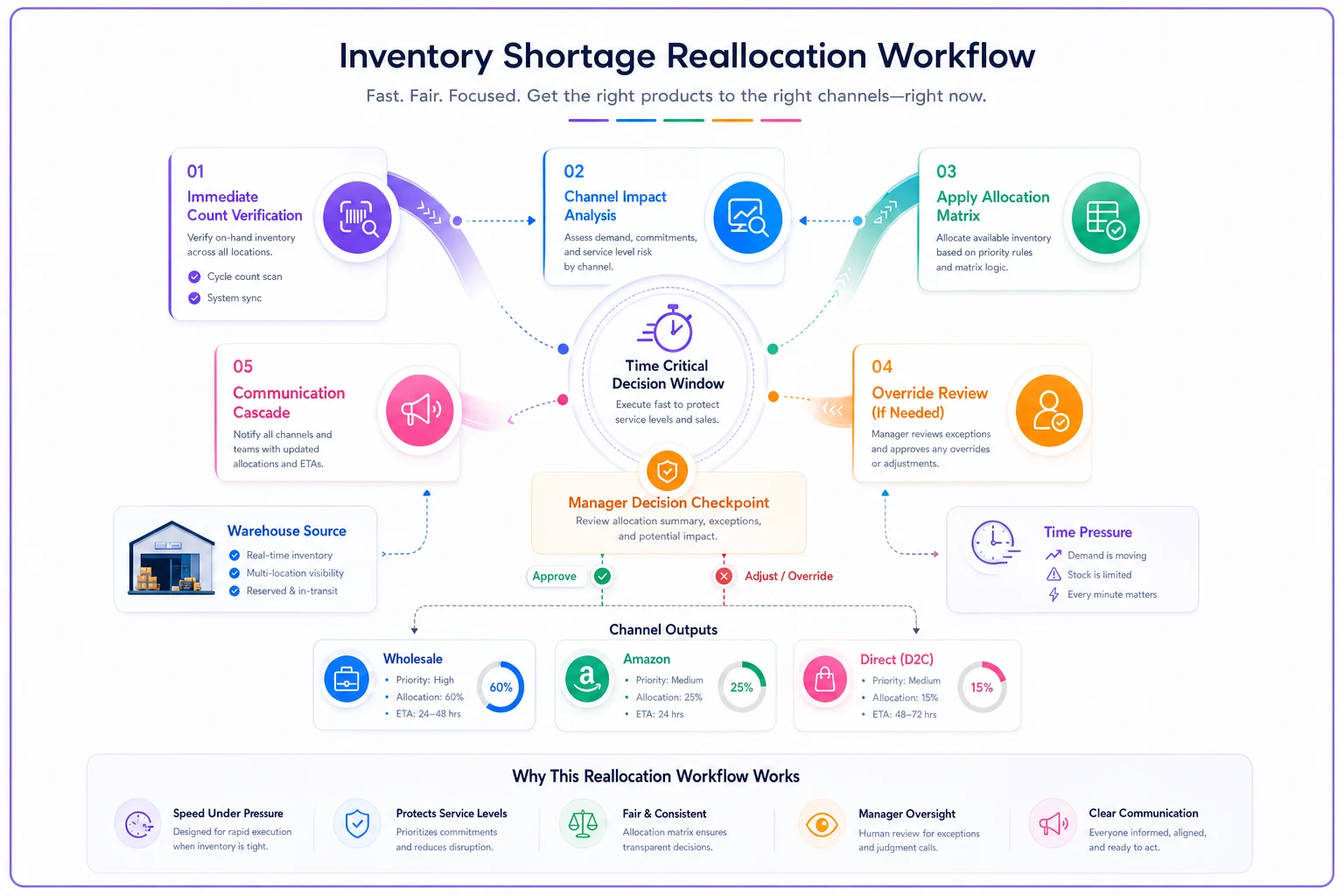
Theory breaks down when Tuesday's container arrives 40% light and you've got orders shipping Wednesday. Here's an actual reallocation workflow that processes in under two hours:
-
Immediate count verification (15 minutes) — Physical count vs. packing list, quick damage assessment, update available-to-promise inventory.
-
Channel impact analysis (20 minutes) — Pull pending orders by channel, calculate shortage impact per channel, flag contractual commitments.
-
Apply allocation matrix (15 minutes) — Assign reserved quantities first, identify remaining uncommitted inventory, calculate secondary allocations.
-
Override review (30 minutes) — Check for time-sensitive orders, review large customer impacts, apply strategic overrides if needed.
-
Communication cascade (40 minutes) — Update channel inventory feeds, send shortage notices to affected customers, notify sales team of restrictions.
An outdoor equipment company runs this workflow twice weekly during peak season. They've processed around 18 shortage events in the past year without losing a major account—though they've definitely frustrated some smaller buyers along the way.
Keep the workflow simple enough to execute under pressure. Complex allocation models sound sophisticated but fall apart when your warehouse team needs answers now, not after running optimization models.
Here's a simple visual of that workflow.
Complex allocation models sound sophisticated but fall apart when your warehouse team needs answers now, not after running optimization models.
Measuring allocation effectiveness
Most businesses track stockout frequency but miss the deeper metrics around allocation quality. You need to know whether your reserves and triggers are actually protecting margins and relationships.
Track these monthly:
-
Revenue lost by channel during shortages
-
Margin impact of reallocation decisions
-
Customer defection rate post-shortage
-
Time to process reallocation events
A specialty foods distributor discovered they were over-protecting their retail channel. Despite having the lowest margins, retail held 40% reserves because "empty shelves look bad." Meanwhile, food service accounts—generating 3x the margin—regularly went unfulfilled. They adjusted reserves and recovered roughly $15,000 in monthly margin without touching inventory levels.
The defection metric reveals long-term damage that doesn't show up immediately. If wholesale buyers consistently experience stockouts, they'll quietly diversify suppliers without saying a word. An auto parts distributor noticed this pattern: accounts that experienced two shortage events in six months reduced order volumes by around 30% the following quarter.
Automation opportunities in channel allocation
Manual allocation works until it doesn't. When shortage events happen weekly instead of quarterly, or when you're managing 50+ SKUs across multiple channels, spreadsheet allocation becomes a full-time job.
The challenge isn't just calculating who gets what—it's executing those decisions quickly across disconnected systems. Your replenishment systems need to talk to allocation rules, but most SMBs run separate processes that don't communicate.
Modern inventory platforms can codify allocation rules and execute them automatically. When inventory falls below a trigger threshold, the system assigns available stock according to your matrix, updates channel feeds, and generates exception reports for review. What took three hours becomes a 15-minute verification process.
The real value is consistency. People make different allocation decisions on tired Tuesday afternoons than on energized Monday mornings. Automated allocation applies your strategic priorities uniformly every time. You can still override for special situations, but the baseline protection stays consistent regardless of who's on shift.
A hardware distributor implemented automated allocation across eight channels and processed over 200 shortage events without a single major customer escalation. Their inventory coordinator now spends time improving allocation rules rather than manually splitting orders during each shortage.
Beyond basic allocation: dynamic channel management
Static reserve percentages work for predictable businesses. Most SMBs face seasonal swings, promotional periods, and shifting channel dynamics that break fixed rules.
Dynamic allocation adjusts reserves based on current conditions. During holiday season, your direct channel might need 45% reserves instead of 30%. When Amazon runs Prime Day, that channel temporarily jumps in priority. When a wholesale account is late on payment, their reserve drops to zero until resolved.
The complexity comes from managing rule interactions. If three channels all have "priority overrides" active simultaneously, which actually wins? You need a clear hierarchy:
-
Contractual obligations (must fulfill)
-
Time-sensitive strategic priorities (Prime Day, key customer orders)
-
Margin optimization (highest contribution first)
-
Standard reserves (baseline protection)
-
Remainder allocation (whatever's left)
This hierarchy prevents confusion when multiple rules trigger at once. Your team knows contractual commitments always win, regardless of other factors.
Making allocation decisions stick
The best allocation matrix fails if your sales team keeps making exception promises. "Just this once" becomes "just every time" when commissions depend on keeping customers happy.
Successful allocation requires organizational alignment. Sales needs to understand why saying yes to everyone during shortages actually hurts the business. Warehouse teams need authority to enforce allocation rules. Customer service needs clear templates for explaining delays.
A medical supplies distributor solved this by tying sales compensation to margin dollars, not just revenue. Suddenly, protecting high-margin channels made financial sense to the sales team. They stopped promising inventory that wasn't allocated to their accounts.
You also need escalation paths that don't break the system. When the CEO's golf buddy calls about their order, there should be a process beyond "override everything." Keep a small strategic reserve—maybe 5% of inventory—for exactly these situations. Better to have that buffer than pretend it never happens.
The reality of channel allocation
Perfect allocation doesn't exist. You'll still disappoint customers, lose some sales, and make wrong calls. The goal isn't perfection—it's making intentional decisions that protect what matters most.
Three months after implementing structured allocation, patterns tend to emerge. That marketplace channel you thought was critical? Turns out customers find you anyway when it's out of stock there. The wholesale account you bent over backward to protect? They still diversified suppliers because that's just smart purchasing on their end.
But you also discover which relationships actually move your business forward. The regional chain increasing orders 20% annually. The direct channel customers buying your highest-margin products. The Amazon presence that introduces new buyers who eventually come back direct.
Channel allocation during shortages forces clarity about priorities. You can't protect everyone, so you protect what matters. The matrix and triggers just make those decisions operational rather than emotional.
Most SMBs will face serious inventory shortages over the next year. Supply chains remain fragile, demand patterns stay volatile, and carrying excess inventory costs too much. The businesses that maintain margins and relationships through shortages won't be the ones with the most inventory—they'll be the ones that allocate stock intelligently when shortages hit.
Ready to optimize your inventory operations?
Join 2,000+ businesses using Listoly to reduce stockouts, save time, and improve order accuracy.