

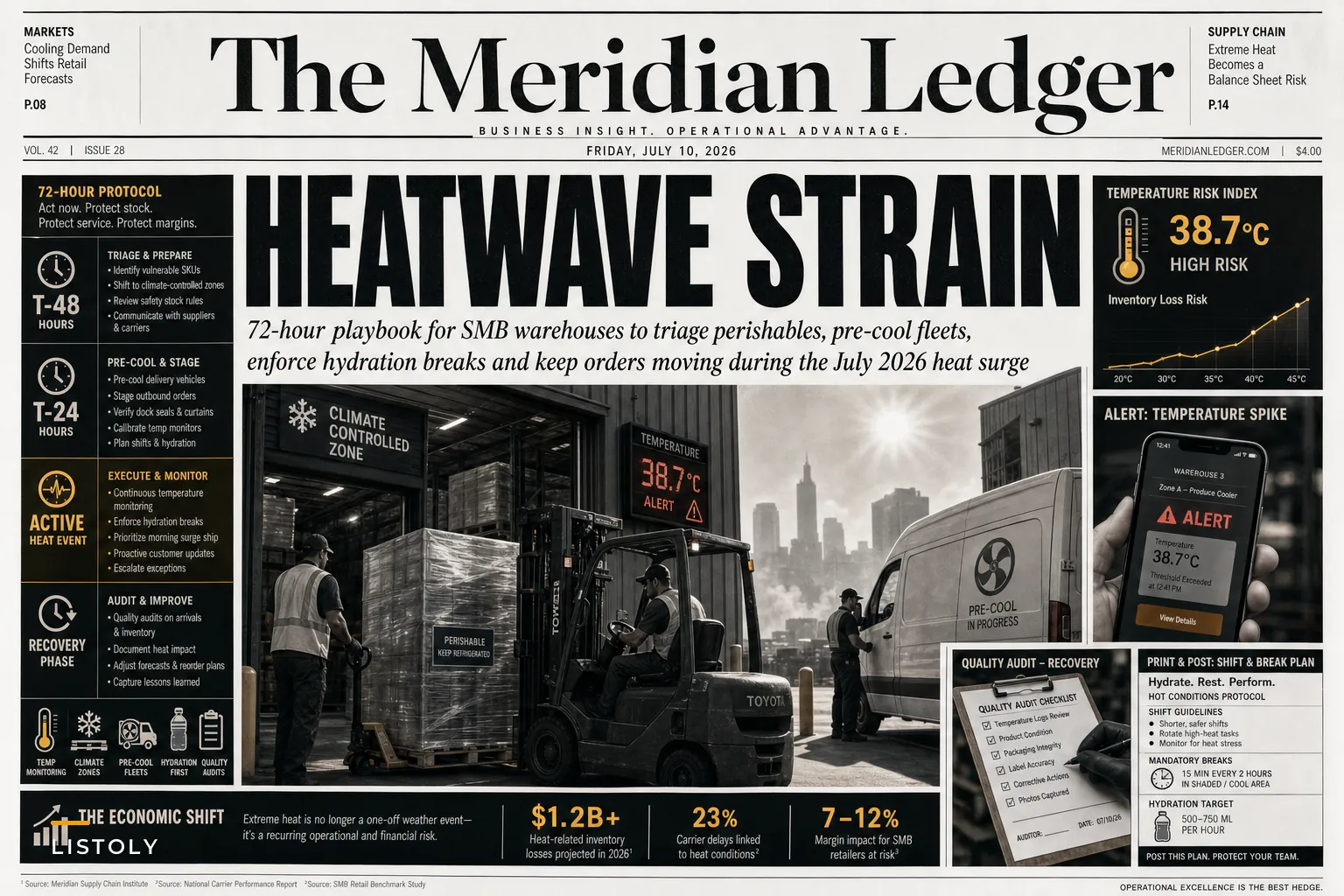

The heat dome that's been crushing the eastern U.S. since late June isn't just breaking temperature records—it's breaking supply chains. Reuters reported disrupted Fourth of July events and strained power grids across major population centers, with rolling blackouts hitting industrial zones in Philadelphia and Baltimore. For inventory managers, that means warehouses without cooling, delivery trucks stuck in traffic with no AC, and perishable stock deteriorating faster than you can move it.
What really caught my attention was a follow-up Reuters piece about companies "flying blind" on heat stress risk. The piece focused on worker safety, but it exposed something deeper: most small businesses have zero operational protocols for extreme heat. No temperature-triggered workflow changes. No automated alerts when warehouse temps spike. No contingency plans for when your usual 2-day ground shipment turns into 5 days because drivers are taking mandatory cooling breaks every hour.
This isn't about climate debates. It's about the warehouse manager in Phoenix who just lost $18,000 in supplements because their backup generator failed during a 118-degree day. Or the food distributor in Houston whose delivery completion rate dropped from 94% to 71% because half their drivers called out during a heat advisory.
The hidden cascade of heat-related inventory failures
Most businesses think heat damage means spoiled food or melted cosmetics. That's the visible part. The real operational damage comes through cascading failures that compound over days.
Start with your receiving dock. At 105 degrees outside, your team can't maintain normal throughput. OSHA requires 15-minute breaks every hour in extreme heat. Your usual 4-hour receiving window for a 200-case shipment now stretches to 6 hours. Meanwhile, that shipment sits on a blazing dock, product temps climbing. Even non-perishables suffer—adhesives fail, packaging warps, barcodes become unreadable.
Then there's the warehouse floor itself. Heat makes people slower and more error-prone. Pick rates drop roughly 35% once indoor temps exceed 85 degrees. One operations manager told me their mispick rate went from 0.8% to 3.1% during last summer's heat wave. That's not just returns and refunds—it's customer trust eroding.
Your delivery network gets hit worst of all. Drivers face genuine safety risks, windows expand unpredictably, and customers refuse deliveries of obviously heat-damaged goods. A small electronics distributor I worked with discovered their "heat-resistant" packaging failed at sustained temps above 95 degrees—$42,000 in refused deliveries over one brutal week.
Temperature zones: The framework nobody talks about
Here's something you won't find in standard inventory guides: temperature zone mapping for extreme events. Not just "frozen" and "ambient"—actual operational zones based on heat vulnerability and recovery time.
Never run out of stock or overorder again.
Listoly streamlines inventory workflows to keep your business stocked and profitable.
- Real-time stock tracking
- Automated reorder alerts
- Supplier and purchase management
No credit card required
| Zone | Description |
|---|---|
| Critical Zone (immediate failure) | Products that fail within 2–4 hours of heat exposure. Fresh produce, dairy, medications, certain adhesives, chocolate, cosmetics with active ingredients. These need active cooling or immediate movement to climate-controlled space. |
| Degradation Zone (48-hour threshold) | Items that lose quality or effectiveness after sustained heat exposure. Supplements, batteries, certain plastics, leather goods, wine, rubber components. These can survive brief heat but need priority processing during extreme events. |
| Stability Zone (heat-resistant) | Products largely unaffected by heat under 120 degrees. Most canned goods, sealed liquids, paper products, many textiles. These become your buffer stock during heat events—delay their processing to focus on vulnerable inventory. |
Map every SKU to a zone. When heat warnings hit, you know exactly what needs immediate attention versus what can wait. A mid-sized beauty retailer implemented this and reduced heat-related losses by around 78% just by knowing what to prioritize first.
Creating surge capacity without hiring
The standard advice during heat events? Hire temps, extend shifts, pay overtime. That's expensive and often impossible—everyone's fishing from the same shallow pool.
Instead, reconfigure your existing operation for heat-surge mode. Cross-train your customer service team on basic warehouse tasks. When call volume drops (and it always does in extreme weather), deploy them for 2-hour warehouse shifts on simple work: applying labels, quality checks, organizing staging areas. One small fulfillment center covers roughly 40% of their heat-surge needs this way.
Try wave picking instead of continuous flow. Concentrate intensive work into cooler morning hours (5 AM–9 AM) and late evening (7 PM–10 PM). Yes, it means split shifts. But workers generally prefer two shorter shifts in tolerable conditions over one long shift in brutal heat. Productivity actually holds up better despite fewer total hours.
Aggressively push your customer pickup option. During heat waves, offer a meaningful discount—15% works well—for customers who come in. It cuts last-mile delivery exposure entirely. A sporting goods retailer saw nearly a third of customers choose pickup during heat advisories when the incentive was real.
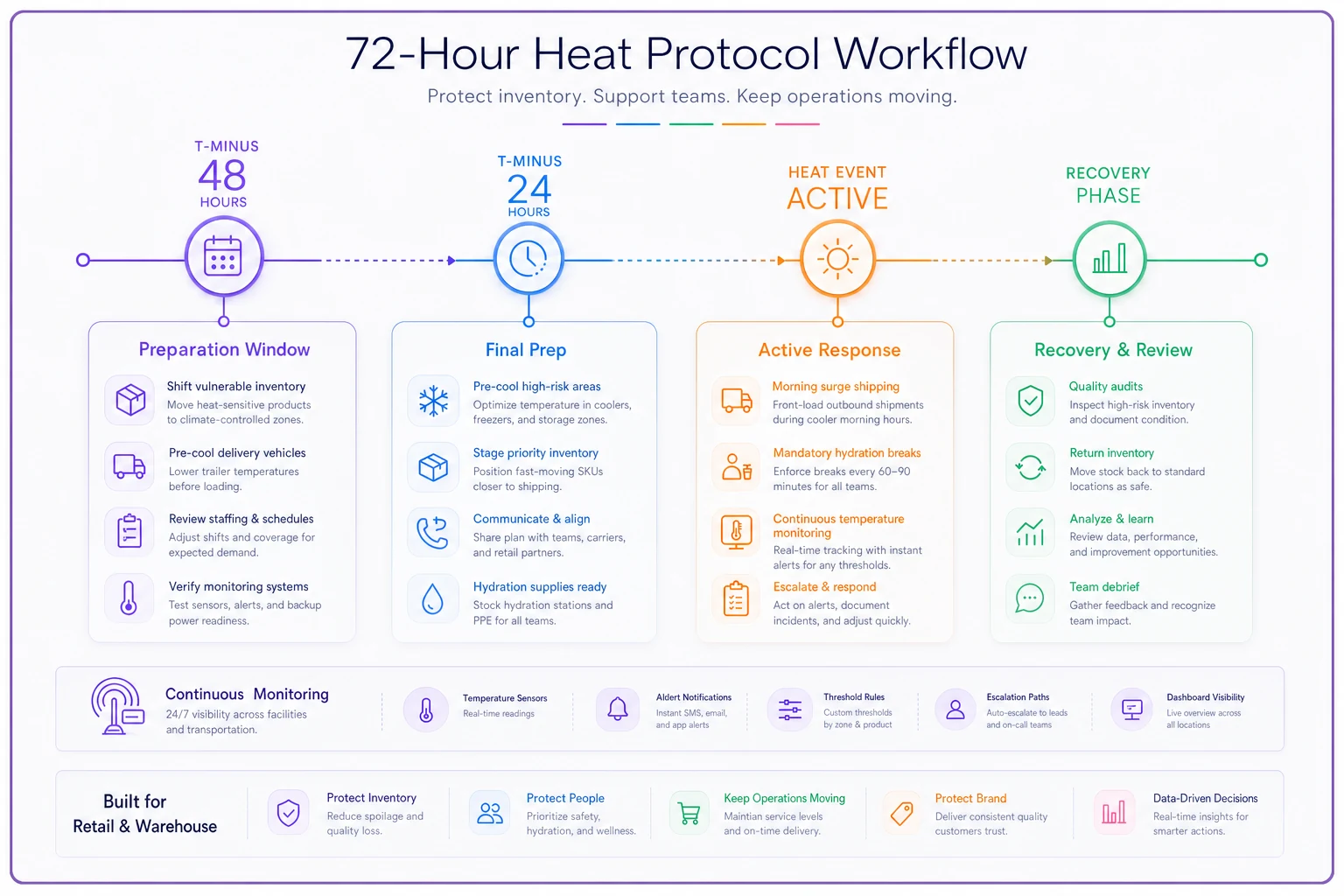
The 72-hour heat protocol
When extreme heat warnings drop, you need predetermined triggers and actions—not meetings and discussions. Here's a practical protocol structure that works:
T-minus 48 hours (heat warning issued):
-
Shift 30% of vulnerable inventory to climate-controlled zones
-
Pre-cool all delivery vehicles overnight
-
Contact your top 20% of customers about potential delays
-
Activate backup supplier agreements for critical items
-
Begin pre-staging orders for rapid fulfillment
T-minus 24 hours:
-
Execute final inventory moves to protected zones
-
Load delivery trucks for maximum morning departures
-
Switch to heat-surge scheduling (early morning and evening waves)
-
Implement mandatory hydration breaks every 45 minutes
-
Test all cooling systems and backup power
Heat event active:
-
Morning surge
5 AM–9 AM focused on shipping
-
Midday minimum
receiving and staging only
-
Evening recovery
6 PM–10 PM processing backlog
-
Continuous temperature monitoring with automatic alerts
-
Real-time delivery route adjustments based on traffic and temperature
Here's a concise visual to keep the team's actions aligned.
Recovery phase (T+24 hours):
-
Quality audits on all heat-exposed inventory
-
Process return and damage claims immediately
-
Update safety stock levels based on actual consumption
-
Document lessons learned while everything is still fresh
When extreme heat warnings drop, you need predetermined triggers and actions—not meetings and discussions.
Tech stack modifications for heat resilience
Your existing inventory management system probably wasn't built with extreme weather in mind. But you can add heat-specific capability without replacing everything.
Temperature data integration matters more than people think. Bluetooth temperature sensors run around $30 each—connect them to your warehouse zones and set automatic alerts when temps hit thresholds. When Zone 3 hits 85 degrees, your system triggers an alert to move cosmetics immediately. No one has to stand there watching a thermometer.
Connect Bluetooth sensors to your WMS so zone thresholds trigger automatic pick-list reorders for vulnerable SKUs.
Delivery routing needs weather-aware logic too. Standard routing minimizes distance or time. During heat events, you want routes that reduce driver exposure: more highway driving where AC is effective, fewer residential stops requiring constant in-and-out of a hot cab, priority toward shaded commercial areas. Most routing software accepts custom constraints—it just needs configuring.
The bigger opportunity is automating routine decision flows. Instead of managers making hundreds of small calls during a heat event, let your system handle the predictable ones. Warehouse temp exceeds 90 degrees: auto-notify customers of potential delays, auto-adjust reorder points for heat-sensitive SKUs, auto-generate pick lists prioritizing vulnerable inventory. Your team handles exceptions instead of drowning in routine stuff.
The connection to variable lead times is obvious here. Heat events are just extreme versions of standard supply variability—compressed into hours instead of days. The same replenishment playbook for handling variable lead times applies directly. Safety stock calculations, supplier communication protocols, demand adjustment methods—all of it transfers.
Supplier contracts: The clauses that save you
Standard supplier agreements fall apart during extreme weather. Force majeure covers hurricanes and floods but rarely mentions heat waves. You need specific heat-event language in your contracts.
Temperature-controlled delivery requirements: Specify maximum product temperatures during transport. "Product must not exceed 75°F during transit" sounds basic until your supplier claims their un-airconditioned truck is fine because they delivered before noon.
Replacement guarantees for heat damage: Who pays when products arrive damaged from heat? Without explicit terms, you absorb the cost. Push for supplier coverage when documented temperatures exceed specified ranges while product is still in their control.
Surge capacity commitments: Lock in guaranteed allocation during weather events. When everyone scrambles for inventory, you need contractual priority. One distributor I know negotiates "weather event priority" in exchange for slightly higher regular pricing. Worth it every time there's a crisis.
Flexible delivery windows: Standard contracts specify tight delivery windows with penalties. Build in "extreme weather modifications" that automatically extend windows and waive penalties when official heat warnings are active.
The Monday morning recovery audit
After heat events, most businesses clean up and move on. The ones that actually improve run systematic recovery audits.
Check your velocity assumptions first. Which products moved faster during the heat? Energy drinks, cooling products, and replacement items for heat-damaged goods all see demand spikes. Which products stalled? Customers defer non-essential purchases during extreme weather. Adjust your auto-replenishment triggers accordingly.
Measure your actual throughput degradation—not your estimate. One fulfillment center discovered their real heat impact was about 50% worse than they'd assumed, which completely changed their surge planning going forward.
Calculate the hidden costs too. Beyond damaged inventory: expedited shipping fees, overtime labor, lost sales from stockouts, customer service time handling complaints. A full picture often reveals you spent $10K to save $5K in inventory losses. That's useful information.
Review your communication effectiveness. Did customers understand the delays? Did staff actually know the protocols? Did suppliers respond appropriately? Poor communication tends to multiply heat-event damage in ways that don't show up in the obvious numbers.
Building heat resilience into daily operations
The smartest approach isn't treating heat waves as special events. It's building resilience into normal operations so extreme temperatures barely register.
Start with layout. Move heat-sensitive inventory closest to cooling sources and loading docks. Most warehouses organize by velocity or product category, which leaves vulnerable items scattered through hot zones. One distributor reorganized their layout and cut heat-related losses by 60% without buying a single piece of new equipment.
Invest in passive cooling. Reflective roof coatings can drop interior temps by 10–15 degrees. Dock door seals prevent hot air from pouring in. Ceiling fans create perceived cooling without expensive AC upgrades. These aren't emergency measures—they pay dividends year-round.
Build redundancy into your carrier network. Single-carrier dependence gets painful fast when that carrier implements emergency restrictions during a heat event. Maintain relationships with at least three carriers, including one with temperature-controlled transport capability. Managing multiple carriers adds complexity, but operational software can handle carrier selection logic automatically based on current conditions.
Adjust your product mix gradually if heat events are becoming regular in your region. A personal care distributor replaced about 15% of their catalog with heat-stable formulations and eliminated most of their temperature-related issues while maintaining margins.
When heat damage becomes competitive advantage
This sounds counterintuitive, but businesses that handle heat events well can actually gain market share while competitors struggle. Prepared operations capture overflow demand from less reliable suppliers.
A regional food distributor implemented comprehensive heat protocols two years ago. During last summer's heat dome, they maintained 87% on-time delivery while competitors dropped to around 60%. They picked up a dozen new long-term contracts from businesses burned by unreliable suppliers. The investment in heat resilience paid back multiple times over in new business alone.
The key is making your capability visible. Update your website during heat warnings: "Full operations maintained during extreme weather." Send proactive messages: "Your orders are protected in our climate-controlled facilities." When customers see you operating smoothly while others are struggling, you become the obvious choice.
The five-SKU test run
Before rolling out wide-scale changes, run a controlled test with five vulnerable SKUs. Pick items with different heat sensitivities, storage requirements, and velocity patterns.
Week 1: Map current heat impact. Track these five SKUs through a normal hot day. Document temperature exposure at each stage, measure quality degradation, calculate actual damage costs.
Week 2: Implement basic protocols. Apply your temperature zone mapping, adjust pick schedules, modify storage locations. Measure improvement without any technology changes.
Week 3: Add monitoring and automation. Deploy temperature sensors, create automated alerts, implement system-driven decisions. Compare results to manual protocols.
Week 4: Stress test with simulated extreme heat. Reduce cooling temporarily, extend exposure times, and see how your protocols actually hold up.
This focused test reveals what works in your specific operation without risking your entire inventory. Lessons from five SKUs scale predictably to five hundred.
Beyond survival mode
Businesses still treating heat waves as random disruptions are stuck in permanent reactive mode—scrambling when warnings drop, counting losses when the heat breaks, hoping next summer is cooler. That's not operations management; it's damage control with extra steps.
The operators who've figured this out treat heat events as predictable operational challenges with systematic solutions. Their inventory software automatically adjusts reorder points when heat warnings trigger. Their warehouse platforms re-route pick paths to minimize exposure. Their delivery systems factor temperature into routing decisions as a matter of course.
The technology exists today. Temperature sensors cost less than the inventory they protect. Operational software that responds to environmental conditions isn't futuristic—it's practical automation that pays for itself in prevented losses. The question isn't whether to build heat resilience, it's whether you'll do it now while you have time to test things properly, or during the next heat wave while inventory spoils and customers walk.
The recent heat dome won't be the last. The workflows, contracts, and systems outlined here aren't theoretical—they're pulled from businesses that learned these lessons the expensive way. You can implement them gradually, test them thoroughly, and actually be ready when the next warning drops. Because in the new reality of regular extreme heat events, the most valuable inventory skill isn't optimization. It's resilience.
The recent heat dome won't be the last. The workflows, contracts, and systems outlined here aren't theoretical—they're pulled from businesses that learned these lessons the expensive way. You can implement them gradually, test them thoroughly, and actually be ready when the next warning drops. Because in the new reality of regular extreme heat events, the most valuable inventory skill isn't optimization. It's resilience.
Ready to optimize your inventory operations?
Join 2,000+ businesses using Listoly to reduce stockouts, save time, and improve order accuracy.