

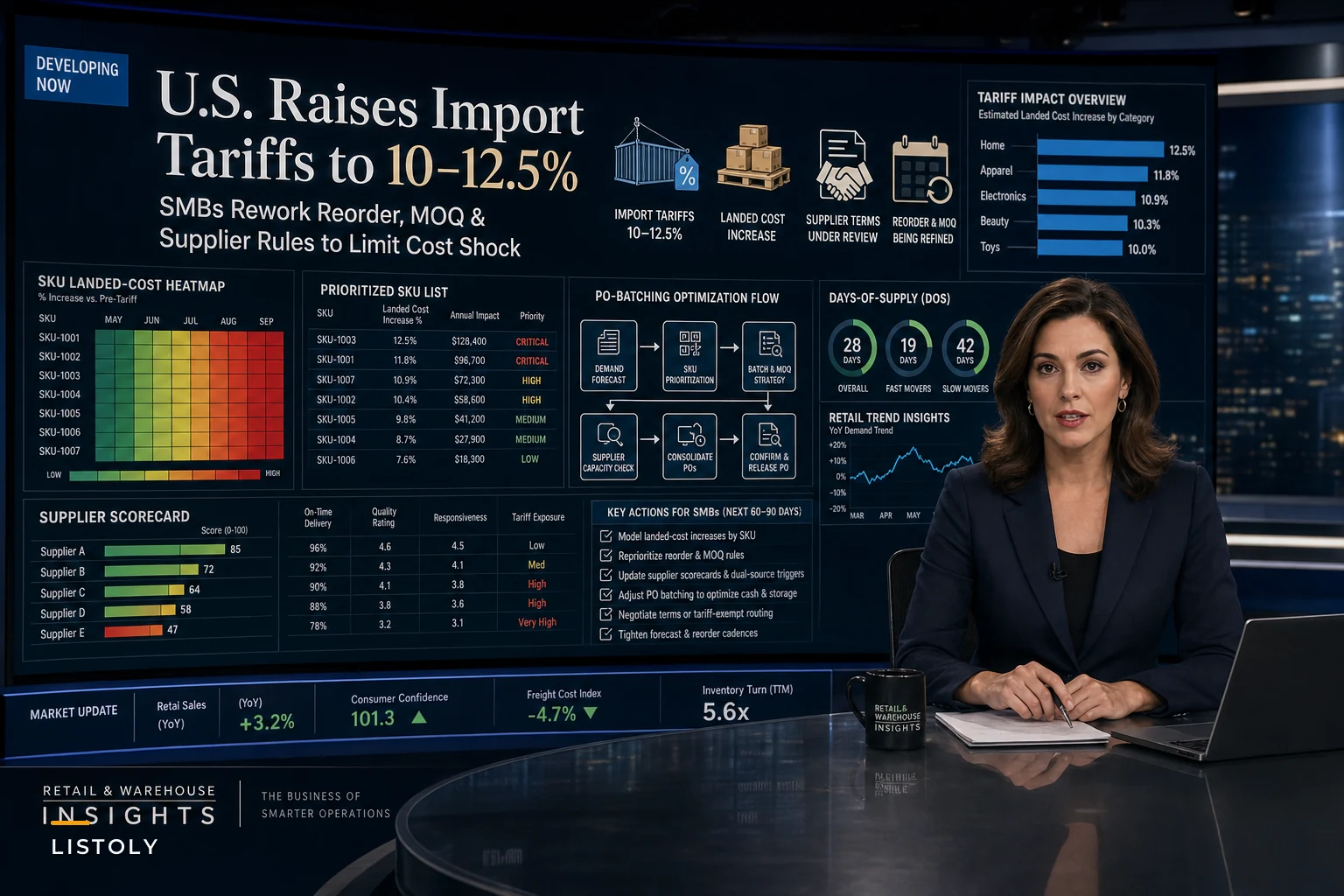

Last week's tariff announcement caught most small businesses mid-cycle. Orders placed, containers on the water, payment terms locked. Then boom — the U.S. slapped 10-12.5% tariffs on 60 trading partners, effective immediately.
If you're importing anything — electronics from Vietnam, textiles from Bangladesh, components from Mexico — your landed costs just jumped. Not next quarter. Not after some grace period. Right now.
The real problem isn't just the cost increase. Every operational assumption you've built your inventory system around just shifted. Your reorder points assume a certain unit cost. Your MOQ decisions balance cashflow against per-unit savings that no longer exist the way they used to. Your supplier scoring weights price stability in ways that don't match this new reality anymore.
Small businesses face a nasty combination: higher costs eating into margins while needing more cash just to maintain the same inventory levels. And you can't pass through a 12% increase to customers overnight without risking serious volume drops.
The cascade effect
Most import tariffs inventory management discussions focus on the obvious — costs go up, margins compress. The operational ripple effects are actually worse than the direct cost increase.
Take MOQ negotiations. That 500-unit minimum you grudgingly accepted because the per-unit discount made sense? At old pricing, ordering 500 units cost you $15,000 and saved $1.20 per unit versus smaller batches. Now that same order costs $16,875, but your savings didn't increase proportionally. The math that justified tying up that cash for 3 months doesn't work anymore.
Or consider safety stock calculations. Standard formulas weigh cost of stockout against holding cost. When your holding cost jumps 12% but your stockout cost — lost sales, expedite fees — stays flat, the optimal safety stock level actually drops. Most businesses won't recalculate though. They'll keep the same buffer levels and wonder why cash is so tight.
Payment terms matter more now too. NET 30 terms on a $50,000 order means floating an extra $6,250 for a month. Extended terms that seemed like a minor perk before become critical.
The timing kills you. Orders placed under old pricing arrive under new tariff rules. A sporting goods retailer had three containers on the water when similar tariffs hit a few years back — roughly $180,000 in inventory suddenly costing an extra $22,000 they hadn't budgeted for. They had to skip their next planned order entirely just to cover the shortfall.
Immediate triage: what to fix in the next 72 hours
Freeze all non-critical POs until you run new numbers. That recurring monthly order for C-class items? Cancel it. The nice-to-have SKUs you were testing? Hold off. You need every dollar of float right now.
Never run out of stock or overorder again.
Listoly streamlines inventory workflows to keep your business stocked and profitable.
- Real-time stock tracking
- Automated reorder alerts
- Supplier and purchase management
No credit card required
Recalculate landed costs on everything immediately. Don't just add 12.5% to invoice price — factor in how the tariff affects freight percentage, insurance costs as a percentage of value, and any financing charges based on order value. A clothing importer might see true landed cost increase by 14-15% once all the percentages cascade.
Here's the quick math most businesses miss:
| Cost Component | Pre-Tariff | Post-Tariff | Real Increase |
|---|---|---|---|
| Product cost | $10.00 | $10.00 | - |
| Tariff (12.5%) | $0 | $1.25 | +$1.25 |
| Freight (8% of value) | $0.80 | $0.90 | +$0.10 |
| Insurance (0.5% of value) | $0.05 | $0.06 | +$0.01 |
| Finance charge (2% of total) | $0.22 | $0.24 | +$0.02 |
| Total landed cost | $11.07 | $12.45 | +12.5% |
Pull your highest-volume SKUs and highest-margin SKUs first. These drive your business — if the math breaks on these, nothing else matters. For each one, answer: Can I maintain margin at current retail price? If not, how much volume would I lose at different price points?
Contact suppliers about payment terms. Not pricing — you won't win that fight right now. But extending NET 30 to NET 45 or NET 60 gives you breathing room without costing suppliers much. Frame it as temporary while you "adjust to new import requirements."
Reworking your reorder triggers and batch sizes
Your old reorder points assumed predictable costs. That assumption just died. The question now is whether you optimize for margin protection or service level maintenance.
Most businesses default to maintaining service levels, but that's often wrong. A hardware distributor might carry 200 SKUs where only 30 drive real profit. Protecting availability on those 30 matters. The other 170? Let them stock out if needed.
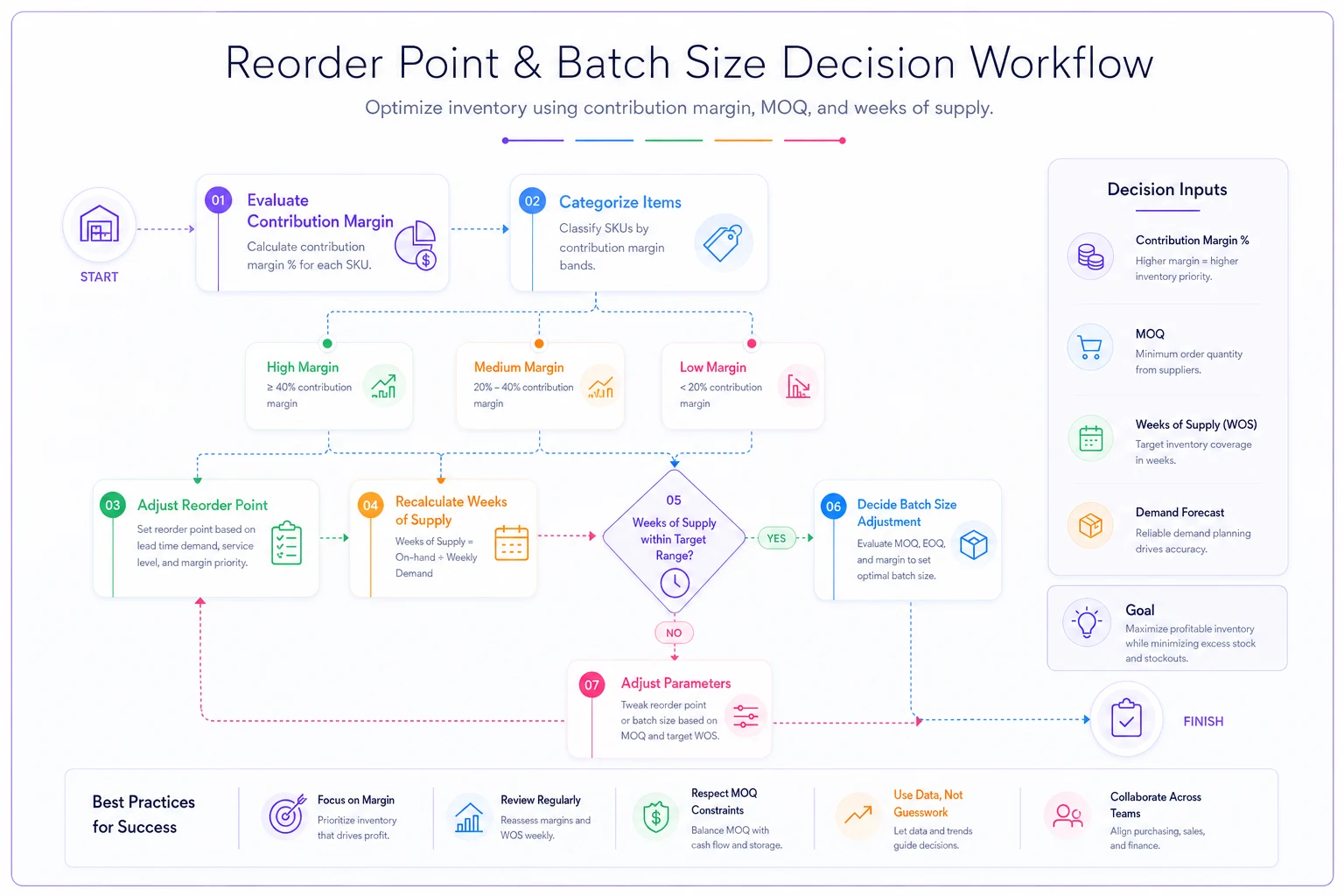
Start with contribution margin per unit, not gross margin percentage. A $100 item with 20% gross margin contributes $20. A $20 item with 35% margin contributes $7. When cash is tight, you care about dollars, not percentages.
Start with contribution margin per unit, not gross margin percentage.
High contribution items (>$50 per unit): Maintain or even increase reorder points. These justify their inventory investment even at higher costs.
Medium contribution items ($10-50): Reduce reorder points by 15-20%. Accept slightly higher stockout risk to free up cash.
Low contribution items (<$10): Cut reorder points by 30-40% or eliminate entirely. The cash tied up here needs to support higher-value inventory.
Batch sizing changes too. Pre-tariff, you might order 3 months of inventory to hit supplier minimums or quantity breaks. Now those larger batches might consume your entire inventory budget for the quarter.
Calculate weeks of supply in dollars, not units. If you previously carried 12 weeks of inventory worth $100,000, and tariffs push that same unit quantity to $112,500, you're actually carrying 13.5 weeks of cash. That extra 1.5 weeks is $12,500 you can't use elsewhere.
This flow shows the decision process for adjusting reorder points and batch sizes.
Start with contribution margin per unit, not gross margin percentage.
Supplier scoring when everyone's prices jumped equally
Traditional supplier scoring weights price heavily — usually 30-40% of the total score. When every supplier's price jumps by roughly the same percentage, that metric becomes useless for differentiation.
According to NBC News, the tariffs apply uniformly across affected countries, so switching from a Chinese supplier to a Vietnamese one won't help if both face the same rates. That shifts the focus to other factors entirely.
Payment flexibility suddenly matters most. A supplier offering NET 60 versus NET 30 effectively provides a 30-day interest-free loan on that extra 12.5% cost. On a $40,000 order, that's worth roughly $500 in financing costs avoided.
Lead time reliability becomes critical when you're ordering smaller, more frequent batches. A supplier that consistently hits their 4-week promise beats one that averages 4 weeks but swings between 3 and 6. Variability forces more safety stock, which costs even more now.
Quality consistency matters more at higher prices too. A 2% defect rate when units cost $10 means $200 in losses per $10,000 in orders. At $11.25 per unit, that same defect rate costs $225. Small quality improvements yield bigger dollar savings.
Look for suppliers who can flex on non-price terms:
-
Smaller minimum orders (even if per-unit cost is slightly higher)
-
Consignment arrangements for steady-selling items
-
Volume rebates paid quarterly versus annual
-
Acceptance of partial payments or progress billing
-
Willingness to hold inventory and ship on-demand
Geographic diversification within tariff-affected regions won't help, but supplier diversification still might. If one supplier can expedite when you're caught short, that flexibility is worth a premium right now.
The MOQ trap that kills cash flow
Minimum order quantities were already a cashflow challenge for small businesses. Add 12.5% to the required spend, and they become genuinely dangerous.
A gift shop used to order ceramic items with a $2,500 MOQ, which represented about 6 weeks of sales. That same unit quantity now costs $2,812, but represents 6.75 weeks of sales if retail prices stay flat. Every order ties up an extra 0.75 weeks of cash that compounds over time.
The instinct is to negotiate lower MOQs, but suppliers facing their own cost pressures rarely budge. Instead, restructure how you hit minimums:
Bundle complementary SKUs rather than going deep on single items. Instead of ordering 500 units of one vase design, order 100 units across 5 designs. Same MOQ, better cash distribution, lower dead stock risk.
Partner with non-competitors to combine orders. Two boutiques in different cities can split container minimums on overlapping products. The coordination hassle is worth the cashflow relief.
Shift to programmatic ordering where suppliers agree to fixed monthly shipments at lower quantities. You might pay 3-4% more per unit, but freeing up thousands in working capital more than compensates.
Some businesses try to get clever with MOQ math by ordering more to hit volume discounts. This rarely works post-tariff. That 10% volume discount on 1,000 units versus 500? It doesn't offset the cash cost of carrying an extra 500 units at inflated prices for months.
The real calculation is opportunity cost of tied-up cash versus per-unit savings. If $10,000 in extra inventory saves you $500 but prevents you from taking advantage of a quick-turn opportunity worth $2,000 in margin, you lost money.
Building cash buffers without killing service levels
The standard playbook says reduce inventory to free up cash. But cutting too deep creates stockouts that drive customers away permanently. The trick is surgical reduction — knowing exactly where to cut and where to protect.
Start with your velocity-margin matrix. Plot every SKU on two axes: inventory turns per year and contribution margin dollars. The four quadrants tell you what to do:
High velocity, high margin: Protect at all costs. These fund everything else.
High velocity, low margin: Reduce carefully. Customers expect availability but you can't afford excess.
Low velocity, high margin: Maintain minimal stock. Each sale matters but tying up cash doesn't.
Low velocity, low margin: Eliminate unless contractually required. Every dollar here is wasted.
Within each quadrant, cut from the bottom up. If you have 50 high-velocity/low-margin SKUs, identify the bottom 10 and reduce those first.
Cross-docking arrangements help too. Instead of taking inventory, arrange for suppliers to drop-ship your steady sellers directly to customers. You lose some margin but eliminate inventory investment entirely.
For seasonal items the math shifts. Previously you might bring in Halloween merchandise in August for September-October sales. Now, consider taking delivery in September even at expedited freight costs. The extra freight might run $500, but avoiding 30 days of carrying cost on $20,000 in inventory saves more.
When to eat the cost versus when to raise prices
The knee-jerk reaction is to pass through the entire tariff as a price increase. This almost always backfires for small businesses. You don't have the market power to force acceptance, and customers have alternatives.
Price elasticity varies dramatically by category and competitive position. A specialty food importer selling unique items can probably pass through 5-7% without major volume loss. A commodity electronics reseller might lose half their volume at a 3% increase.
Test price increases carefully:
Week 1-2: Increase prices on your lowest-velocity items by the full tariff amount. These customers are least price-sensitive since they're buying specialized products.
Week 3-4: Raise prices on medium-velocity items by 50-60% of the tariff impact. Monitor daily sales versus the same period last year.
Week 5-6: Decide on high-velocity items based on what you're seeing. You might eat the entire cost here to maintain volume and customer relationships.
Bundle pricing helps obscure increases. Instead of raising a $50 item to $56, create a bundle with a normally $15 accessory for $65. The perceived value increase softens the shock.
Tiered pricing helps too. Keep small quantity prices the same but reduce volume discounts. A customer buying one unit pays the old price, but someone buying 10 units gets 5% off instead of the previous 10%.
For B2B sales, introduce "freight and handling surcharges" rather than changing list prices. These feel temporary and avoid messy catalog reprints. A 3% surcharge is psychologically easier to accept than new pricing.
Eating some cost temporarily might be strategic. If competitors raise prices immediately while you hold for 60 days, you might gain enough market share to offset the margin hit. A specialty toy store gained around 20% more customers by holding prices during the holiday season while competitors passed through costs immediately.
Software solutions that actually help
Most inventory software treats cost as a static field you manually update. That breaks completely when tariffs create different landed costs for identical products ordered on different dates. You need systems that calculate true landed cost dynamically based on receipt date and origin.
The features that actually matter right now:
Multi-tier cost tracking that maintains historical cost, current replacement cost, and projected future cost simultaneously. Without this, you're making reorder decisions on outdated data.
Scenario planning that lets you model different price points and see the impact on margin and inventory investment. Spreadsheets work, but purpose-built tools update in real-time as sales happen.
Automated reorder point adjustments based on margin thresholds, not just sales velocity. When an item's margin drops below your threshold, the system should automatically reduce its reorder point to free up cash.
Payment term optimization that factors financing cost into supplier selection. A system that ranks suppliers by total cost of ownership — including payment terms — helps you make better sourcing decisions.
For businesses managing multi-supplier, multi-currency operations with constantly shifting tariff impacts, AI-powered operational platforms help navigate the complexity. These systems track true landed costs across batches, automatically adjust reorder points based on margin changes, and simulate pricing scenarios before you commit.
The real value isn't the automation — it's the visibility. When you can see exactly how a 2% price increase affects demand, inventory investment, and cashflow at the same time, you make better decisions. Small adjustments compound quickly in either direction.
Practical steps for next week
Stop thinking about tariffs as a pricing problem. They're a working capital problem that happens to involve prices. Your response should focus on cash optimization.
First, implement a daily cash position dashboard. Track inventory dollars, payables, receivables, and available credit. When cash gets tight, you need to know immediately, not at month-end.
Second, create a SKU hit list. Identify the 20% of items that would free up the most cash if eliminated. Don't cut them yet, but know exactly what to cut if needed.
Third, negotiate everything except price. Payment terms, delivery schedules, return policies, quality guarantees — every non-price term that improves your cash position is worth pursuing.
Fourth, build scenarios for different duration assumptions. If tariffs last 6 months, what changes? What about 18 months? Having pre-planned responses prevents panic decisions when things shift again.
Perfect optimization is impossible right now. The situation is too fluid, the variables too numerous. Focus on being approximately right rather than precisely wrong. Make small adjustments weekly rather than big changes monthly.
The businesses that survive this shift won't be the ones with the best spreadsheets or the most sophisticated systems. They'll be the ones that adapt fastest, preserve cash most carefully, and maintain customer relationships through the chaos. Your operational discipline over the next few months determines whether you emerge stronger or spend the next year trying to recover.
For those looking to systematically evaluate and adjust supplier relationships in this new environment, our supplier scorecard and PO-rule playbook provides templates and scoring frameworks that factor in payment flexibility, reliability, and total cost of ownership beyond just unit price.
The tariffs are here. Your old inventory rules are dead. Time to build new ones.
Ready to optimize your inventory operations?
Join 2,000+ businesses using Listoly to reduce stockouts, save time, and improve order accuracy.