

Running purchase orders for a small business feels like playing three-dimensional chess while your suppliers keep changing the rules. You're balancing cash flow against MOQ requirements, warehouse space against volume discounts, and somehow trying to keep enough inventory without locking up your entire operating budget.
The real mess shows up when you're working with multiple suppliers who all operate differently. Your main fabric supplier wants $5,000 minimum orders. Your button supplier ships in case quantities of 1,440 units. Your packaging vendor gives you a 12% discount at 10,000 pieces but hits you with a $75 expedited shipping fee if you go under their standard two-week lead time. And you're sitting there with a calculator trying to figure out if ordering six months of inventory saves you money or just creates a storage problem.
Most SMBs end up with a patchwork of Excel sheets, email threads, and mental notes about which suppliers are reliable and which ones ship late. Then someone new takes over purchasing and has to start from scratch because nobody wrote down why you stopped ordering from that cheaper supplier three years ago.
The batching window trap that kills small business cash flow
Batching orders should save you money, but the way most small businesses approach it creates more problems than it solves. The classic mistake is setting arbitrary batching windows without thinking about how they interact with your actual cash conversion cycle.
A home goods retailer I worked with had set up monthly batching for all suppliers to "simplify operations." Sounded reasonable until you looked at what was actually happening. Their ceramic supplier had 45-day payment terms and reliable 10-day delivery. Their textile supplier required 50% deposits with net-30 on the balance, plus shipping took 3-4 weeks from overseas. By forcing both into the same monthly batch, they were prepaying for textiles while sitting on ceramic inventory that could've been ordered just-in-time.
The better approach treats batching windows as supplier-specific, based on three things: payment terms relative to your sales velocity, the supplier's actual (not promised) lead time consistency, and the real cost difference between batched and individual orders including freight breaks.
Here's what a practical batching matrix looks like:
| Supplier Type | Payment Terms | Lead Time Variance | Optimal Batch Window | Trigger |
|---|---|---|---|---|
| Fast-turn domestic | Net 30-45 | <5 days | 2-3 weeks | When combined order hits freight break |
| Slow-turn domestic | Net 60+ | <7 days | 4-6 weeks | Monthly on fixed date |
| Overseas reliable | Deposit required | 10-15 days | 6-8 weeks | When forward coverage drops below 10 weeks |
| Overseas variable | Deposit required | 15-30 days | 8-12 weeks | Quarterly with buffer stock |
The trigger column matters more than the window. Setting a freight break trigger for domestic suppliers means you might order every 18 days or every 25 days depending on sales. That flexibility keeps you from forcing orders when you don't need inventory just because the calendar says it's batching day.
Use sales-driven triggers (like freight breaks tied to recent velocity) rather than fixed calendar batching to avoid unnecessary prepayments.
This approach reduces cash tied up in inventory while preserving the benefits of batching where they actually exist.
MOQ math that actually works for cash-constrained businesses
Minimum order quantities get exponentially messier when you're managing multiple SKUs from the same supplier. The standard advice—calculate weeks of supply, order at the MOQ when you hit your reorder point—breaks immediately when your supplier has both product-level and order-level minimums.
Never run out of stock or overorder again.
Listoly streamlines inventory workflows to keep your business stocked and profitable.
- Real-time stock tracking
- Automated reorder alerts
- Supplier and purchase management
No credit card required
Take a small fashion brand ordering from a trim supplier. Each button style has a 500-unit minimum, but the supplier also requires a $400 order minimum. If buttons cost $0.30 each, you need roughly 1,333 buttons to hit the order minimum. But you can't order 1,333—you need quantities of 500 per style. So you're looking at 1,500 or 2,000 buttons minimum, which puts you at $450 or $600, not $400.
Then carton rounding adds another layer. Your supplier ships buttons in boxes of 2,000. You need 3,100 buttons across three styles. Do you order 4,000 (two boxes) and deal with excess, or 6,000 (three boxes) to get a better per-unit price? The answer depends on your carrying cost, storage capacity, and cash position—not just the unit price.
A workable MOQ decision framework needs four calculations:
-
True minimum cost
Product MOQs vs order minimum, whichever is higher
-
Carton efficiency
Next carton break vs partial carton upcharge
-
Cash recovery time
Weeks to sell through the MOQ at current velocity
-
Opportunity cost
What else you could do with that cash
The fourth point is where most small businesses slip up. If spending an extra $1,200 to hit a carton break saves you 8% but ties up cash for 16 weeks, you might be better off paying the higher unit cost and using that $1,200 to stock a faster-moving SKU that turns in 4 weeks.
Run those four numbers before you commit to a big MOQ purchase and you'll stop mistaking a lower unit price for a better business decision.
When expedited freight makes sense (and when you're just lighting money on fire)
Every small business owner has paid for overnight shipping in a panic, usually because someone forgot to order something critical. But there's a big difference between emergency expediting and treating expediting as part of your regular operation.
Strategic expediting works when the math genuinely supports it. A specialty food company found they could air freight 20% of their orders from a European supplier and actually come out ahead. The key: their highest-margin items were also their lightest. By air freighting premium spice blends and sea freighting bulk herbs, they cut their average inventory investment by around 35% while holding service levels steady.
Your expedite decision sequence should go like this:
-
Can the customer wait? (Often they can if you communicate early)
-
What's the true margin impact? (Revenue minus all costs including the expedite)
-
Can you partial ship? (Send what you have, expedite only the gap)
-
Is this a pattern? (Third expedite for the same SKU means fix your planning)
The partial ship option gets missed constantly. If a customer ordered 50 units and you have 40, shipping 40 now and expediting 10 might cost less than expediting all 50 from your supplier. And the customer gets most of their order immediately.
Where businesses really burn cash: expediting to avoid stockouts without calculating whether the stockout would actually cost more. If expediting costs $500 extra and the stockout would only cost you $300 in lost margin, you're paying $200 to feel better about availability. That's not a business decision—that's anxiety driving purchasing.
Building a supplier scorecard that actually drives decisions
Most supplier scorecards SMBs build are useless because they track the wrong metrics, or track the right metrics without any built-in action triggers. Quality, delivery, and price are obvious, but they don't tell you what to do when a supplier starts slipping.
A functional scorecard for an SMB needs to be simple enough to update monthly but detailed enough to support real decisions.
Core Metrics (tracked monthly):
-
On-time delivery rate (within agreed window)
-
Order accuracy (correct items, quantities, documentation)
-
Quality pass rate (items accepted vs items ordered)
-
Invoice accuracy (matches PO and receipt)
-
Response time to issues (hours to meaningful response)
Calculated Scores (quarterly):
-
Total cost of ownership (price + freight + handling + error costs)
-
Cash cycle impact (payment terms vs actual payment timing)
-
Flexibility rating (based on accepted change requests)
Action Triggers:
-
Below 85% on-time for 2 consecutive months → Add 1 week buffer to all orders
-
Below 95% accuracy for any month → Require photo confirmation before shipping
-
Quality issues >5% → Immediate supplier meeting, consider inspection service
-
3 expedite requests accepted → Upgrade to preferred status
-
3 expedite requests declined → Begin sourcing alternatives
The predetermined actions are what make this actually useful. When your fabric supplier hits 82% on-time delivery two months running, you don't schedule a meeting to discuss feelings about it—you automatically add buffer time to orders. Removes the politics.
A ceramic studio implemented this framework and discovered their "reliable" clay supplier was actually costing them about 15% more than a "difficult" one when they factored in expediting costs and production delays. They didn't switch immediately, but they had real data to negotiate with and set clear performance requirements.
The multi-source vs single-source decision framework
Conventional wisdom says always have backup suppliers. That advice ignores the operational complexity multiple suppliers create for small businesses. Every additional supplier means another set of payment terms, another MOQ, another relationship, another set of invoices.
The real decision depends on four factors most SMBs don't properly think through:
Volume concentration risk: If one SKU represents over 30% of your revenue, you probably need multiple sources regardless of complexity. If sales spread across 50+ SKUs relatively evenly, single sourcing might actually make more sense.
Supplier financial stability: A great price from a small supplier means nothing if they go under mid-season. Quick checks: How long have they been in business? Do they require deposits? Are their payment terms getting stricter?
Product complexity: Custom or branded products generally need single sources for consistency. Commodity items where customers won't notice small variations can multi-source more easily.
Geographic concentration: Single sourcing overseas during port strikes or Chinese New Year creates predictable, avoidable problems. Single sourcing domestically from multiple locations might actually give you better risk coverage than multi-sourcing from one region.
The table below summarizes typical scenarios:
| Scenario | Single Source | Multi Source |
|---|---|---|
| Custom/branded products | Yes, with documented backup plan | Only if suppliers can match exactly |
| Commodity items <$10k monthly | Yes, switch if issues arise | No, complexity not worth it |
| Commodity items >$10k monthly | Only with quarterly reviews | Yes, 70/30 split typical |
| Sole income source product | Never | Minimum 60/40 split |
| Seasonal items | Yes, order entire season | No, unless lead times differ |
| New product testing | Yes, establish baseline first | After 6 months stable sales |
The seasonal item point surprises people, but think about it operationally. If you're ordering Halloween decorations in March for October delivery, managing multiple suppliers with different lead times and MOQs just creates unnecessary complexity for what's essentially a one-shot purchase.
Use these factors together to decide whether the added complexity of multi-sourcing is worth the marginal procurement savings.
Implementing PO rules without overwhelming your operation
The gap between having good PO rules and actually following them consistently is where most SMBs fall apart. You build policies, train everyone once, then six months later discover purchasing has reverted to chaos because the rules were too complicated to follow when things got busy.
Start with three non-negotiable rules that address your biggest cash flow risks:
-
No PO splits to avoid MOQs without approval
Sounds obvious, but purchasing teams regularly place multiple small orders to stay under approval thresholds—paying 3x in shipping what they saved in unit costs.
-
Expedite requests require a margin calculation
Before approving any expedited shipping, calculate: selling price minus all costs including the expedite. If margin drops below your threshold (usually 20-30% for SMBs), find another solution.
-
Payment terms logged before order placement
Not after. You'd be surprised how many SMBs discover they agreed to prepayment only when the supplier sends the invoice.
These rules need enforcement mechanisms, not just documentation. The simplest approach: require a second signature on any PO that breaks a rule, even if it's within someone's normal approval limit. Just enough friction to make people pause without grinding things to a halt.
Here's a visual of the PO rule enforcement workflow.
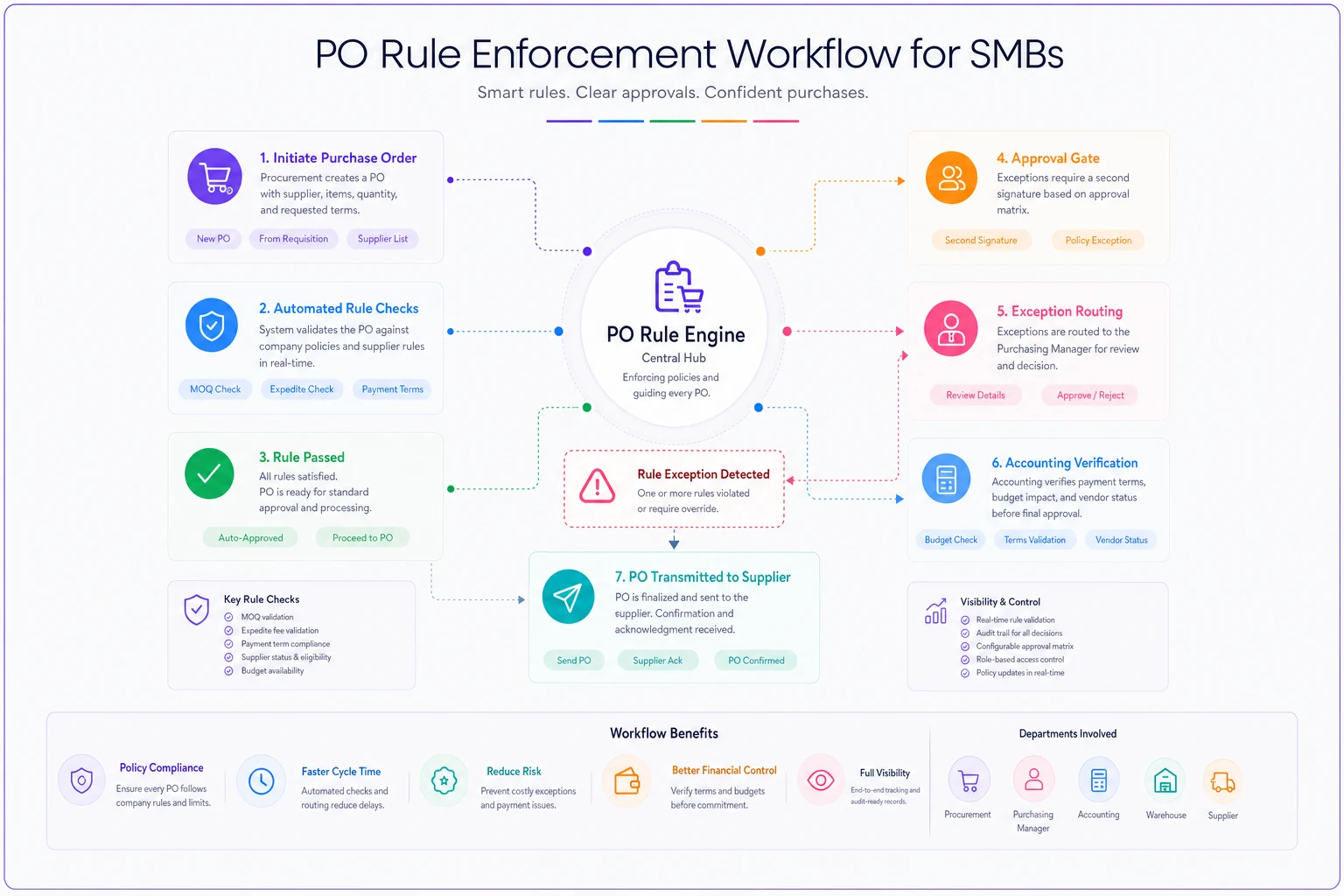
A distribution business with 8 employees tried this. First month was rough—lots of grumbling about extra steps. By month three, their cash conversion cycle had improved by 12 days, mostly from eliminating unnecessary expedites and catching surprise prepayment terms early. The purchasing team actually preferred it because they had clear guidelines instead of guessing what would get approved.
The hidden cost of supplier complexity nobody calculates
Every supplier relationship carries overhead that SMBs rarely quantify. You're tracking another payment schedule, maintaining another contact list, learning another ordering system, reconciling another set of invoices. It compounds.
Consider 15 active suppliers versus 8. Those 7 extra might save you 5-8% on certain items, but they also mean your accounting person spends an extra day per month on reconciliation. Your warehouse processes 7 more shipment types. Your purchasing coordinator manages 7 more relationships. If those labor hours run you $2,000 monthly but the savings only amount to $1,500, you're losing money—it just doesn't show up anywhere obvious.
The sweet spot for most SMBs is somewhere between 5 and 12 core suppliers depending on industry and complexity. Below 5, you're probably overpaying or carrying unnecessary risk. Above 12, operational overhead starts eating the savings unless you have dedicated purchasing staff and real systems.
A practical consolidation approach:
-
List all suppliers ordered from in the past 12 months
-
Calculate true volume (not just PO count) for each
-
Flag suppliers representing less than 5% of spend
-
Check if larger suppliers can absorb those SKUs
-
Run a total cost comparison including labor hours
-
Consolidate gradually—one supplier per quarter
The gradual part matters. Dropping 5 suppliers at once usually creates chaos. Start with the most problematic small supplier, transition their SKUs, document what worked and what didn't, then move to the next.
Using operational software to enforce PO discipline
Manual PO rules work until they don't—usually right when sales spike and everyone's too busy to follow procedures. This is where properly designed operational software actually earns its cost, turning supplier management from a constant scramble into something that mostly runs itself.
The key isn't buying the most sophisticated system. It's choosing software that enforces your rules without requiring someone to babysit it. AI-powered platforms now handle the complex calculations around MOQs, batching windows, and multi-supplier optimization that would take hours in spreadsheets. More importantly, they catch the expensive mistakes that happen when someone's rushing through orders on a Friday afternoon.
A building supplies distributor moved from Excel-based ordering to an operational platform with built-in PO rules. The software automatically flagged expedite requests on low-margin items, suggested order combinations to hit MOQ thresholds efficiently, and tracked supplier performance without anyone manually updating a scorecard. First-year savings covered the software cost several times over, mostly from eliminated expediting fees and better payment term utilization.
The automation side extends beyond calculations too. When routine supplier communication gets handled automatically—PO confirmations, shipping status follow-ups, delayed delivery flags—your team focuses on exceptions and actual relationship work instead of administrative back-and-forth. That shift from reactive to proactive supplier management tends to improve on-time delivery rates meaningfully within the first six months.
Building supplier systems that scale with your business
The difference between SMBs that grow profitably and those that constantly fight cash flow problems usually comes down to how well they manage supplier relationships and PO processes. It's not about finding perfect suppliers—those don't exist. It's about having systems that make imperfect suppliers predictable enough to manage.
Your supplier scorecard should evolve from a simple tracking sheet into a decision-driving tool as you grow. Start with the basics: on-time delivery, order accuracy, quality metrics. Add sophistication only after the basic metrics are stable and you're actually acting on them. Same with PO rules—get three non-negotiable policies working consistently before adding more.
The businesses that do this well long-term treat supplier management as a core operational competency, not just administrative overhead. They invest in systems and tools that make good decisions automatic rather than depending on someone's memory or heroics during a busy stretch. They document not just the policies but the reasoning behind them, so whoever handles purchasing in two years understands why you don't chase every 5% discount or why certain suppliers get priority when allocations get tight.
Supplier complexity has real costs that regularly outweigh marginal savings. Eight reliable suppliers with clear scorecards and documented procedures will almost always outperform fifteen suppliers creating daily fires. Build your supplier systems with that in mind and growth gets operationally simpler, not harder.
Ready to optimize your inventory operations?
Join 2,000+ businesses using Listoly to reduce stockouts, save time, and improve order accuracy.