


Most inventory managers treat costing methods as an accounting decision that happens somewhere upstairs, far away from the reorder screen. For a lot of SKUs, that instinct is right. The costing method you use barely nudges the operational call.
But there's a specific set of situations where FIFO, weighted average, and landed cost quietly push you toward the wrong decision — the wrong reorder quantity, the wrong markdown timing, the wrong number to anchor a supplier negotiation. And because the cost number looks official, nobody questions it.
This post is about spotting those situations fast. Not accounting theory. Just: which costing shortcut to trust when you're staring at a decision, and when to flag it to whoever owns your books.
The core problem: your decision cost and your book cost aren't the same number
The cost your accounting system reports is designed to satisfy tax and financial reporting rules. The cost you should use to decide whether to reorder or mark down is the cost of the next unit — or the cost you'd actually recover.
Those two numbers drift apart most when:
-
Your unit cost has moved recently (price increase, tariff, freight spike)
-
You're holding old and new stock at different costs simultaneously
-
Freight and duties make up a big chunk of landed cost but get buried in a separate GL line
When costs are stable, FIFO and weighted average land within pennies of each other and none of this matters. The moment costs move, the gap opens — and that's exactly when you're making the highest-stakes decisions.
FIFO vs weighted average: where the operational difference actually shows up
Here's a concrete mid-sized reorder situation.
Never run out of stock or overorder again.
Listoly streamlines inventory workflows to keep your business stocked and profitable.
- Real-time stock tracking
- Automated reorder alerts
- Supplier and purchase management
No credit card required
You stock a packaging component. You bought 400 units at $2.10 back in Q1 when freight was cheap. Two weeks ago you got another 300 units at $2.85 because the supplier raised prices and freight climbed. You've still got roughly 500 units on hand, blended across both buys.
Under weighted average, your system reports a unit cost around $2.42. Under FIFO, the next units you consume are still costed at $2.10 until the old batch runs out.
Now you're deciding on margin for a customer quote. If you anchor to $2.10, you feel fine about the margin — but your replacement cost is $2.85. Every unit you sell against that quote has to be bought back at the higher price. You're quietly selling profit you don't actually have.
This is probably the most common costing mistake in day-to-day ops: using a backward-looking cost to make a forward-looking decision.
The quick rule
For decisions that trigger a future purchase — reorders, quotes on repeat items, negotiating a new PO — ignore both FIFO and weighted average. Use your most recent landed unit cost as the decision cost.
| Decision | Best cost to use | Why |
|---|---|---|
| Reorder quantity / timing | Most recent landed cost | You're buying again at today's price |
| Repeat-item customer quote | Most recent landed cost | Margin must survive replacement |
| Markdown on aging stock | Booked cost (FIFO layer) | Sunk cost; you want recovery vs. what you paid |
| Supplier negotiation anchor | Most recent landed + trend | You're arguing about the next price |
| Financial reporting / tax | Whatever your books use | Compliance, not operations |
For decisions about stock you already own and won't replace the same way — clearing old inventory, one-time markdowns — the actual booked cost (FIFO layer or weighted average) is the right anchor, because that's the money already spent.
Landed cost is where SMBs lose the most money silently
FIFO vs weighted average gets all the attention, but in real operations the bigger distortion is usually landed cost — or the lack of it.
A typical example: a small importer sees a supplier invoice at $4.00/unit and treats that as their cost in the reorder tool. But by the time freight, duties, brokerage, and the occasional inspection fee land, the real cost is closer to $5.10–$5.40. That's a 27%+ gap sitting invisible in every margin calculation.
What happens in a lot of small operations is that landed cost gets recorded as a lump freight expense in accounting, never allocated back to the SKU. The accountant's books are technically fine — total cost is captured — but the per-unit number the inventory manager sees is wrong. And per-unit is exactly what drives reorder and markdown math.
When landed cost meaningfully changes the decision
-
Freight/duty is over roughly 15% of the base cost. Below that, using base cost as a proxy is usually close enough not to flip a decision.
-
Freight per unit changes with order size. If consolidating a PO drops your per-unit freight from $1.20 to $0.70, that changes your true reorder economics and might justify a bigger buy.
-
Tariffs shifted recently. New duty rates can move landed cost enough to change which supplier actually wins on price.
Check landed cost sensitivity at two common PO sizes — small freight shifts can flip a reorder decision.
When freight is basically a rounding error — small, light, domestic items — don't bother allocating it per SKU. You'll spend hours on math that doesn't change the answer.
A simple workflow to keep decision cost and book cost from fighting
You don't need to overhaul your accounting to fix this. You need a clean handoff so operational decisions use one number and the books use another, on purpose, without confusion.
-
Tag each SKU by cost volatility. Stable, moderate, or volatile based on how much its landed cost moved in the last 6–12 months. Only the volatile ones need special handling.
-
Maintain a "decision cost" field separate from booked cost — this holds the most recent landed unit cost (base + allocated freight + duty).
-
Update decision cost on every new PO receipt for volatile SKUs. For stable ones, quarterly is plenty.
-
Let accounting keep its own method. FIFO or weighted average stays in the books untouched for reporting.
-
Reconcile monthly. Whoever owns the books checks that the freight lump on the P&L roughly matches the freight allocated per-SKU. Big gaps mean an unallocated cost is hiding somewhere.
-
Flag any SKU where decision cost and booked cost differ by more than roughly 10%. Those are the ones where a bad decision is most likely.
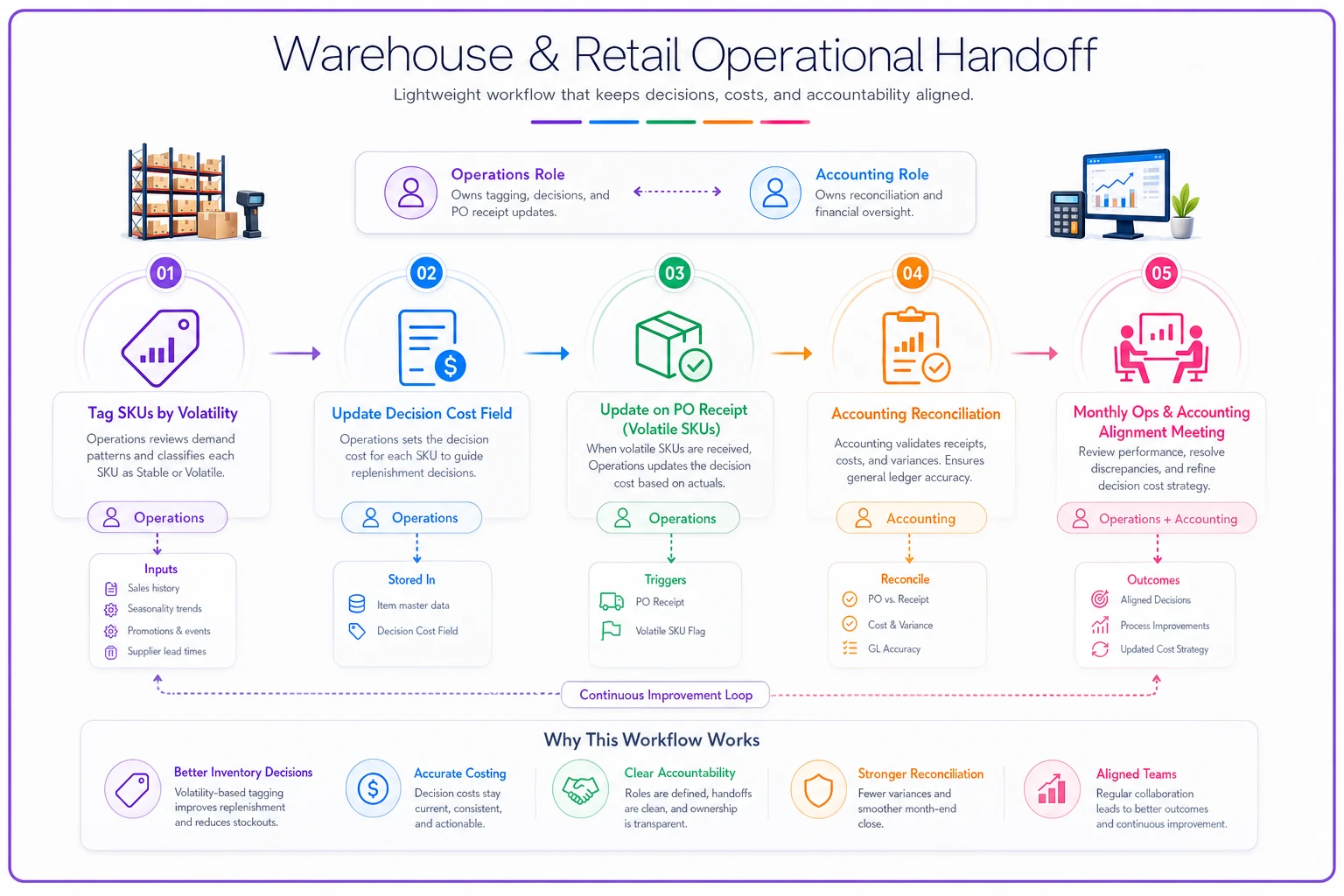
The handoff to accounting is the step people skip, and it's what keeps this from turning into two teams arguing about "the real cost." The deal is simple: operations owns the decision cost, accounting owns the book cost, and they meet once a month to make sure neither is quietly wrong. Most small teams that set this up spend maybe 30–45 minutes a month maintaining it once it's running.
A quick negotiation angle most people miss
Costing method also changes how you show up in a supplier conversation. If you're anchored to an old weighted-average cost, you'll under-ask. If you know your actual recent landed cost and the trend behind it, you negotiate from reality.
A practical move: bring your landed cost breakdown to the table, not just the invoice price. When you can say "your base price went up 12%, but freight allocation added another 9% on my end — my real cost jumped over 20% — I need to talk volume tiers," you're working with numbers the supplier can't easily wave away. Anchoring on invoice-only cost leaves that leverage sitting on the floor.
Real scenario: the markdown that shouldn't have happened
A small home-goods retailer had a slow-moving SKU sitting for months. Their system showed a weighted-average cost of about $18, blended from an old cheap batch and a newer expensive one. Staff looked at a competitor price of $22, figured a markdown to $21 still cleared a small margin, and ran a clearance event.
The problem: the units actually on the shelf were all from the newer batch, which had a FIFO layer cost closer to $23 once freight was allocated. The old cheap units had already sold. The "small margin" markdown was actually selling below cost — they lost roughly $2–$3 a unit across several hundred units before anyone caught it. Somewhere between a few hundred and over a thousand dollars of margin gone on a single clearance.
The fix wasn't complicated. Once they started checking the actual layer cost of remaining stock before markdowns — instead of the blended average — the same clearance decisions started protecting a real margin. Pairing that with a periodic review of which SKUs even deserve shelf space, using the kind of scoring approach in SKU rationalization, cut the number of desperate end-of-life markdowns in the first place.
When to not overthink this
Plenty of inventory doesn't need any of this. If you sell stable-cost, fast-turning items where freight is trivial and prices haven't moved in a year, FIFO and weighted average will give you nearly identical numbers and your invoice price is basically your landed cost. Forcing per-SKU landed allocation in that situation is busywork.
This matters when:
-
Costs are moving (inflation, tariffs, freight swings)
-
You hold old and new stock at meaningfully different costs
-
Freight/duty is a large, uneven share of total cost
-
You're making a high-stakes reorder, quote, or negotiation
Skip the extra effort when:
-
Costs are flat
-
Freight is small and consistent
-
The SKU turns fast enough that old layers never linger
Forcing per-SKU landed allocation in that situation is busywork.
Bringing it together
The costing method inside your accounting system isn't the enemy — it's just answering a different question than the one you're asking on the ops floor. FIFO and weighted average tell you what you spent. Reorders, markdowns, and negotiations depend on what you'll spend next or what you can recover.
Keep a clean separation: a forward-looking decision cost for operations, the compliant booked cost for accounting, and a monthly check so the two don't drift apart. Do that only for the SKUs where costs actually move, and you'll stop the small, invisible leaks — the below-cost clearance, the under-priced repeat quote, the negotiation you walked into anchored to a number that expired months ago.
Keep a clean separation: a forward-looking decision cost for operations, the compliant booked cost for accounting, and a monthly check so the two don't drift apart. Do that only for the SKUs where costs actually move, and you'll stop the small, invisible leaks — the below-cost clearance, the under-priced repeat quote, the negotiation you walked into anchored to a number that expired months ago.
Ready to optimize your inventory operations?
Join 2,000+ businesses using Listoly to reduce stockouts, save time, and improve order accuracy.