



Most inventory SOPs don't fail because they're wrong. They fail because nobody follows them after the first busy week. You write a careful cycle-count procedure, everyone nods during the standup, and by the following Friday the receiving guy is back to eyeballing counts and scribbling on a clipboard because a truck showed up early and the official process felt slow.
That gap — between the SOP that exists on paper and the one that actually runs on the floor — is the core problem of inventory change management that SMB owners keep running into. And it hits differently for tiny teams than it does for a 200-person warehouse. Big operations have compliance officers, training departments, and enough headcount that one person's slip doesn't sink the process. When you've got four or five people, one person quietly reverting to the old way is the process breaking.
This is a playbook for making changes stick when you don't have a change-management department — adoption milestones you can actually hit, a champion model that doesn't require hiring anyone, training that fits in the cracks of a workday, and audit checklists lightweight enough that you'll actually run them.
Why inventory SOPs quietly die in small teams
The failure is almost never dramatic. Nobody stands up and says "I refuse to scan bins." What happens is slower and harder to see.
A new procedure gets introduced during a slow stretch, everyone tries it, it works fine. Then volume spikes — a seasonal push, a big wholesale order, someone out sick — and the new process feels like friction exactly when there's no time for friction. People fall back to muscle memory. The muscle memory is the old process. Two weeks later the new SOP is theoretically active but functionally dead, and the owner doesn't find out until a count is off by 60 units and nobody can explain why.
A few patterns come up over and over in small operations:
-
The SOP was written by someone who doesn't do the work. The owner or manager designs a "clean" process that ignores the messy realities the floor deals with — early trucks, partial shipments, damaged cartons, the barcode that won't scan.
-
There's no defined "done" for adoption. Nobody knows whether the rollout succeeded, so there's no moment where the team actually commits. It just trails off.
-
One person carries the whole thing. Usually whoever cares most. When they're on vacation, the process goes with them.
-
The old way still works "well enough." As long as the legacy method doesn't cause an immediate, visible failure, there's no pressure to change.
These are system problems, not discipline problems. Telling people to "just follow the SOP" is like telling water to stop flowing downhill. If the new process is harder than the old one during peak load, water finds the old channel.
Adoption milestones that fit a five-person team
Big-company change management talks about "phased rollouts" over quarters. Tiny teams don't have quarters — and they don't have the patience for that either. What works instead is a short ladder of concrete milestones where each rung proves the last one held.
Never run out of stock or overorder again.
Listoly streamlines inventory workflows to keep your business stocked and profitable.
- Real-time stock tracking
- Automated reorder alerts
- Supplier and purchase management
No credit card required
Here's the rough shape that works for almost any inventory SOP change — receiving, cycle counts, put-away, whatever:
Milestone 1 — Runs once, correctly, with the author present. The person who wrote the SOP does it alongside the person who'll own it. Not a demo. The actual task, on a real shipment or a real count. This surfaces the "oh, we didn't account for that" gaps immediately.
Milestone 2 — Runs three times without the author. The owner steps back. If the process only works when the boss is watching, it's not adopted, it's performed.
Milestone 3 — Survives one bad day. This is the one everyone skips, and it's the only one that really matters. The SOP hasn't stuck until it's survived an early truck, a short-staffed shift, or a volume spike. If it holds under pressure, you have something real. If it collapses, you learned exactly where the weak joint is before it cost you a stockout.
Milestone 4 — Someone new learns it from the doc alone. The final test isn't whether the current team follows it. It's whether the next hire can pick it up from the written procedure without a 45-minute verbal explanation. If they can't, the real process still lives in someone's head, and you're one resignation away from starting over.
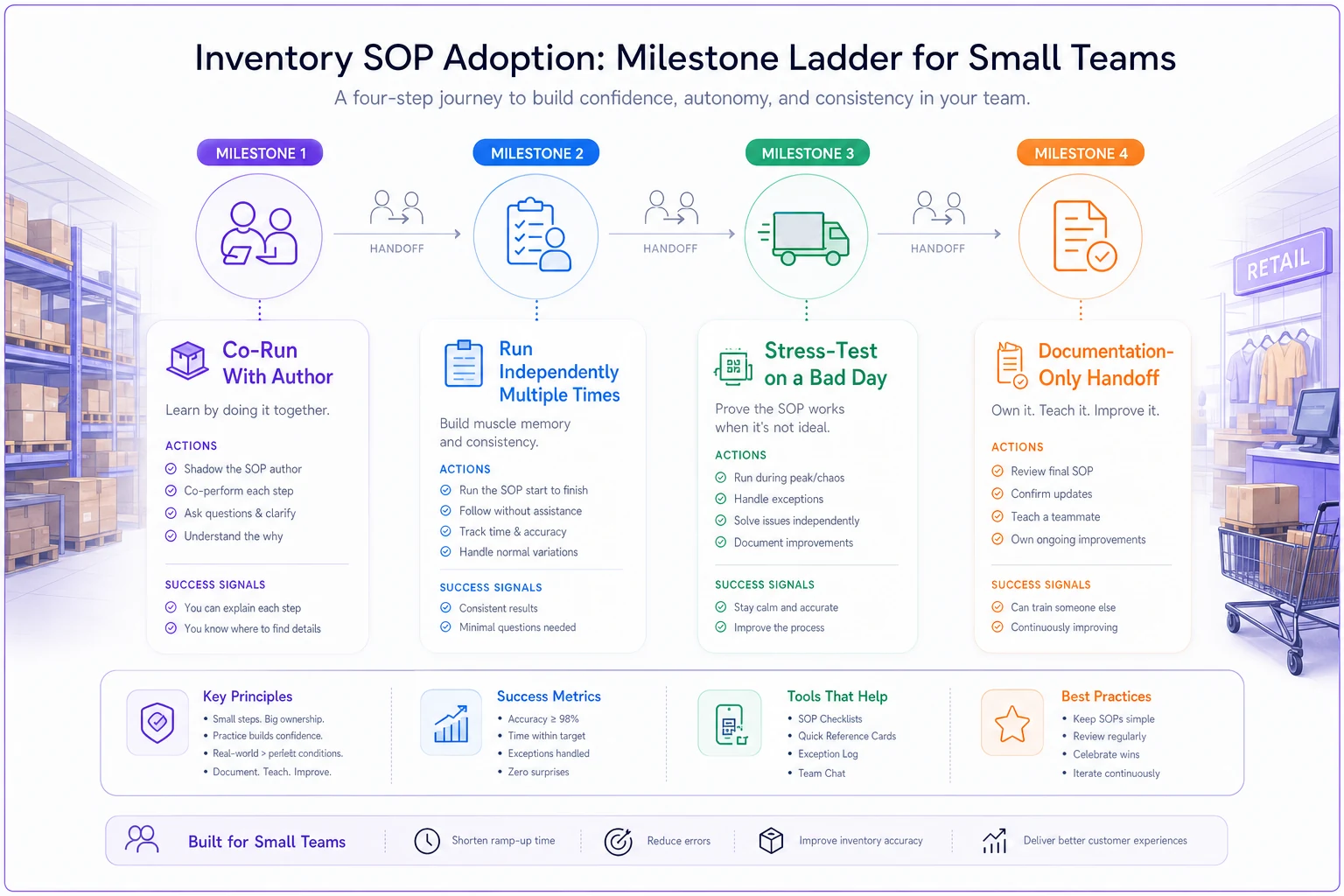
Notice these aren't time-based. "Week 1, week 2" milestones assume a steady environment small businesses never actually have. Event-based milestones — it survived a bad day — map to how work actually happens.
The champion model without hiring a champion
"Assign a champion" is standard change-management advice and it's mostly useless for a team of four, because everybody's already doing three jobs. You don't need a dedicated champion. You need to be deliberate about who carries the SOP and how that responsibility is shared.
A few things that actually work at small scale:
The champion should be the person who does the task most, not the most senior person. Seniority doesn't help adoption — credibility does. If your best receiver champions the new receiving flow, the rest of the team follows because they respect his judgment on receiving. If the owner champions it, people comply while the owner's watching and quietly revert when he's not.
Rotate the champion role on a loose schedule. When one person owns a process forever, it becomes "their thing," and the moment they leave or check out, it dies. If two people have each owned the cycle-count SOP for a stretch, the knowledge is distributed and the process is much harder to kill. Same logic as cross-training pickers so a single absence doesn't stall pick/pack.
Give the champion one real power: the authority to amend the SOP without a meeting. If the person on the floor can fix a broken step, the document stays alive. If every change requires owner sign-off, the doc goes stale, the floor works around it, and now the written process and the real process have quietly diverged — which is where most inventory drift starts.
When the champion model is a bad idea
If your team is two people, skip the formality entirely. You don't need a champion; you need both of you doing the task the same way and writing down what you agreed on. The overhead of "roles" on a two-person team just creates theater.
It's also a bad fit if the owner can't actually let go. If you assign a champion and then override their calls constantly, you've taught the team the champion is decorative. Better to not pretend.
Training that fits inside a workday
Small teams can't afford training days. Nobody's shutting down receiving for an afternoon workshop. So training has to happen inside the flow of work, in short bursts, tied to real tasks.
A training script isn't a manual. It's a tight, spoken walkthrough — three to eight steps — that the champion reads (or nearly memorizes) while doing the task with the person learning it. The point is consistency: every new person hears the same explanation, in the same order, with the same emphasis on the parts that go wrong.
A decent training script for a cycle-count SOP might run:
-
"We count by zone, not by SKU list — grab the zone sheet, not the full inventory report."
-
"Blind count first. Write your number before you look at what the system says."
-
"If you're off by more than five units, don't adjust — flag it. Adjusting quietly is how errors hide."
-
"Recount flagged bins together before end of shift."
-
"Log the variance reason, even if it's a guess. 'Probably a mispick' is more useful than blank."
That whole thing takes ninety seconds to say and can be taught during an actual count. No conference room, no slides. The script also doubles as a refresher — when someone's been sloppy, you don't lecture, you just run through it again.
Keep the script visible near the work area so champions can read the exact wording during a live run.
The mistake small teams make with training is treating it as a one-time event. The receiver who learned the new put-away flow in March has drifted by July. Short scripts make re-training cheap enough to do it casually, right when you notice the drift, instead of scheduling a whole "retraining session" that never actually happens.
Audit checklists you'll actually run
The reason audit checklists get ignored is that they're too long and too infrequent. A 40-line quarterly audit sounds thorough and gets done zero times. A 6-line weekly check that takes four minutes gets done because it doesn't feel like a project.
The trick is to audit the SOP, not the inventory. You're not counting stock — that's cycle counting. You're checking whether the process is being followed. Those are different questions and small teams constantly conflate them.
Here's a lightweight SOP-adherence checklist for a receiving process. Should take one person a few minutes, once a week:
-
- [ ] Were the last five receipts logged using the current form (not the old spreadsheet)?
-
- [ ] Did any receipts skip the count-verification step? (Look for blanks.)
-
- [ ] Were damaged/short items flagged, or just silently received?
-
- [ ] Did put-away happen same-day, or is there a pile of unshelved stock?
-
- [ ] Any variance notes written, or all blank? (All-blank usually means nobody's checking, not that everything's perfect.)
-
- [ ] Did the champion amend the SOP this week? If yes, does everyone know?
The last two lines matter more than they look. All-blank variance notes are a red flag, not a good sign. In real operations, a process that's genuinely running produces a steady trickle of small exceptions — a short shipment here, a mislabeled carton there. When the log is spotless, it almost always means people are skipping the step and logging nothing, not that reality is perfect.
Tying rollout audits to a few real metrics — count accuracy, receiving cycle time, variance frequency — keeps you honest. This is why it helps to have an inventory KPI system that turns metrics into decisions already running. The SOP audit and the metrics should agree, and when they don't, that disagreement is usually the most useful thing you'll learn all week.
Paper SOPs vs. SOPs built into the workflow
There's a real difference between a procedure that lives in a document and one that's embedded in the tool people already use. It affects everything about whether the change sticks.
| Aspect | Paper / document SOP | SOP embedded in the workflow |
|---|---|---|
| Where it lives | A file someone has to remember to open | Inside the daily task itself |
| Enforcement | Relies on memory and discipline | The step is required to move forward |
| Drift over time | High — reverts under pressure | Low — the "old way" isn't available |
| Training a new hire | Read the doc, hope it sticks | Learn by doing the guided flow |
| Visibility of skipped steps | Invisible until something breaks | Skipped steps show up immediately |
| Cost to maintain | Cheap to write, expensive to enforce | Slightly more setup, cheap to sustain |
A paper SOP is fine for milestones 1 and 2 — proving the process works. But paper is exactly what collapses under pressure, because reverting to the old way is frictionless. When the procedure is built into the system people use to receive, count, or pick, skipping a step isn't a matter of willpower; the step is just part of the flow.
Inventory platforms with light workflow automation handle a lot of this quietly — flagging when a receipt skipped verification, or nudging when a variance goes unlogged — so the audit isn't something a person has to remember to run. The point isn't the software. Enforcement built on human memory decays. Enforcement built into the workflow doesn't.
That said, don't jump to tooling before the process is proven. Automating a broken SOP just makes you break it faster and more consistently. Get the process past milestone 3 on paper first, then bake the version that survived into your system.
A real scenario: the specialty-foods distributor
A small specialty-foods distributor — six people, roughly 900 active SKUs, a lot of short-dated product — kept getting burned on receiving. New SOP after new SOP, and their monthly cycle counts kept coming up off by 40 to 90 units, with a chunk of it expired stock nobody caught at receiving because the "check dates on arrival" step kept getting skipped when trucks stacked up.
-
They named their lead receiver as champion, not the owner, and gave him actual authority to tweak the receiving steps.
-
They cut the training down to a five-line script he could run during an actual receipt.
-
They ran a four-minute weekly adherence check instead of a monthly deep audit.
-
They deliberately stress-tested the process on a heavy delivery day — milestone 3 — and found the date-check step broke whenever two trucks overlapped. So they moved the date check to put-away instead of receiving, where there was more breathing room.
Within about two months, cycle-count variances dropped to the low teens most weeks, and the expired-stock write-offs — which had been running a few hundred dollars a month — mostly stopped. Nothing about the change was sophisticated. The key move was designing the SOP around the bad day instead of the good one.
When a formal rollout isn't worth it
Not every change needs this whole apparatus. If you're adjusting one field on a form, just tell people and move on. The milestone ladder, champion model, and audit cadence are for changes that alter how work flows — a new receiving process, a switch to zone-based counting, a put-away logic change, anything where reverting to the old way is easy and tempting.
The rough test: if the old way still physically works, you need the rollout structure. If the old way is now impossible, you don't. Changing a scanner setting so the old workflow literally can't happen anymore doesn't need adoption milestones — it enforces itself. Introducing a blind-count step that people can silently skip needs all of it.
If your team is genuinely tiny — two or three people who all do everything — collapse the model down. Skip champions and formal audits. Agree on the process, write the five-line script, and check each other's work for the first few weeks. The principles hold; the ceremony doesn't.
The through-line
Inventory SOPs stick when the process is designed for the worst day, owned by the person who actually does the work, taught in ninety-second bursts, and checked often enough that drift shows up while it's still small.
Every part connects: the champion keeps the script current, the script makes training cheap, cheap training makes re-training possible, and the lightweight audit catches drift before it becomes a 60-unit variance nobody can explain. The operations that get this right aren't more disciplined than the ones that don't — they've stopped relying on discipline. They built the new way into how work actually happens, proved it under pressure, and made sure the knowledge lives in more than one head.
That's the whole game for small teams. Not a perfect procedure, but one that survives the messy Tuesday when the truck comes early and everyone's slammed.
Ready to optimize your inventory operations?
Join 2,000+ businesses using Listoly to reduce stockouts, save time, and improve order accuracy.