



Most small businesses wait 6–8 weeks for supplier credits because they're missing critical documentation when vendors push back. After watching hundreds of RMA returns to vendor workflows across SMB operations, the difference between getting credits in 2 weeks versus 2 months comes down to preparation, not negotiation.
Your supplier doesn't want to pay you back. They have entire departments dedicated to finding reasons to reject or delay credits. Every missing photo, vague description, or delayed submission gives them ammunition to stall. The businesses recovering credits fastest aren't playing defense—they're building airtight cases from day one.
Why vendor RMAs turn into operational nightmares
Return merchandise authorizations should be straightforward. Product arrives damaged, you document it, supplier issues credit. Instead, most SMBs end up in this cycle: initial claim gets questioned, vendor requests more evidence, you scramble to find photos from three weeks ago, accounting doesn't know what's outstanding, vendor claims the deadline passed, and a partial credit gets issued months later if you're lucky.
The core problem isn't that vendors are difficult (though they are). It's that small businesses treat RMAs reactively. Someone notices damage during receiving, takes a quick photo on their phone, sends an email to purchasing, then everyone moves on to the next fire. Two weeks later when the vendor responds asking for batch codes and receiving documentation, that photo is buried in someone's camera roll and nobody remembers which PO it came from.
Vendors know this pattern. They've learned that requesting documentation buys them 2–3 weeks minimum because most businesses can't produce it quickly. They know your receiving team probably didn't document properly. They know your accounting team has no visibility into pending claims. They exploit these gaps systematically.
The inspection evidence template that vendors can't dispute
Strong RMA claims start at receiving, not after you discover problems. Every damaged shipment needs documentation that anticipates vendor objections. Think like their claims department—what excuse would they use to deny this credit?
Never run out of stock or overorder again.
Listoly streamlines inventory workflows to keep your business stocked and profitable.
- Real-time stock tracking
- Automated reorder alerts
- Supplier and purchase management
No credit card required
Initial receiving documentation (within 2 hours of delivery):
-
Wide shot of entire pallet/shipment showing carrier labels
-
Close-up of shipping label with tracking number visible
-
Photo of packing slip with PO number highlighted
-
Overview shot showing total quantity received
-
Carrier signature/timestamp from delivery
Damage-specific evidence (document immediately upon discovery):
-
Individual item photos showing damage from multiple angles
-
Batch/lot/serial numbers clearly visible in frame
-
Comparison photo of damaged vs undamaged unit if available
-
Ruler or common object for scale reference
-
Timestamp visible (phone display or written note in frame)
Context documentation that speeds approval:
-
Photo showing how the item was packaged (inadequate protection claims)
-
Images of outer carton damage correlating to product damage
-
Environmental conditions if relevant (water damage, temperature indicators)
-
Quantity verification showing shortages against packing slip
Most businesses take one blurry photo and call it documentation. That's why claims get rejected. Vendors need evidence that eliminates their standard objection scripts.
Email templates that bypass vendor stalling tactics
The initial RMA email sets the tone for the entire claim. Weak, apologetic requests get ignored. Aggressive demands get escalated to legal. The sweet spot is professional persistence with overwhelming evidence upfront.
Initial RMA request structure:
Subject: RMA Request - PO #[NUMBER] - [ITEM SKU] - Damage Claim
Body framework:
-
State the issue in one sentence
-
Reference specific PO, invoice, and receiving date
-
Quantify the claim value immediately
-
List attached evidence by filename
-
Request specific next steps with a deadline
Example that consistently works:
"We received 24 units of SKU-789 damaged on PO #45678 delivered January 8th. The damaged units represent $1,847.28 per invoice #12345."
Attached evidence:
-
ReceivingOverviewPO45678.jpg
-
DamageDetailUnits1-6.jpg
-
BatchNumbersaffected.jpg
-
CarrierLabelTimestamp.jpg
-
PackingSlipPO45678.pdf
"Per our terms, we request RMA authorization within 48 hours and full credit issued within 10 business days. Please confirm receipt and provide the RMA number for our records."
Notice what's missing? Apologies, lengthy explanations, emotional language. Vendors process hundreds of claims. They respond to clarity, not stories.
Follow-up escalation framework:
-
Day 3 (if no response)
forward original email; add "SECOND REQUEST" to subject line; CC accounts payable contact from vendor; reference original timestamp
-
Day 7
start a new email thread; CC vendor's supervisor (find on LinkedIn); mention reviewing alternative suppliers; attach original documentation again
-
Day 10
email to leadership (CFO or VP typically); include claim summary with timeline; state specific resolution deadline; mention preparing chargeback if necessary
This isn't about being aggressive. It's about demonstrating you have a process they can't simply wait out.
SLA timelines that prevent vendor ghosting
Vendors rely on SMBs not knowing standard timelines. They'll claim "processing delays" or "under review" indefinitely unless you establish clear deadlines upfront. Industry standards exist, but you have to enforce them.
Standard RMA timeline benchmarks:
-
Initial response
24–48 hours
-
RMA number issued
3 business days
-
Inspection decision
7–10 business days
-
Credit processing
14–21 days from RMA approval
-
Account credit visible
30 days maximum
These aren't suggestions—they're what well-run vendors actually achieve. The problem is nobody holds them accountable.
Creating enforceable SLAs:
Document your timelines in writing before issues arise. During vendor onboarding or annual reviews, get email confirmation of their RMA process timeline. When Larry from purchasing promises "quick turnaround on any issues," reply with: "Thanks Larry. To confirm, you'll provide RMA authorization within 48 hours and process credits within 14 days of approval?"
That email becomes your reference point for every future claim. "Per our agreed SLA from [date], this claim should have been processed by [date]."
Tracking mechanism for multiple claims:
| PO Number | Claim Date | Item/Issue | Value | RMA# | Due Date | Status | Days Outstanding |
|---|---|---|---|---|---|---|---|
| 45678 | Jan 8 | Damaged units | $1,847 | Pending | Jan 22 | Awaiting response | 6 |
| 45692 | Jan 12 | Short ship | $423 | R-1122 | Jan 26 | Under review | 2 |
| 45699 | Jan 15 | Wrong item | $2,190 | R-1128 | Jan 29 | Credit pending | -1 |
Share this tracker with vendors monthly. They'll realize you're monitoring patterns, not just individual claims. Vendors get noticeably faster when they know you're tracking their response metrics.
The accounting handoff that actually closes claims
This is where most RMA processes fall apart completely: operations gets the credit approved, tells accounting "vendor owes us money," then everyone assumes it's handled. Six months later during audit, you find out half those credits were never applied.
The gap exists because operations and accounting speak different languages about the same problem. Operations says "vendor approved $1,847 credit for damaged products." Accounting needs: which invoice, what GL code, credit memo number, application instructions, tax implications.
Clean handoff documentation:
-
Original invoice number and date
-
PO number and received date
-
Credit amount approved
-
RMA number from vendor
-
Expected credit method (account credit, check, future PO offset)
-
GL coding for damaged goods
-
Any partial credits or negotiations
-
Supporting documentation location
Don't rely on email forwards. Accounting gets buried in emails. One summary document with clear action items prevents the "I never saw this" problem three months later.
Credit application tracking:
The biggest recovery delays happen after approval. Vendor says credit was issued, accounting says nothing received, vendor points to some cryptic adjustment on page 47 of last month's statement.
-
Vendor must provide credit memo number upon approval
-
Credit memo must reference original invoice and PO
-
Statement credits must be line-itemed, not bundled
-
Check payments must reference RMA numbers
-
Future PO offsets require written confirmation
Without these specifics, credits disappear into "adjustments" that nobody can trace.
Monthly reconciliation between operations and accounting:
First Monday of each month, operations and accounting spend 30 minutes reviewing open RMA claims and expected timelines, credits approved but not yet received, credits received but not yet applied, aging claims requiring escalation, and pattern issues with specific vendors.
Companies doing this monthly reconciliation recover noticeably more credits than those handling RMAs ad-hoc—often $15,000–40,000 annually for businesses doing $2–5M in purchasing. It's not glamorous work, but the numbers are hard to argue with.
When to fight versus when to write off
Not every RMA battle is worth fighting. Small businesses waste enormous energy chasing $50 credits from vendors doing $500K in annual business. Meanwhile, they let $5,000 claims slide because the vendor seems difficult.
Credit pursuit decision matrix:
| Claim Value | Vendor Relationship | Approach |
|---|---|---|
| High (>$1,000) | Good | Persistent professional follow-up |
| High (>$1,000) | Poor | Aggressive escalation, consider vendor change |
| Low (<$500) | Good | Bundle with next claim or write off |
| Low (<$500) | Poor | Document pattern, negotiate annual settlement |
The businesses recovering the most credits aren't fighting every battle—they're choosing which ones actually matter.
Recognizing delay tactics versus legitimate processing:
Legitimate processing delays have actual explanations: "Our claims specialist is reviewing batch documentation with the quality team, expected completion Thursday." Stalling sounds like: "Still under review, check back next week."
-
After three vague responses, skip the buyer and go to accounting.
-
After accounting gives two non-answers, go to leadership.
-
After leadership goes quiet, initiate chargeback procedures.
Building leverage for habitual offenders:
Some vendors systematically deny or delay every claim. For these, you need leverage beyond individual RMAs. Document everything for 6–12 months, then present the pattern during contract renewal:
"Over the past year, your team averaged 47 days to process RMA credits, with roughly a third of claims initially denied then approved after escalation. This created significant administrative burden for our team. We need either improved RMA processing or a discount to offset those costs."
Vendors suddenly become responsive when patterns threaten contract terms.
Preventing RMA problems through receiving protocols
The fastest RMA resolution is avoiding the need entirely. Most damage claims stem from poor receiving practices that miss problems within the vendor's reporting window. By the time someone notices damaged goods during picking, it's been two weeks and the vendor claims you should've caught it at receiving.
The 10-unit rule: Open and inspect 10 units from every shipment, regardless of vendor history. Not just the outer cartons—actual product inspection. Seems excessive until you calculate how much time you're losing on RMAs.
Photo-first receiving: Before breaking down pallets, photograph everything. Takes 30 seconds, saves hours of trying to "prove" how products arrived. Store photos for 90 days minimum, organized by PO number.
Damage zones: Designate a specific area for damaged goods discovered during receiving. Don't mix them with returns, don't store them with good inventory. Physical separation prevents the "where did this come from?" confusion three weeks later.
24-hour rule: Any damage discovered must be reported to purchasing within 24 hours. Not "when things slow down" or "end of week." The receiving team member who found it owns the initial documentation.
These aren't complex systems. They're basic disciplines that prevent the inventory mismatches that complicate RMA claims later.
Making vendor credits systematically recoverable
The difference between businesses recovering 90% of eligible credits versus 40% isn't luck or vendor relationships. It's having a consistent process that removes friction at every step. Manual tracking, scattered documentation, and unclear ownership guarantee vendors will outlast your collection efforts.
This is where operational software starts making sense—not because you need fancy technology, but because human-dependent processes break down exactly when you need them most. That damaged shipment arrives during your accountant's vacation. The receiving manager who took the photos left the company. The purchasing agent forgot to follow up because they're juggling seventeen other things.
Here's a simple workflow visualization:
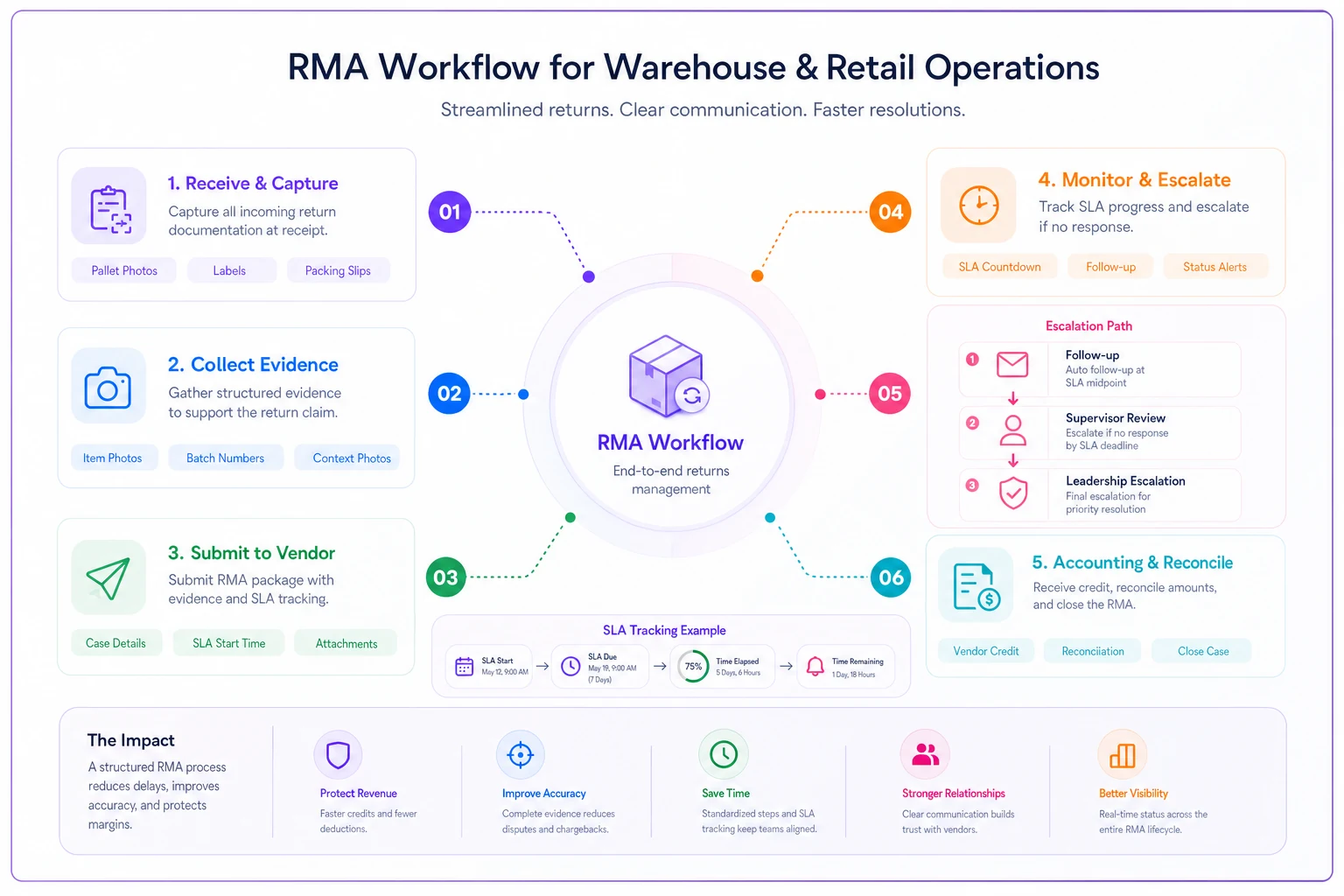
More importantly, they don't forget, don't get overwhelmed, and don't accept vague vendor responses. When every RMA follows the same evidence collection, submission, and escalation pathway, vendors learn they can't simply wait you out.
The real value isn't automating the easy claims—it's maintaining consistency on the difficult ones. When your RMA process runs on workflows instead of memory, recovery rates improve. Not because the software fights harder, but because it closes the gaps vendors exploit.
Small businesses typically leave tens of thousands in uncollected vendor credits on the table each year. Not because vendors won't pay, but because the operational burden of collection exceeds internal capacity. Fix the process, automate the repetition, and those credits turn from write-offs to recovered cash.
Bottom line on vendor RMA recovery
Your suppliers have entire departments dedicated to minimizing credits. You have part of someone's attention when they remember to follow up. That imbalance explains why most SMBs recover less than half their eligible credits.
The solution isn't hiring dedicated RMA specialists or accepting vendor delays as normal. It's building systematic processes that make credit recovery consistent, not heroic. Document everything at receiving. Submit complete claims immediately. Track every timeline. Escalate systematically. Hand off cleanly to accounting.
None of this is complicated. The challenge for small businesses isn't knowing what to do—it's maintaining that consistency when everything else is on fire. That's why the best operators build systems that don't rely on human perfection. They document, track, and escalate automatically, turning vendor credit recovery from an endless battle into a predictable process.
Your vendors are counting on you being too busy to follow up. Prove them wrong with process, not persistence.
Ready to optimize your inventory operations?
Join 2,000+ businesses using Listoly to reduce stockouts, save time, and improve order accuracy.