

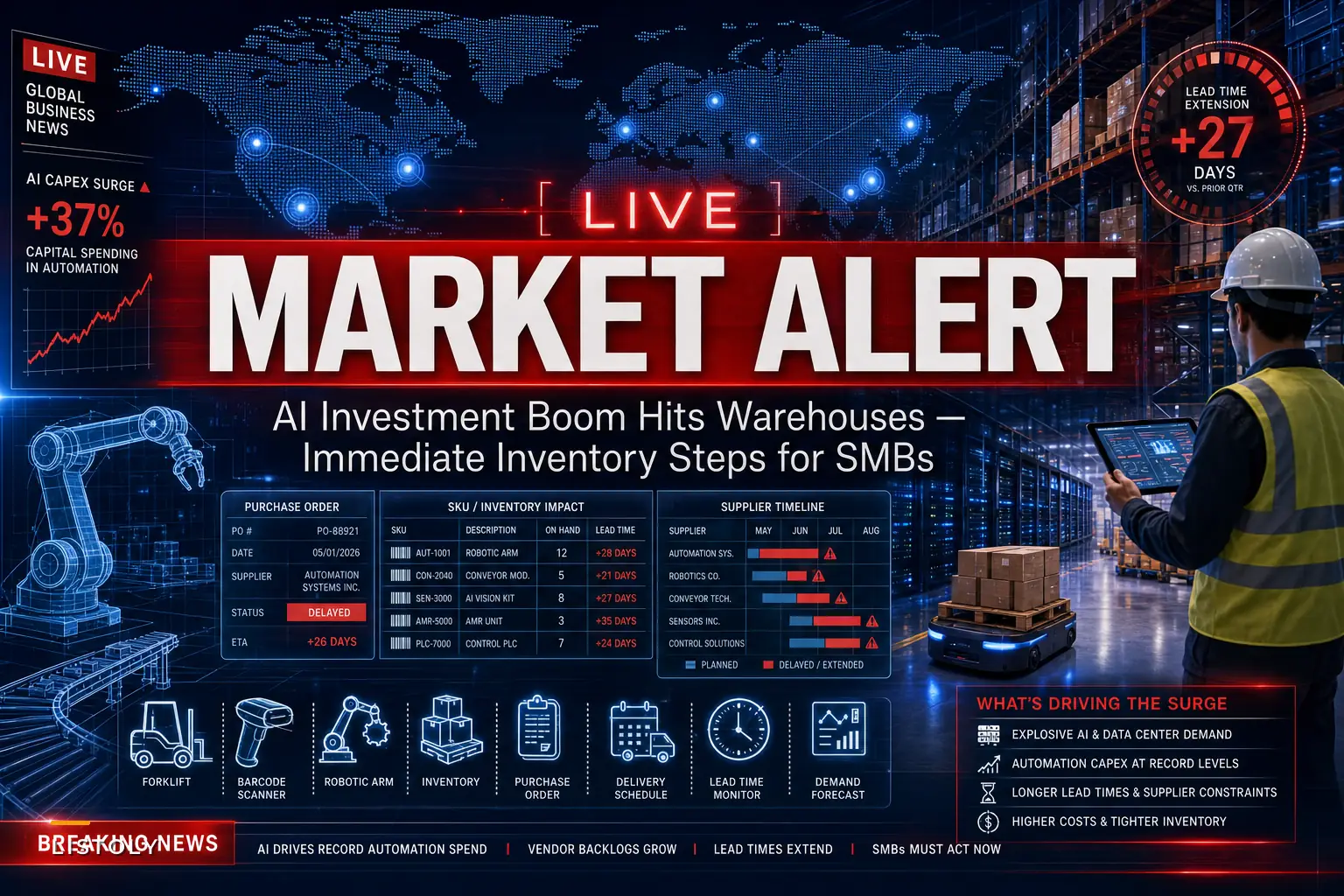

There's something strange happening upstream from your receiving dock right now. The massive spending on AI infrastructure — data centers, robotics, automation hardware — is pulling demand forward across the whole equipment supply chain. Reuters reported in late October that core capital goods orders and shipments accelerated, driven largely by an AI investment boom. That sounds like a macroeconomic story with zero relevance to a 12,000 square foot warehouse running on three forklifts and a part-time receiving clerk.
It has more to do with you than you'd think.
When large buyers flood the market for automation hardware, integration labor, and the industrial PCs that run warehouse equipment, two things happen for small operations: lead times stretch and prices firm up. The quiet third effect — the one most SMB inventory managers never price in — is that larger competitors automating their fulfillment changes how their ordering behaves, which eventually changes the lead times and minimums you see from shared suppliers.
So this isn't a "should we buy a robot" article. Most of you shouldn't, and I'll get to why. This is about what to actually do over the next few quarters when the whole market tilts toward automation capital and you're running lean.
The mistake most small teams are about to make
The reflex, when you read headlines about everyone else automating, is to assume you're falling behind and need to buy something. That's expensive mistake number one. The second is the opposite — deciding none of this applies to you and changing nothing.
The pattern worth noticing: when capital equipment demand spikes, the companies that get burned aren't the ones who bought early or sat still. They're the ones who panic-bought mid-cycle — paying inflated prices for hardware with a 20-week lead time, then discovering the integration contractor is booked out four months because every regional 3PL grabbed them first.
A small distributor doesn't lose on the sticker price of a conveyor. They lose on the gap between "we paid the deposit" and "it actually runs." That gap used to be six to eight weeks. In a hot capital-spending environment it can balloon to five or six months, and during those months you've committed cash, frozen a layout decision, and you're still picking orders by hand.
So the first real move isn't buying. It's understanding how this market shift changes the timing and economics of every decision you were already planning to make.
Where the pressure actually lands on SMB inventory operations
"Automation is booming" is useless until you translate it into things you can act on. These are the specific pressure points worth paying attention to:
Never run out of stock or overorder again.
Listoly streamlines inventory workflows to keep your business stocked and profitable.
- Real-time stock tracking
- Automated reorder alerts
- Supplier and purchase management
No credit card required
-
Longer lead times on anything with a chip in it. Not just robots. Barcode scanners, label printers, networked scales, the server running your WMS — all of it competes for the same components and the same integration techs. Plan replacements earlier than you normally would.
-
Integration labor gets scarce before hardware does. People consistently underestimate this one. You can often find the equipment; what you can't find is someone to install, configure, and connect it to your existing systems. That bottleneck shows up first and clears last.
-
Supplier behavior shifts underneath you. As larger buyers automate fulfillment, some suppliers raise minimums or restructure PO batching to match automated replenishment cycles. Your reorder math quietly stops matching reality. A minimum that was 5 cases becomes 1 pallet. The safety stock assumptions you built months ago no longer fit.
-
Labor-cost planning gets genuinely confusing. On one hand, automation headlines create pressure to cut headcount. On the other, Reuters noted that wage growth moderated in the third quarter, which actually weakens the financial case for replacing people with expensive hardware right now. If labor costs aren't climbing as fast, the payback window on a $40k–$90k automation project stretches out considerably. That math matters more than any trend headline.
Here's a simple way to see the trade-off most small teams are working through:
| Decision | Looks attractive when | Quietly backfires when |
|---|---|---|
| Buy automation hardware now | Hardware lead times are climbing and you have a locked, stable process | Your process still changes monthly, or integration labor is booked out |
| Wait and keep manual | Wage growth is moderate and your volume is flat-to-slow | Volume is spiking and labor availability is your actual constraint |
| Upgrade software first | Your bottleneck is data accuracy and coordination, not physical movement | You already have clean data and the real problem is pick travel |
| Re-slot / re-process | Throughput gains are possible with layout, not capital | You're genuinely at the physical ceiling of the space |
Most SMBs skip straight to the first row. The real wins over the next year are mostly hiding in the bottom two.
The deeper problem the boom exposes: you can't automate a process you don't understand
This is the part nobody puts in the budget conversation. The AI investment boom is pulling attention toward buying capability. But the single biggest predictor of whether a small warehouse actually benefits from any automation — hardware or software — is whether the underlying process is documented, measured, and stable enough to automate in the first place.
What shows up repeatedly across small operations is that the process lives in one or two people's heads. The receiving clerk knows which vendors ship short. The lead picker knows which SKUs are mis-slotted and quietly works around it. None of that is written down anywhere. The moment you automate on top of undocumented tribal knowledge, you automate the workarounds too — except now they're locked into a system and nobody remembers why they're there.
A common example: a specialty food wholesaler adds handheld scanning and system-directed putaway because they heard competitors were automating. The tech works fine. But their SKU master had three different unit-of-measure conventions depending on which buyer originally set up the item. The scanners faithfully enforced all three inconsistencies at machine speed. Receiving errors didn't drop — they got faster and more confident. Around $11k spent before they realized the hardware exposed a data problem, not a labor problem.
That's the underlying lesson of this whole moment. Automation amplifies whatever process you already have. Clean process, good outcome. Messy process, expensive mess at higher speed.
A low-cost sequence to run before you spend real capital
> Workflow: Pre-Automation Readiness Sequence
> [GRAPH: linear flow — Freeze & document error-prone workflows → Establish baseline metrics (2–4 weeks) → Clean master data → Software pilot → Staged capital purchase → Quarterly supplier review]
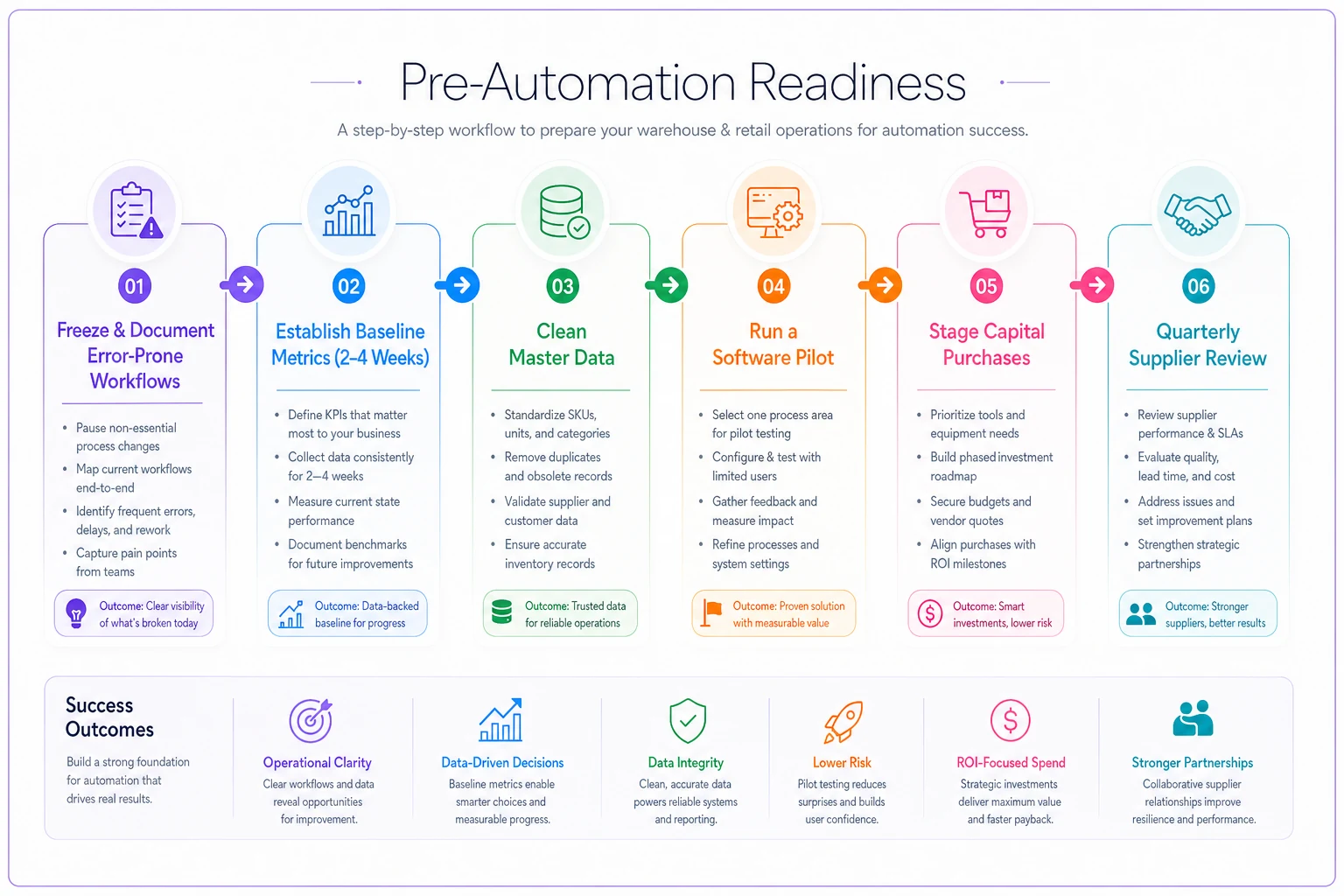
You don't need to match anyone's capital budget to respond well to this environment. You need to get your operation to the point where, when you do spend, the money actually works.
-
Freeze and write down your three most error-prone workflows. Usually receiving, putaway, and pick/pack. Not a polished SOP — just the real steps, including the workarounds. If a workflow can't survive being written on one page, it can't survive automation.
-
Measure the current baseline for two to four weeks. Lines per labor hour, receiving accuracy, cycle count variance, pick errors per thousand lines. You cannot evaluate a future automation claim if you don't know your starting number. Vendors will quote percentage gains against a number you don't have.
-
Clean the master data before touching hardware. Consistent units of measure, consistent location naming, one SKU convention. Boring work. Highest-ROI item on this list.
-
Run a software-level pilot before a hardware-level one. Software upgrades are cheaper, faster to reverse, and often remove the coordination bottleneck that people assume requires physical automation. Many "we need a conveyor" problems are actually "our system doesn't tell the picker where to go" problems.
-
Stage capital purchases in small tranches. In a hot market, avoid one big irreversible commitment. Lock in the piece with the longest lead time first, and only after the pilot confirms baseline improvement.
-
Re-check supplier minimums and reorder logic quarterly, not annually. The market is shifting fast enough that annual reviews won't catch the drift.
Prioritize master data cleanup early—it's the highest ROI and prevents automated systems from amplifying messy exceptions.
Working through this sequence also tends to surface where AI-assisted operational software can genuinely help — not by replacing your team, but by centralizing information that currently lives across spreadsheets, whiteboards, and people's memory. When decision rules are written down and data is clean, tools that automate coordination and flag anomalies actually have something real to work with.
When buying automation actually makes sense right now
Capital isn't the enemy. Timing and readiness are. Buying makes sense when a few conditions line up at once:
-
Your volume is genuinely at or near the physical ceiling of your current labor and space
-
The target process has been stable for several months with no planned changes
-
Your master data is clean enough that you'd trust a machine to act on it unsupervised
-
You have a financing structure that doesn't strangle cash during a longer-than-expected install window
-
You've already captured the easy wins from slotting and software
If three or more of those are false, you're not buying automation — you're buying risk at a premium price.
Who should sit this cycle out
Some operations should deliberately do nothing on the hardware front right now, and that's a legitimate strategy, not a cop-out.
If your SKU mix changes seasonally in ways that would force equipment reconfigurations, physical automation will fight you. If you're running under roughly 2,000 order lines a week, the labor math rarely supports expensive hardware — especially with wage growth cooling. If your process still changes month to month, you're not automating a process, you're automating a guess. And if a single capital commitment would leave you cash-fragile through a slow season, the lead-time risk alone should stop you.
For most teams in these buckets, the right response to the boom is unglamorous: tighten the process, fix the data, and upgrade the software layer where coordination and accuracy actually live. That's where the real constraint usually is anyway.
A short real scenario
A regional auto-parts distributor running two small warehouses felt the pressure when a larger competitor announced automated fulfillment. Their instinct was to price out a goods-to-person system — a quote that came back north of $120k with a lead time pushing five months.
Instead they ran through the sequence above first. Two weeks of baseline measurement showed the real problem wasn't pick travel; it was that their two sites couldn't see each other's stock, so they were double-ordering slow movers and stocking out on fast ones. They spent a fraction of the hardware budget tightening their inventory software and cleaning location data across both sites. Lines per labor hour improved somewhere in the 15–20% range within a couple months, and emergency inter-site transfers dropped noticeably.
The conveyor quote went in a drawer. They may revisit it in a year — but now they'd be automating a process they actually understand, against a baseline they can measure. That's the whole game this cycle. The boom makes capital look urgent. The operations that come out ahead treat it as a prompt to get ready rather than a signal to spend.
Pulling it together
The acceleration in business spending on automation and AI infrastructure is real, and it will touch your lead times, your supplier terms, and your competitive position whether you buy anything or not. But the headline reaction — spend to keep up — is usually the wrong first move for a small team. The market is pulling prices and integration labor in the wrong direction for impulse buyers, and the labor-cost picture doesn't support rushing.
The durable advantage goes to operations that use this moment to document workflows, fix master data, and get decision rules clean enough that automation — when it finally fits — actually pays. If you want a practical framework for keeping automation accountable once you do start upgrading, this breakdown on inventory automation governance for small teams covers how to put guardrails around it so the tools serve the process instead of the other way around.
Spend the next quarter getting ready, not getting sold. In a market this hot, readiness is the cheapest edge you can buy.
Ready to optimize your inventory operations?
Join 2,000+ businesses using Listoly to reduce stockouts, save time, and improve order accuracy.