



Seasonal buying is where a lot of otherwise well-run small businesses quietly lose money. Not because the buyer is bad at forecasting — most are surprisingly good at guessing peak demand — but because the decision to commit weeks or months of cash into a single early purchase order rarely gets stress-tested against three things at once: lead time, storage cost, and how much cash the business can actually afford to freeze.
The usual failure looks like this. A buyer sees a good pre-season price, the vendor pushes a "book by August 15" deadline, and the whole seasonal quantity goes into one PO. It arrives in September, sits in a rented unit until November, and half of it is still there in January at markdown prices. The buy wasn't wrong. The shape of the buy was wrong.
This post is about splitting that commitment intelligently — and running the small set of calculations that tell you whether a split-buy actually helps or just adds freight cost for no real gain.
Why one big seasonal PO usually beats you
The single-shot pre-buy feels efficient. One negotiation, one freight bill, one receiving day. But it front-loads every risk into the earliest, least-informed moment of the season.
A few patterns show up repeatedly with seasonal SMB buying:
-
The vendor deadline drives the quantity, not the demand curve. Buyers round up to hit a price break, then discover the price break saved them $600 while the extra units cost $1,400 in storage and markdown.
-
Cash gets locked before the season proves itself. Commit 100% of the seasonal spend in August and you have zero flexibility to react to an early read on what's actually selling.
-
Storage cost is treated as free. It almost never is. Even owned warehouse space has an opportunity cost — that pallet position could hold faster-moving stock.
The core idea of a split-buy is simple: commit enough early to protect against long lead times and price breaks, then hold a second (and sometimes third) tranche that you release once you have a real sales signal. If you've worked through a replenishment playbook for small businesses handling variable lead times, this is the seasonal cousin of that thinking — same lead-time math, higher stakes because the window closes.
The three numbers that decide the split
Before any tactic, you need three inputs. Most buyers have two of them in their head and ignore the third.
Never run out of stock or overorder again.
Listoly streamlines inventory workflows to keep your business stocked and profitable.
- Real-time stock tracking
- Automated reorder alerts
- Supplier and purchase management
No credit card required
-
Lead time (and its variability). Not the quoted lead time — the real one. If a vendor says 6 weeks but has historically run 6–10, your first tranche has to cover the gap between when you commit and when a reorder could realistically land.
-
Storage cost per unit per month. This is the number people skip. You need a rough monthly holding cost: rent or opportunity cost of the space, plus insurance, plus any handling. Even a crude figure changes decisions.
-
Cash available to freeze. Not total cash — the amount you can commit to seasonal inventory without starving replenishment of your everyday SKUs.
Once you have those, the split almost designs itself.
A worked example: seasonal candles for a home-goods shop
A small home-goods retailer buys a seasonal candle line for the Oct–Dec window.
-
Expected season demand
1,200 units
-
Unit cost
$6.50, with a price break to $6.10 if they commit 1,200+ up front
-
Vendor lead time
7 weeks, historically 7–11
-
Storage
overflow space at roughly $0.18 per unit per month for anything held before the selling window
-
Selling window opens mid-October
The tempting single buy: 1,200 units at $6.10 = $7,320, committed in early August. The $0.40/unit break saves $480 versus the standard price.
But look at what August-to-October storage actually does. If most of those 1,200 units sit for roughly 2 months before selling:
1,200 units × $0.18 × 2 months = $432 in storage.
The price break saved $480 and storage ate $432. The "deal" netted about $48. And that ignores markdown risk on whatever doesn't sell — plus the fact that $7,320 is locked in August.
The split-buy version:
-
Tranche 1 (commit early) 700 units. Covers the opening weeks plus lead-time coverage for a reorder. Take the smaller-volume price of $6.50.
-
Tranche 2 (release ~week 2 of selling) up to 500 units, ordered only if the early read supports it.
Storage is smaller because Tranche 1 is smaller and Tranche 2 arrives closer to when it sells. Cash committed in August drops from $7,320 to about $4,550. You lose the price break, but you also drop most of the storage cost and nearly all of the markdown exposure on the back half.
The point isn't that the split always wins. It's that once you put storage and frozen cash next to the price break, the "obvious deal" often isn't one.
Side-by-side: single buy vs split buy
Putting the two approaches next to each other makes the trade-off pretty clear. The single buy wins on price per unit. Everything else tilts toward the split.
| Factor | Single pre-buy (1,200) | Split buy (700 + 500) |
|---|---|---|
| Cash committed in August | ~$7,320 | ~$4,550 |
| Price break captured | Yes (~$480) | No |
| Est. pre-season storage | ~$432 | ~$180–$220 |
| Markdown risk (back half) | High | Low |
| Freight events | 1 | 2 |
| Ability to react to early sales | None | Strong |
The one column that favors the single buy is freight — you pay to ship twice. That's the trade you're actually weighing: extra freight and a lost price break against lower storage, lower markdown risk, and cash you can actually use elsewhere.
Worth noting that the storage estimate for the split buy assumes Tranche 2 is timed reasonably well. If you're sloppy about the release date and Tranche 2 sits for six weeks before selling, the gap narrows fast.
When the single big buy is actually the right call
Split-buys aren't a religion. There are clear cases where committing the full season up front makes more sense:
-
Lead time is longer than your season. If the vendor runs 12 weeks and your selling window is 8, a second tranche literally can't arrive in time. Buy it all.
-
The item is genuinely scarce or allocation-limited. If missing the pre-book means no product at all, protection beats optimization.
-
Storage is nearly free and the item doesn't go obsolete. Non-perishable, non-dated stock with plain packaging and evergreen colors that you'll sell eventually carries almost no markdown risk.
-
The price break is large enough to survive the storage math. Run the numbers. If the break clears storage and leaves real margin, take it.
For brand-new seasonal SKUs with no history, the calculation gets shakier because your demand number is a guess. That's a different problem — worth reading forecasting inventory for product launches and new SKUs with no sales history before you size any tranche, because a split-buy on top of a bad forecast just means you're wrong twice.
When a split-buy is a bad idea
Not every situation calls for a split. A few scenarios where it actually makes things worse:
-
Your reorder lead time can't beat the season's back half. If Tranche 2 would arrive in the last two weeks, the flexibility is fake.
-
The second freight cost wipes out the storage savings. Small-parcel or LTL freight on a modest Tranche 2 can cost more than the storage you avoided. Do the math both ways.
-
Nobody is actually watching the early signal. A split only pays off if someone is tracking week-1 and week-2 sell-through and pulling the trigger on Tranche 2 in time. No owner watching means no benefit.
The third one is probably the most common failure mode. Teams design a clean two-tranche plan in August, then get buried in the season and never make the second call on time.
A repeatable pre-buy evaluation checklist
Run this for every seasonal SKU before committing. It takes about ten minutes per item once you've done it a couple of times.
-
[ ] What's the realistic lead time, including the high end of the historical range?
-
[ ] Can a reorder land while the selling window is still open? (If no → lean single buy.)
-
[ ] What's the all-in storage cost per unit per month for pre-season holding?
-
[ ] How much cash can I freeze without hurting core replenishment?
-
[ ] What's the price break, in dollars, versus the added storage of buying it all early?
-
[ ] What's my markdown exposure if I overbuy by 20%?
-
[ ] If I split, does Tranche 2's freight cost stay below the storage I'm avoiding?
-
[ ] Who is responsible for reading early sell-through and releasing Tranche 2 — and by what date?
If that last box has no name and no date next to it, don't split. You'll end up scrambling and reordering late.
The tranche-sizing process
Sizing each tranche is less complicated than it sounds, but there's a sequence that keeps things honest. Skipping steps — especially steps 5 and 6 — is where most teams get burned.
-
Estimate total season demand and pick a conservative number, not your optimistic one.
-
Calculate lead-time coverage — how many units you need to survive from season open until the earliest a reorder could arrive. That's your minimum Tranche 1.
-
Add opening-weeks demand to Tranche 1 so you don't stock out during the first traffic spike.
-
Assign the remainder to Tranche 2 (and Tranche 3 if the season is long enough to support it).
-
Set a decision date for Tranche 2 based on when you'll have a real read and still leave time for it to arrive.
-
Set a kill rule — if week-2 sell-through is below X%, you skip or shrink Tranche 2 rather than committing out of habit.
Here's a simple visual of the tranche-sizing sequence.
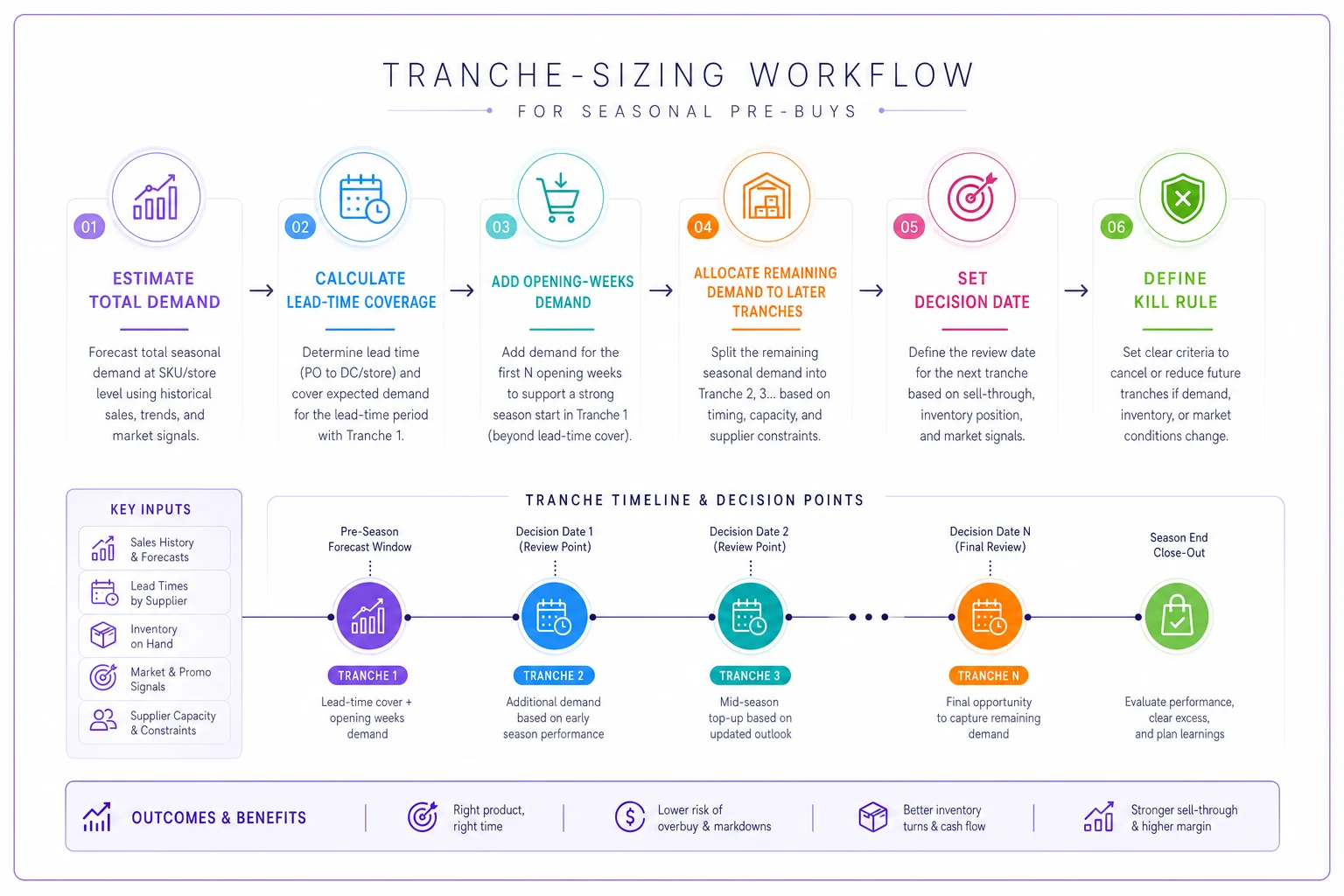
Steps 5 and 6 are where most teams fall apart. They design a clean split and then never make the second decision on time. The kill rule especially — it forces you to define what "bad early signal" actually looks like before the season starts, not in the middle of it when you're already second-guessing everything.
A short real scenario
A regional pet-supply store used to pre-buy its entire winter coat-and-sweater line in one August PO — roughly $11k, arriving early September, most of it sitting in a rented overflow unit until real cold hit in November.
Two problems kept repeating. First, overflow storage for nearly three months on stock that couldn't sell yet. Second, sizing was always slightly off — they'd end January with a pile of XL sweaters and no smalls, then discount the leftovers.
They shifted to a two-tranche approach: about 60% committed in August (enough to cover their longer vendor lead time and the first cold snap), and the balance released in early November once they could see which sizes and styles were actually moving.
The results weren't dramatic on paper, but they were real. Pre-season storage dropped by close to half. End-of-season markdown stock shrank because the second tranche matched the actual size mix instead of the August guess. The cash freed up in August went into their fast-moving everyday SKUs, which they'd been under-buying to fund the coat order. No single number jumped, but the season stopped ending with a corner full of clearance sweaters.
Keeping the numbers straight without spreadsheet chaos
The math here isn't hard — it's the tracking that breaks down. Lead-time history lives in someone's memory, storage cost is a rough estimate, and the Tranche 2 decision date gets forgotten somewhere in a busy October.
This is where an inventory platform earns its keep on seasonal buys: maintaining actual lead-time history per vendor, flagging when a tranche decision date is approaching, and surfacing early sell-through against your plan so the release-or-skip call is based on data instead of a gut feeling on a Friday afternoon.
Keep lead-time history, storage cost, and tranche decision dates in one place so the second-tranche call isn't forgotten.
You don't need anything fancy. You need the three inputs — lead time, storage cost, committed cash — sitting in one place next to real sell-through, so the split-buy decision doesn't rely on remembering everything at once. When that information is scattered across a spreadsheet, a vendor email thread, and someone's head, the second tranche decision almost always happens late or not at all.
The value in seasonal pre-buying isn't finding the lowest unit price. It's shaping the commitment so that lead time, storage, and cash all get a vote — not just the vendor's price sheet and their booking deadline. Run the three numbers, split when the math and the season actually support it, buy it all when they don't, and put a name and a date on the second decision. Do that consistently and the season stops surprising you every year.
Ready to optimize your inventory operations?
Join 2,000+ businesses using Listoly to reduce stockouts, save time, and improve order accuracy.