
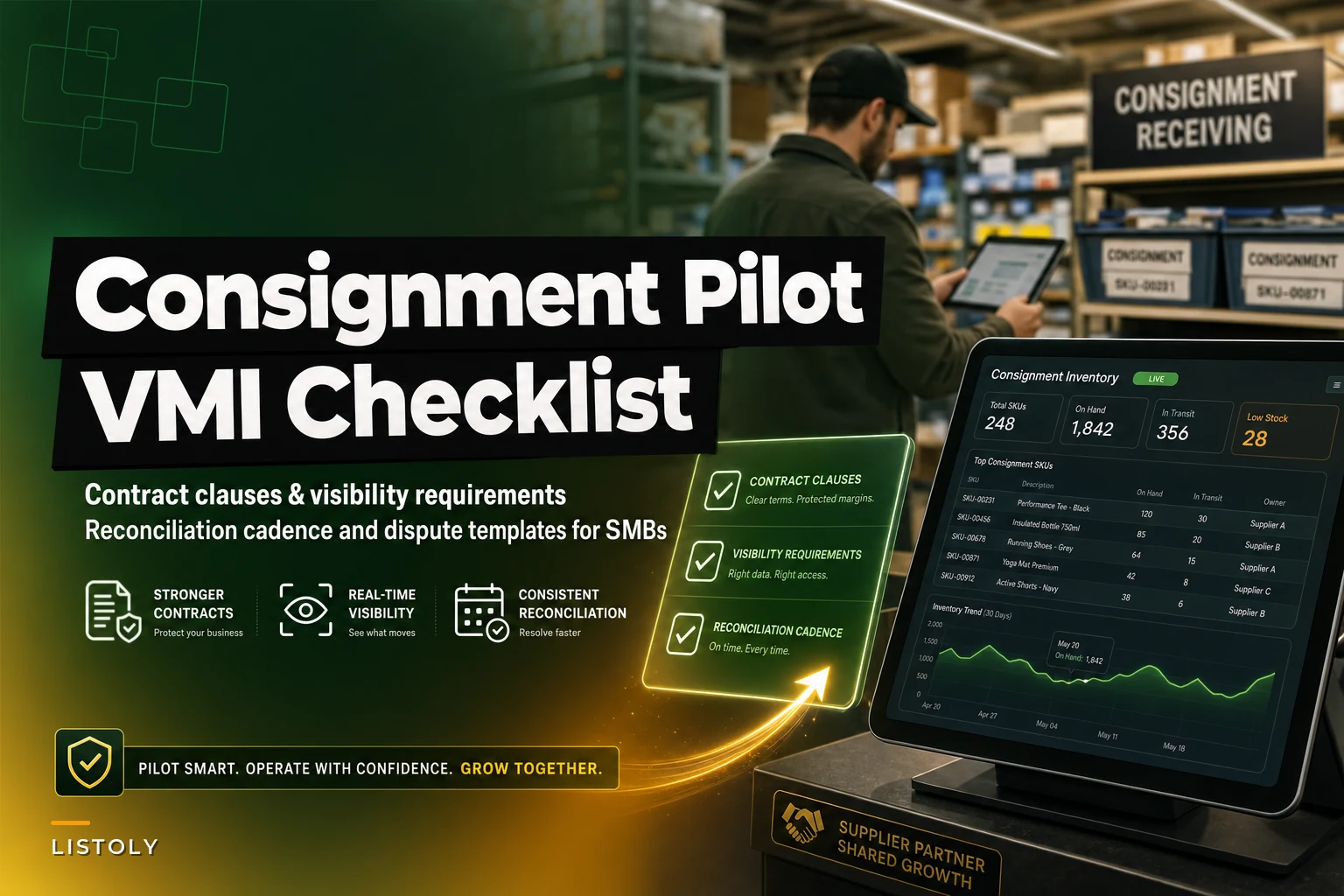

When a supplier pitches consignment or VMI (vendor-managed inventory), the promise sounds perfect: inventory without upfront cash, automatic replenishment, reduced carrying costs. But the operational reality gets messy fast.
Small manufacturers and distributors approach SMBs with consignment offers because they want guaranteed shelf space and sales data. The buyer gets essentially free inventory financing. Theoretically everyone wins. Except consignment inventory SMB pilots fail constantly because nobody sets clear operational boundaries upfront.
The problem isn't the concept. It's that most small businesses jump into consignment deals without establishing the right tracking mechanisms, reconciliation schedules, or dispute processes. You end up with phantom inventory, payment disputes, and suppliers who suddenly change terms mid-pilot because "the system isn't working as expected."
Why consignment pilots go sideways for small operations
The fundamental disconnect happens because consignment flips traditional inventory ownership on its head. Your warehouse staff treats consignment stock differently than owned inventory—sometimes they don't track it at all. Your accounting system might not even have proper consignment categories set up. Meanwhile, the supplier expects perfect visibility into their stock levels and immediate payment upon sale.
Small businesses typically discover these gaps after launching the pilot. A specialty food distributor working with three consignment suppliers lost track of around $47,000 worth of inventory in their first quarter because their warehouse management system couldn't distinguish consignment from owned stock. The reconciliation process turned into a monthly nightmare of spreadsheets, emails, and disputed counts.
The operational burden hits differently at small scale. Enterprise retailers have dedicated vendor management teams and sophisticated VMI platforms. Small businesses usually assign consignment management to whoever handles purchasing, and that person already has a dozen other responsibilities. When reconciliation time comes, they're comparing the supplier's records against three different internal systems that don't talk to each other.
Contract clauses that actually protect small buyers
Most consignment agreements favor the supplier because they wrote the contract. Small buyers often sign standard templates without understanding the operational commitments they're making.
Never run out of stock or overorder again.
Listoly streamlines inventory workflows to keep your business stocked and profitable.
- Real-time stock tracking
- Automated reorder alerts
- Supplier and purchase management
No credit card required
The payment trigger clause determines everything. Some contracts require payment upon sale to end customer. Others trigger payment when you move inventory from receiving to active stock locations. That distinction matters enormously for cash flow. One small electronics retailer discovered their consignment agreement required payment within 3 days of "deployment to sales floor" even if products sat unsold for months.
Here's what needs explicit definition in any pilot agreement:
Ownership transfer points: Exactly when does title pass? Upon sale? Upon damage? Upon theft? Upon expiration? Each scenario needs clear ownership rules.
Inventory count responsibility: Who performs counts, how often, and what happens with discrepancies? Without this, you'll spend hours arguing over missing units.
Return and defect handling: Can you return slow-moving consignment inventory? Who bears the cost of defective units discovered after receiving?
Data sharing requirements: What sales and inventory data must you provide? Daily? Weekly? In what format? Through which systems?
Pilot termination conditions: How much notice for ending the pilot? Who pays for return shipping? What happens to unsold inventory?
A wholesale beauty supplier shared a template that includes automatic termination if reconciliation disputes exceed 5% of inventory value for two consecutive months. That's the kind of specific protection small buyers need.
Building visibility without enterprise systems
The biggest operational challenge with consignment inventory SMB programs is maintaining accurate visibility across locations and systems. You need to track what's yours versus what's theirs, monitor sales velocity, and reconcile constantly—all without the sophisticated VMI platforms large companies use.
Start with location segregation. Physical separation makes tracking infinitely easier. Dedicate specific rack locations or bin ranges exclusively to each consignment supplier. Mark them clearly. Train warehouse staff that these locations require special handling and counts. A small auto parts distributor cut their reconciliation time by around 70% just by moving all consignment inventory to clearly marked yellow racks.
Your inventory system probably wasn't designed for consignment, but you can usually work around it. Create distinct SKUs for consignment items—prefix them with "CS-" or something similar. Set their cost to $0.01 (not zero, which causes calculation errors in many systems). Track quantities normally but run separate reports for consignment SKUs.
Prefix consignment SKUs with "CS-" and set their cost to $0.01 to avoid calculation errors and simplify reporting.
Build a simple reconciliation spreadsheet that pulls from three sources:
-
Your inventory system's consignment SKU quantities
-
Your POS or sales system's consignment sales
-
The supplier's inventory feed or portal
The gaps between these three numbers tell you exactly where problems hide. Receiving errors show up as differences between supplier feeds and your inventory system. Warehouse mistakes appear as discrepancies between inventory and POS data.
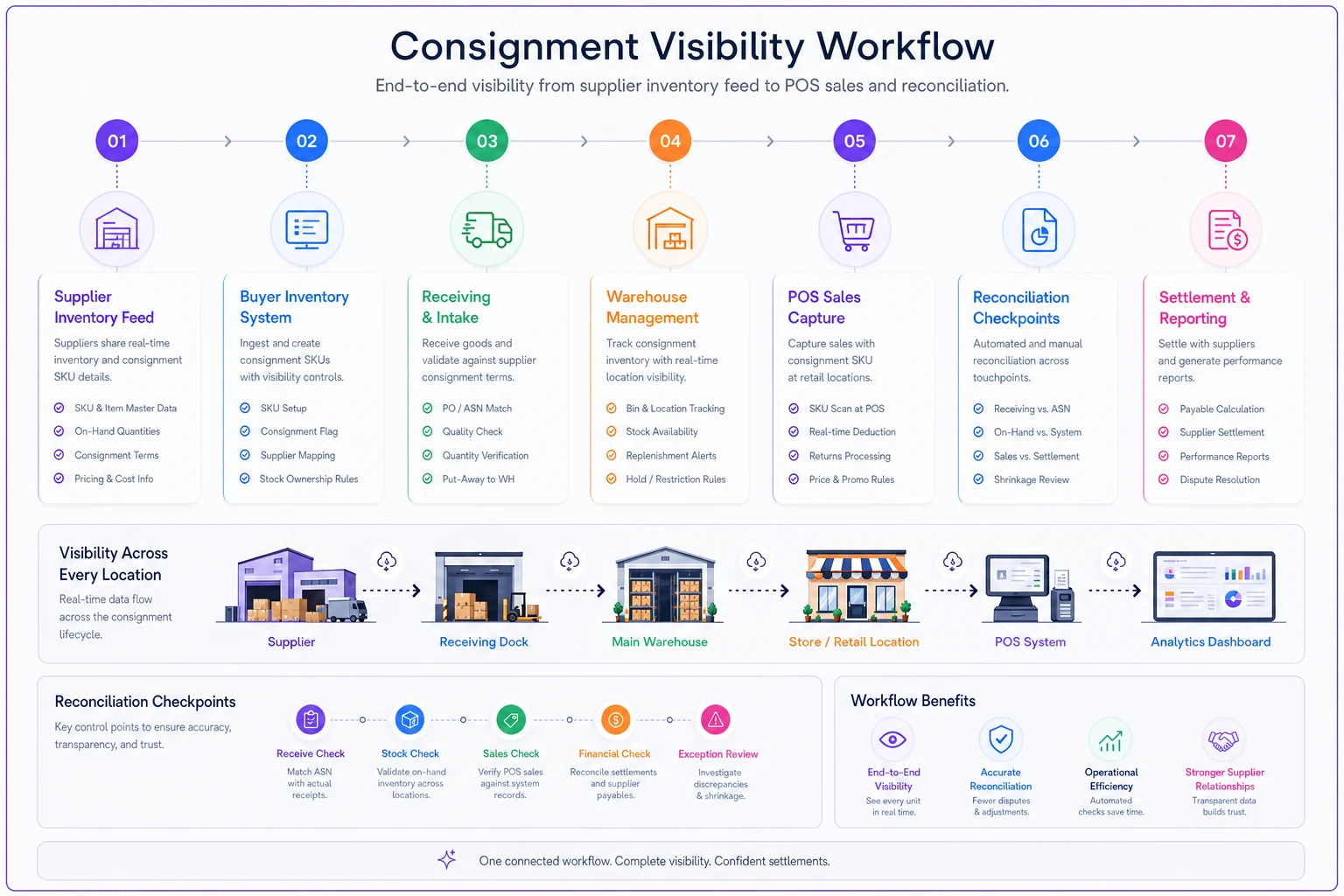
This simple workflow highlights the three data sources and where reconciliation checks should occur.
Reconciliation cadence that prevents disputes
Weekly reconciliation sounds excessive until you've dealt with a two-month inventory dispute where nobody can figure out what actually happened. The longer you wait between reconciliations, the harder problems become to diagnose.
For pilots, this cadence works well:
Daily: Quick spot-checks of high-value or fast-moving consignment items. Takes 10 minutes. Compare yesterday's sales to inventory decrements.
Weekly: Full reconciliation of quantities across all systems. Export your consignment SKUs, compare to supplier records, flag any variances over 2 units or $100.
Monthly: Complete financial reconciliation including sales, payments, returns, and adjustments. Generate aging reports for unpaid consignment sales.
A sporting goods retailer running consignment pilots with four suppliers holds Monday morning reconciliation meetings—45 minutes total. They review the previous week's movements, resolve discrepancies on the spot, and approve payment runs. Small issues get fixed before they compound.
The key is making reconciliation systematic, not reactive. When you only reconcile after the supplier complains, you're already in dispute territory. Proactive reconciliation lets you catch process gaps while the trail is still warm.
Dispute resolution templates that work
Even with solid processes, disputes happen. Inventory disappears. Systems glitch. Counts don't match. Having dispute templates ready prevents these issues from killing the pilot relationship.
Create standard templates for common disputes:
Inventory variance template:
-
Date discrepancy discovered
-
Your system quantity vs. supplier claimed quantity
-
Last known accurate count date
-
Investigation steps taken
-
Proposed resolution
Payment timing dispute template:
-
Invoice number and date
-
Claimed payment trigger event
-
Your record of trigger event
-
Supporting documentation
-
Payment proposal
Damage/defect claim template:
-
Items affected and quantities
-
When damage discovered
-
Photo documentation
-
Proposed responsibility split
-
Return/disposal plan
A small hardware distributor avoided a $12,000 dispute by having clear documentation templates ready. When their supplier claimed 200 missing units, they produced receiving records, cycle count histories, and sales reports within two hours. The supplier found the error in their own system.
Beyond templates, establish escalation paths before disputes arise. Who makes decisions on variances under $500? Over $5,000? When does senior management get involved? Define these thresholds in the pilot agreement.
Technology gaps that derail consignment programs
Most SMBs hit the same technology limitations when piloting consignment inventory. Your accounting system doesn't properly track consignment payables. Your warehouse system can't handle split ownership. Your reporting tools weren't built for vendor-specific analysis.
These gaps create manual workarounds that don't scale. One outdoor equipment retailer spent 15 hours monthly reconciling consignment inventory across three Excel sheets because their inventory system couldn't generate consignment-specific reports. The labor cost ended up exceeding the financing benefit.
The integration problem compounds when suppliers require EDI or API connections for inventory feeds. Small businesses rarely have the technical resources to build custom integrations for a pilot program. You end up manually downloading reports from supplier portals and uploading them to your systems.
This is where AI-powered operational platforms solve real problems. Instead of building complex integrations, modern platforms can automatically pull data from multiple sources—supplier portals, inventory systems, sales platforms—and reconcile them using intelligent matching rules. The system flags discrepancies, suggests resolutions, and maintains audit trails without the manual spreadsheet grind.
Pilot structure that enables clean exits
Structure your consignment pilot with defined phases and exit points. Too many SMBs sign open-ended agreements that become operational dead weight when the economics don't work out.
| Phase | Duration | Actions |
|---|---|---|
| Phase 1 (Months 1-2) | Months 1-2 | Start with 5-10 SKUs maximum; Focus on establishing counting and reconciliation processes; Weekly reviews with supplier; Document every process gap |
| Phase 2 (Months 3-4) | Months 3-4 | Add SKUs if Phase 1 reconciliation stays under 2% variance; Test return and defect processes; Reduce reconciliation to bi-weekly if things are clean; Calculate true operational costs |
| Phase 3 (Months 5-6) | Months 5-6 | Run complete cost-benefit analysis; Include labor costs for reconciliation; Factor in dispute resolution time; Compare to traditional purchasing models |
Phase 1 (Months 1-2): Limited SKU test
-
Start with 5-10 SKUs maximum
-
Focus on establishing counting and reconciliation processes
-
Weekly reviews with supplier
-
Document every process gap
Phase 2 (Months 3-4): Expanded trial
-
Add SKUs if Phase 1 reconciliation stays under 2% variance
-
Test return and defect processes
-
Reduce reconciliation to bi-weekly if things are clean
-
Calculate true operational costs
Phase 3 (Months 5-6): Full pilot evaluation
-
Run complete cost-benefit analysis
-
Include labor costs for reconciliation
-
Factor in dispute resolution time
-
Compare to traditional purchasing models
Build specific exit criteria into the agreement. If reconciliation takes over X hours monthly, either party can terminate with 30 days notice. If payment disputes exceed Y% of volume, automatic pilot suspension. These guardrails protect both parties from dragging out a failing experiment.
The real economics of consignment for SMBs
The financing benefit seems obvious—no upfront cash for inventory. But the operational costs often eat into those savings for small businesses without proper systems.
Calculate the true cost before committing to post-pilot expansion:
Hidden operational costs:
-
Reconciliation labor (typically 8-20 hours monthly per supplier)
-
System modifications and integration costs
-
Dispute resolution time
-
Additional insurance for non-owned inventory
-
Opportunity cost of dedicated warehouse space
Actual benefits:
-
Eliminated inventory financing (typically 8-15% annually)
-
Reduced obsolescence risk
-
Improved cash conversion cycle
-
Access to products you couldn't otherwise afford
A specialty tool retailer ran these numbers after a six-month pilot. The consignment program freed up $85,000 in working capital—worth roughly $9,000 annually in financing costs. But reconciliation and disputes consumed 18 hours monthly, around $7,200 in labor. Add system modifications and insurance, and the program barely broke even.
The math improved dramatically once they implemented automated reconciliation through their operational platform, cutting manual work to about 3 hours monthly. Same program, $6,000 in annual net benefit.
Making the consignment decision
Consignment inventory SMB success depends entirely on operational readiness, not the supplier's sales pitch. Before signing any pilot agreement, honestly assess your capacity for the additional operational burden.
Ask yourself:
-
Can our systems distinguish consignment from owned inventory?
-
Do we have bandwidth for weekly reconciliations?
-
Can we dedicate specific storage locations?
-
Will our accounting properly track consignment payables?
-
Can we generate the reports suppliers require?
If you answered no to any of these, fix the gaps before starting a pilot. The operational chaos of poorly managed consignment damages supplier relationships and burns internal resources fast.
The suppliers pushing hardest for consignment often have the most to gain—they're trying to secure shelf space and sales data without traditional retailer commitments. That's not necessarily bad, but understand their motivation. They'll promise "simple" and "automated" processes that rarely materialize for small businesses.
Consignment works well in specific scenarios: high-value slow-moving items where financing costs kill margins, new product categories where demand is uncertain, seasonal items with short selling windows. The SKU rationalization strategies that identify carrying cost problems often point directly to consignment opportunities.
The path forward
Smart consignment pilots start small, establish clear boundaries, and maintain rigorous reconciliation discipline. The contract clauses, visibility systems, and dispute processes outlined here prevent the common failures that plague consignment inventory SMB arrangements.
The businesses succeeding with consignment treat it as an operational enhancement, not a financing shortcut. They've built the processes, trained the teams, and invested in systems that make consignment manageable at small scale. When suppliers see clean reconciliations and prompt payments, they offer better terms and expanded programs.
Your next step is an honest evaluation of operational readiness. If you lack the systems or bandwidth for proper consignment management, traditional purchasing with solid replenishment planning will serve you better. But if you can implement the controls outlined here, consignment offers real working capital advantages without the typical operational headaches.
The difference between consignment success and failure isn't the supplier or the terms—it's the operational discipline you bring to the pilot. Build that first, and consignment becomes a useful tool for inventory optimization rather than a source of perpetual disputes and reconciliation pain.
Ready to optimize your inventory operations?
Join 2,000+ businesses using Listoly to reduce stockouts, save time, and improve order accuracy.