



A supplier promises to shave a week off lead time. Maybe they upgraded a line, moved a warehouse closer, or switched to air freight on a certain lane. The temptation is to believe them, drop your safety stock, and pocket the working-capital savings.
That's usually where things go sideways.
The gap between a quoted lead time and a reliable lead time is where inventory managers get burned. A supplier can hit 14 days three orders in a row and then quietly slip back to 21 the moment their own demand picks up. If you've already rebuilt your reorder logic around the shorter number, you're now under-buffered on exactly the SKUs you leaned on hardest.
A properly designed pilot solves this. Not a gut-feel "let's see how it goes," but a controlled test with pre-chosen SKUs, capped volumes, tracked metrics, and — the part almost everyone skips — a written rollback rule that fires automatically when the numbers turn.
This is a walkthrough of how to run that pilot without over-engineering it.
Why lead-time claims break down in practice
The core issue is that lead time isn't a single number. It's a distribution. When a supplier says "we can do 14 days," they usually mean best case, or an average across their whole book — not the specific reliability you'll see on your SKUs at your order cadence.
In real operations, the reduction breaks down in a few predictable ways:
-
The faster time holds for small orders but collapses at full carton quantities.
-
It works while their factory is quiet and evaporates during their peak season, which may not line up with yours.
-
The "reduction" is really just them holding a bit of your finished goods on their side, which disappears the moment another customer draws it down.
-
Transit variance stays the same even though production time drops, so total landed time barely moves.
The most common mistake is treating one fast order as proof. One good PO tells you the fast time is possible. It tells you nothing about whether it's dependable. And dependability — the variance, not the mean — is what your safety stock is actually protecting against.
What you're really measuring
A lead-time pilot has one job: replace a promise with evidence. To do that cleanly, you need to decide upfront what "success" looks like in numbers, not in vibes.
Never run out of stock or overorder again.
Listoly streamlines inventory workflows to keep your business stocked and profitable.
- Real-time stock tracking
- Automated reorder alerts
- Supplier and purchase management
No credit card required
Lead-time variance, not just the average. If the mean drops from 21 to 15 days but the spread widens from ±2 days to ±6 days, you may have gained nothing usable. Wide variance forces you to keep safety stock high regardless of the shorter mean. This is the metric people forget, and it's the one that matters most for planning.
Fill rate on the pilot orders. Did they actually ship complete, on time, at the promised quantity? A shorter lead time that comes with short-shipments or split deliveries isn't a win — it's a new problem wearing a bow.
Landed cost per unit. Faster often means a different freight mode, expedited handling, or a smaller order that loses a price break. If the reduction costs you an extra $0.40/unit and saves you a day of buffer you didn't need, you've paid for nothing.
Here's a rough scoring frame that works for most SMBs:
| Metric | Baseline (current) | Pilot target | Rollback trigger |
|---|---|---|---|
| Mean lead time | Your current avg (e.g., 21 days) | Supplier's claim (e.g., 15) | Slips above baseline − 20% |
| Lead-time variance (std dev) | Current spread | Equal or tighter | Widens by more than 50% |
| Fill rate (complete + on time) | Current % | ≥ 95% on pilot POs | Any two consecutive misses |
| Landed cost / unit | Current | ≤ current +2% | Exceeds current +5% |
The numbers in that table are placeholders — plug in your own baseline first. Which brings up the single biggest prep step people skip.
Get your baseline before you touch anything
You cannot measure a reduction if you never measured the "before." Pull the last 8–12 POs for the candidate SKUs and calculate:
-
Order date → actual received date (that's your real lead time, not the PO's stated one)
-
The spread across those orders
-
How often they arrived complete vs. short
-
The all-in landed cost, freight included
Most inventory teams think they know their lead times, but the stated number in the system is frequently the original quote from onboarding, not reality. It's pretty common to find a supplier listed at 18 days who's actually been running 24 for the last quarter. If your baseline is fiction, your pilot conclusion will be too.
If you're already tracking replenishment against variable lead times, you'll have most of this data. If not, our replenishment playbook for handling variable lead times covers how to capture actual received dates cleanly so this step doesn't turn into archaeology.
Selecting SKUs for the pilot
The instinct is to test the reduction on your most important, highest-volume SKU because that's where the savings are biggest. That's exactly the wrong instinct.
Better selection criteria:
-
Mid-velocity SKUs — enough order frequency to generate 3–4 pilot POs in a reasonable window, but not so critical that a stockout is a crisis.
-
SKUs with a clean order history so you can actually compute a baseline.
-
SKUs from a single supplier if you're testing a supplier's capability, so you're not confounding results across vendors.
-
Items you can safely over-buffer during the pilot — keep extra cover while testing the faster time, so a slip doesn't hit customers.
Pick 3 to 5 SKUs. Fewer than three and one weird order skews everything. More than five and the pilot gets heavy to track for a small team.
One nuance worth flagging: avoid SKUs that are seasonal or promo-linked during the pilot window. Demand spikes distort both your ordering pattern and the supplier's ability to deliver, and you won't be able to separate a lead-time miss from a volume problem. The same reasoning applies to brand-new items with no history — those belong in a different process entirely, closer to how we handle forecasting for launches with no sales data.
Controlling the volume
Order size is the other confounder. Suppliers can often deliver a small order faster than a normal one — so if your pilot POs are unusually light, you'll get a fast time that won't hold at real volume.
-
Order at your normal quantity range, not artificially small.
-
Run at least 3 pilot POs so you're measuring a pattern, not a single event.
-
Keep quantities within ±15% of your typical order so size isn't a hidden variable.
-
Space the orders to match your real cadence — don't cram three POs into two weeks to finish faster, because that's not how you'd actually order.
Pro-tip: note known supplier busy windows in your planning calendar so you can purposely schedule at least one pilot PO during a stress period.
If you can, slip one pilot PO during the supplier's known busy period. That's the order that tells you whether the reduction survives stress.
A short real scenario
A regional homewares distributor ordered a line of ceramic planters from an overseas supplier who'd quoted a drop from "about 28 days to 18." Their system had the SKU set at 25 days.
They ran four pilot POs at normal quantity over roughly ten weeks. What they found:
-
Two orders landed at 17–19 days — right on the claim.
-
One landed at 22.
-
One, placed just before the supplier's peak, came in at 29 and short-shipped by about 12%.
Mean came out around 21–22 days — better than the old 25, but nowhere near 18. And the variance was worse than baseline, driven entirely by that peak-season order.
The read was clear: they could safely reset the planning lead time to about 22 days and trim a little buffer, but keep extra cover heading into the supplier's busy months. Landed cost was flat. Had they believed the 18-day quote and cut safety stock to match, that short-shipped peak order would've put them out of stock during their own strong Q4.
Writing the rollback rule before you start
This is the step that separates a real experiment from wishful thinking. Decide in advance what result sends you back to the old settings, and write it down where the whole team can see it.
> "If two consecutive pilot POs exceed the baseline mean, OR fill rate on any two orders drops below 90%, OR landed cost per unit rises more than 5% over baseline — revert reorder point and safety stock to pre-pilot values and flag for review."
Why pre-commit? Because when the first slow order shows up, there's always a story. "They had a one-off issue." "It was the holiday." "The next one will be fine." Every one of those might be true. But without a written trigger, you'll rationalize your way past three bad orders and only notice when you stock out. The rule takes the emotion out of the call.
Keep the rollback mechanically simple: the pre-pilot reorder point and safety stock should be saved somewhere retrievable, so reverting is a two-minute change, not a rebuild.
The pilot, start to finish
Running this well doesn't require a fancy process — it just requires doing the steps in order and not skipping the uncomfortable ones (baseline math, over-buffering, writing the rollback rule down). Here's the full sequence:
Below is a simple visual of the pilot workflow to keep the team aligned.
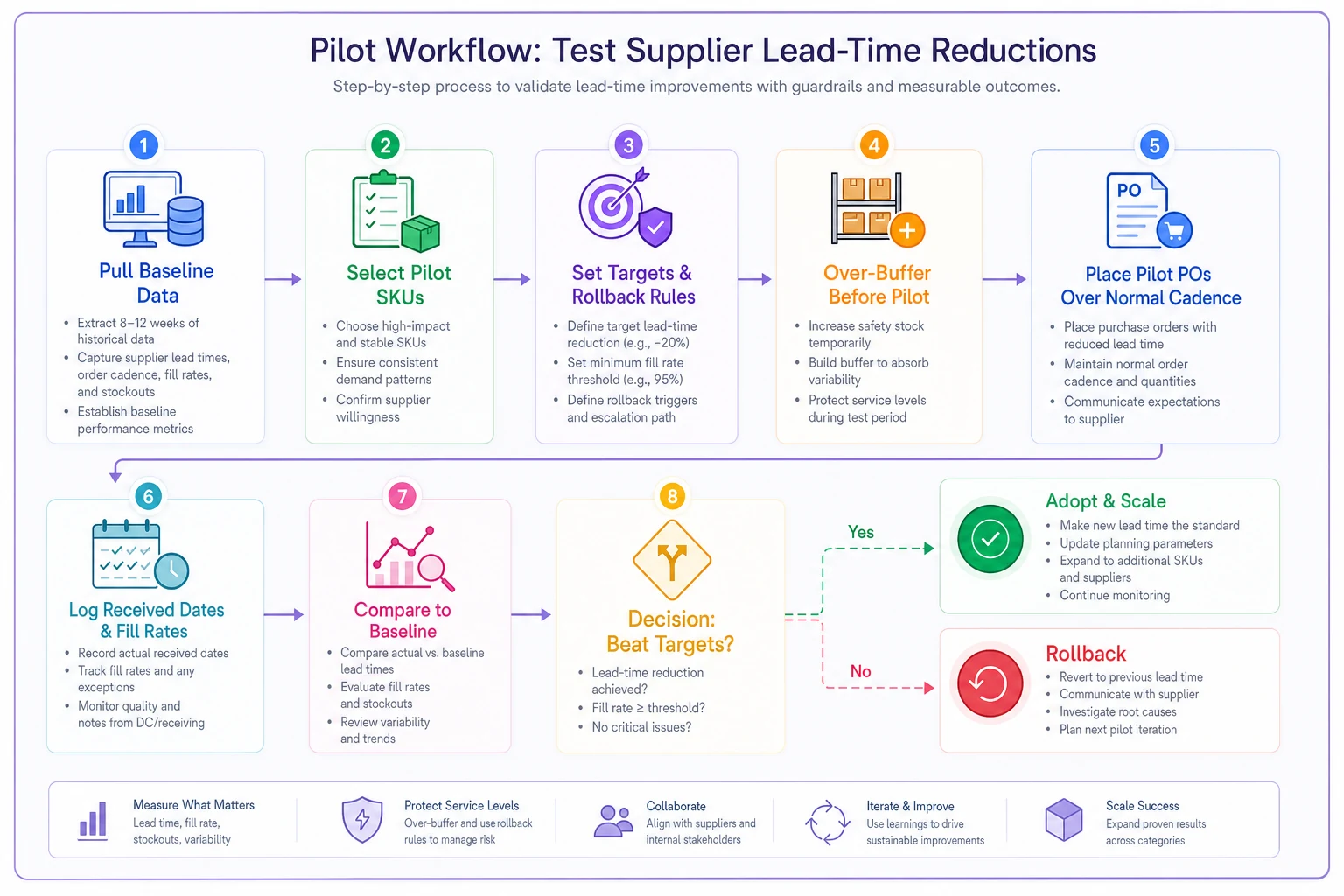
Use this flow as a checklist while running the pilot so nothing important gets skipped.
-
Pull baseline from the last 8–12 real POs per candidate SKU (received dates, variance, fill, landed cost).
-
Select 3–5 mid-velocity SKUs from one supplier, no seasonal or promo items.
-
Set pilot targets and rollback triggers in a shared doc before ordering.
-
Over-buffer the pilot SKUs so customers are protected while you test.
-
Place 3–4 POs at normal quantity, spaced at real cadence, one during the supplier's busy window if possible.
-
Log actual received dates, completeness, and landed cost for each order as it lands.
-
Compare against baseline — mean, variance, fill, cost.
-
Decide adopt the new lead time, adopt a partial reduction, or roll back.
-
If adopting, reset reorder points and safety stock to the proven number — not the quoted one.
Step 9 is where the money actually shows up. And notice it uses the proven time from your data, which is often somewhere between the old number and the supplier's claim.
When a lead-time pilot makes sense — and when it doesn't
Not every supplier claim is worth running a formal test on. Sometimes the situation doesn't support it, and running a half-baked pilot is worse than not running one at all — you end up with numbers you can't trust and a false sense of confidence.
Run it when:
-
A supplier is claiming a meaningful reduction and you'd change buffers if it's true.
-
You have clean order history to build a baseline.
-
The SKUs are stable enough that you can isolate lead time as the variable.
Skip it when:
-
Your demand for those SKUs is volatile or promo-driven right now — you won't get clean signal.
-
The reduction is minor (a day or two on a 25-day lead time rarely justifies the tracking effort).
-
You can't safely over-buffer during the test, meaning a slip would directly hit customers.
Be honest about the last point in particular: if you don't have reliable received-date data and can't commit to logging it for a few orders, the pilot will produce numbers you can't trust. Fix the data capture first. A pilot built on a guessed baseline just launders a guess into something that looks rigorous.
The one takeaway
A shorter quoted lead time is a hypothesis, not a fact. The reason to run a proper test supplier lead time pilot isn't to prove the supplier wrong — plenty deliver exactly what they promise. It's to make sure that when you finally reset your reorder points, you're building on a number you've watched happen three or four times, under real order sizes, including at least one order placed when the supplier was under pressure.
Get the baseline honest, cap the volume, write the rollback rule before the first PO, and let the received dates tell you the truth. The savings are real when the reduction is real — and the pilot is how you tell the difference.
Get the baseline honest, cap the volume, write the rollback rule before the first PO, and let the received dates tell you the truth. The savings are real when the reduction is real — and the pilot is how you tell the difference.
Ready to optimize your inventory operations?
Join 2,000+ businesses using Listoly to reduce stockouts, save time, and improve order accuracy.