


Most inventory improvements in small businesses don't come from a big strategy deck. They come from someone saying "let's try lowering the safety stock on these fast movers" or "what if we split that big weekly PO into two?" — and then nobody tracks whether it actually worked. Six months later the change is baked in, nobody remembers why, and everyone's afraid to touch it because it feels risky.
That's the real problem. Not a lack of ideas. Small teams are drowning in ideas about how to fix stockouts, cut carrying cost, tighten reorder points. What they lack is a lightweight, repeatable way to run those ideas as experiments — decide which ones are worth testing, run a controlled pilot, and kill the losers fast before they quietly cost money.
This post is about building an inventory experiment operating model that a small team can actually run without hiring a data scientist. PDCA (Plan-Do-Check-Act) is the backbone, but the interesting part is everything around it: how ideas get in the door, how you rank them, what a pilot template looks like, and where you set the gates that say "keep going" or "stop."
Why inventory changes go untested (and why that's expensive)
Here's the pattern that keeps showing up. A change gets made in reaction to a bad month. There was a stockout on a hero SKU during a promo, so someone bumps safety stock across the whole category. It feels responsible. Nobody argues.
But that change now sits on 40 SKUs. Most of them didn't need it. Carrying cost creeps up quietly — maybe $200-$400 a month tied up in stock that never turns — and because it's spread thin across many SKUs, no single line item screams. It just erodes.
-
Changes are reactive. They're triggered by a fire, not a plan, so nobody sets up a way to measure them.
-
No control group. You changed the setting and the season changed and a supplier got faster. Which one moved the needle? Nobody knows.
-
No off-switch. There's no pre-agreed threshold that says "if this doesn't beat X by [date], we revert." So bad changes live forever.
-
The person who made the change moves on. Six months later the reasoning is gone.
At two or three people, you can hold this in your head. At scale — more SKUs, more locations, more channels — untracked changes compound into a system nobody fully understands. That's when you get the classic "why is our cash tied up but we're still stocking out?" situation. Both things are true because dozens of untested tweaks are fighting each other.
The shape of a lightweight experiment operating model
You don't need a heavy framework. You need four moving parts that hand off to each other cleanly:
Never run out of stock or overorder again.
Listoly streamlines inventory workflows to keep your business stocked and profitable.
- Real-time stock tracking
- Automated reorder alerts
- Supplier and purchase management
No credit card required
-
Intake — where ideas enter and get captured in a consistent format
-
Prioritization — how you decide what to test first
-
Pilot — a scoped, time-boxed test with a template
-
Gates — the ROI and success thresholds that decide keep / kill / expand
Here's a quick visual of how the parts hand off.
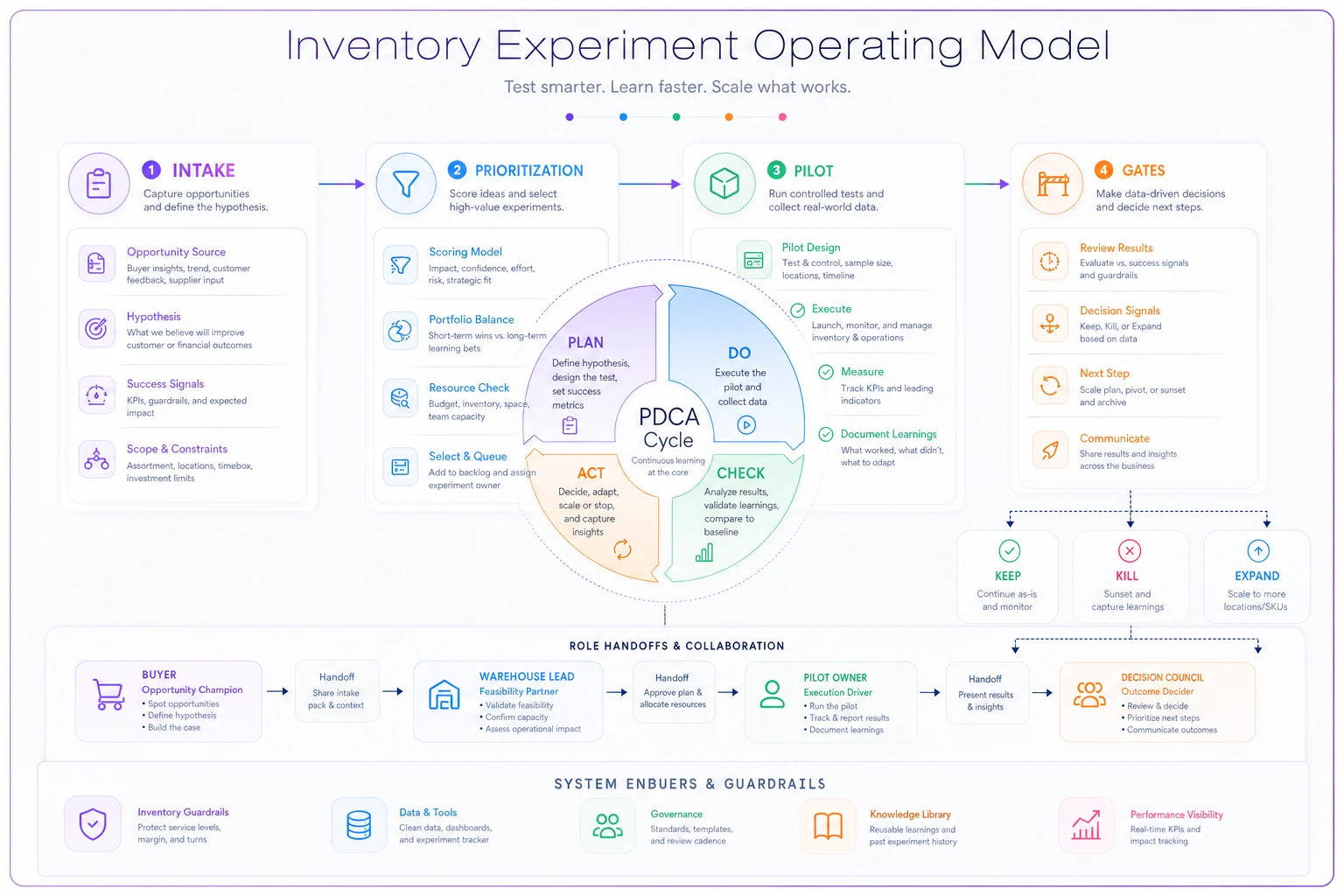
The whole thing runs on PDCA, but PDCA alone is too abstract for a busy warehouse. "Plan-Do-Check-Act" doesn't tell you what to plan or when to stop. The intake, prioritization, and gates are what make it operational.
The key mindset shift: treat every inventory change as an experiment with a defined scope and an expiry date, not a permanent decision. A change is innocent until proven useful.
Intake: getting ideas in the door without chaos
Intake is where most teams either over-engineer or do nothing. The goal is a single place where anyone — the buyer, the warehouse lead, even a part-timer at the pick station — can drop an idea in a format you can actually act on.
Keep the intake form to five fields. More than that and people stop using it.
-
What's the idea? (one sentence)
-
What problem is it solving? (stockouts, excess, labor, cash)
-
Which SKUs / locations does it touch? (be specific — this scopes the pilot)
-
What would "better" look like? (fewer stockouts, faster turns, less overtime)
-
Gut effort estimate (an hour, a day, needs supplier buy-in)
Make the intake form easy to access so frontline staff actually use it.
The person closest to the problem usually has the best idea and the worst ability to estimate its impact. The pick-station worker who says "we keep running out of the medium size on Fridays" is handing you gold. Your job isn't to judge the idea at intake — it's just to capture it cleanly so it doesn't die in a group chat.
A common mistake is filtering too early. Someone dismisses an idea in the moment because it "sounds small." But small, cheap tests are exactly what you want in the pipeline. The expensive, ambitious ideas are the ones that need to earn their way through prioritization.
Prioritization: a scoring approach that fits on one screen
Once you've got a backlog of ideas, you need a way to rank them that doesn't turn into a two-hour meeting. Score each idea on three things, 1 to 5:
| Factor | 1 (low) | 5 (high) | Why it matters |
|---|---|---|---|
| Impact | affects a few slow SKUs | affects hero SKUs or lots of cash | Bigger prize justifies effort |
| Effort (inverted) | needs supplier/system change | can start this week | Fast tests keep momentum |
| Confidence | pure guess | backed by recent data | Filters wishful thinking |
Multiply or just add them — doesn't matter much. What matters is you get a rough ranking and a shared reason. A change touching your top 20 revenue SKUs with a one-day setup and clear data behind it beats a clever idea that needs a new supplier contract and a leap of faith.
One pattern worth naming: teams consistently over-rate confidence on ideas that match their existing beliefs. If the buyer already thinks a supplier is unreliable, every idea about dual-sourcing scores a 5 on confidence — even without data. Push back on high-confidence scores that don't cite an actual number. "Confidence" should mean "we have evidence," not "we feel strongly."
Prioritization also protects you from running too many experiments at once. Two or three live pilots is plenty for a small team. More than that and you can't isolate what's working, and you'll blow your gate reviews.
The pilot template: scope small, measure clean
This is the heart of it. A pilot needs to be small enough that failure is cheap and clean enough that you can actually read the result. Here's the template:
-
1. Hypothesis (one sentence). "If we lower reorder point on these 12 fast movers by 15%, we'll free up cash without adding stockouts."
-
2. Scope. Pick a subset. Not the whole category — a testable slice. 10-15 SKUs, or one of your locations. Keep an untouched comparison group of similar SKUs so you have something to measure against.
-
3. Primary metric + guardrail metric. This pairing is the part people skip and regret. Your primary metric is what you're trying to improve (cash tied up). Your guardrail is what you must not break (stockout rate). A pilot that improves the primary while blowing the guardrail is a failure, not a win.
-
4. Duration. Long enough to cover a normal demand cycle. For most SMBs that's 4-8 weeks. Slow-moving SKUs need longer — you can't judge an intermittent-demand change in two weeks.
-
5. Owner + review date. One name. One date on the calendar where you look at results and hit a gate.
Here's the workflow in practice. The idea comes off the prioritized backlog. The owner writes the hypothesis and picks the scope and comparison group. They make the change only on the pilot SKUs. The system (or a spreadsheet) tracks the primary and guardrail metrics against the comparison group for the duration. On the review date, the numbers hit a gate. Keep, kill, or expand. Then the result — win or loss — goes into a log so the next person doesn't re-run a dead idea.
That log is underrated. Failed experiments are institutional knowledge. "We already tried tightening safety stock on the seasonal line and stockouts spiked" saves you from repeating it in eighteen months when everyone who remembers has left.
Success gates and ROI thresholds
A gate is a pre-agreed rule you set before the pilot starts, so the decision isn't emotional at the end. The discipline is deciding the threshold while you're neutral, not while you're attached to a result.
-
Expand primary metric beats target, guardrail stays inside its limit. Roll out to the full category.
-
Keep and extend trend is positive but not conclusive, guardrail is fine. Run another cycle.
-
Kill and revert guardrail broke, or primary metric moved the wrong way. Revert immediately, log why.
For the ROI threshold, small teams should set a floor that accounts for the hidden cost of complexity. Every change you keep adds a little operational overhead — one more rule to remember, one more setting that behaves differently. So a change that saves $30 a month usually isn't worth keeping even if it "worked." It's not worth the cognitive load.
A reasonable rule of thumb: a kept change should either free up meaningful cash, cut a recurring labor task, or measurably reduce stockouts on SKUs that matter. If it does none of those clearly, kill it even if the number is technically positive. Marginal wins clutter the system.
A real scenario
A home-goods retailer running an online store plus one physical location — around 600 active SKUs — had a chronic split problem: cash tied up in slow stock while their better sellers went out of stock a few times a quarter. Classic both-problems-at-once.
Instead of overhauling everything, they ran three pilots off a prioritized backlog. The winner was almost boring: they tightened reorder points on their top 25 fast movers by roughly 12% and moved that freed-up purchasing budget toward more frequent, smaller reorders on those same SKUs. Scope was just those 25, with a comparison group of the next 25 SKUs left untouched. Guardrail: stockout rate couldn't rise.
Over about six weeks, cash tied up in that pilot group dropped somewhere in the $4k-$5k range, and stockouts on the group actually improved slightly because they were reordering more often. The comparison group didn't move, which told them the change — not the season — drove it. They expanded to the next tier of SKUs.
The other two pilots? One was a wash and got killed. One broke its guardrail in week three (stockouts spiked on a seasonal line) and got reverted immediately — cheap, because it only touched a handful of SKUs. One clear win, two contained failures, no drama, and a written log of all three.
When this operating model makes sense — and when it doesn't
When it's worth it:
-
You've got enough SKUs or locations that changes affect a lot of cash and you can't track them in your head anymore.
-
You keep making reactive changes and can't tell which ones helped.
-
You're growing and want changes to be reversible, not permanent guesses.
When it's overkill:
-
You're running 30-50 SKUs out of a garage. Just try things and pay attention. A formal pipeline is more overhead than it's worth at that size.
-
You're in the middle of a genuine crisis. Firefighting isn't experimentation. Stabilize first, then run clean pilots.
Who should not do this: teams that won't commit to review dates. The whole model depends on someone actually looking at the numbers on the calendar date and making a keep/kill call. If reviews keep slipping, you don't have an experiment pipeline — you've just added paperwork to the same untracked changes you had before.
How this connects to the rest of your inventory system
An experiment pipeline isn't a standalone thing. It's the connective tissue between your other inventory decisions. Reorder points, safety stock, MOQ rules, sourcing choices — every one of those is a change that should have been tested rather than assumed.
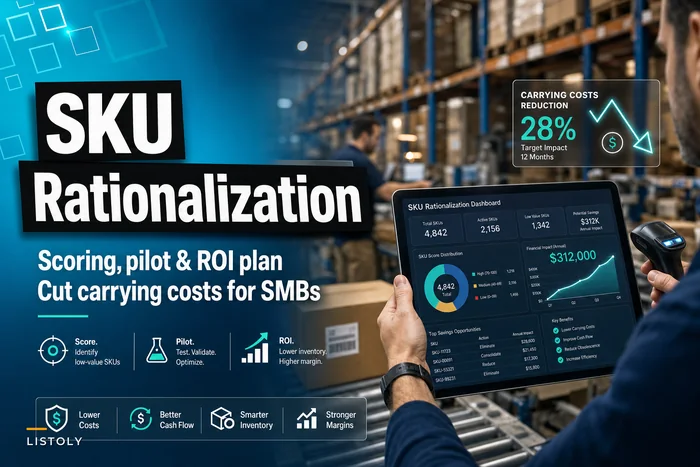
A SKU rationalization effort is basically a big experiment — you're hypothesizing that cutting certain SKUs will reduce carrying cost without hurting revenue, and you need a pilot and ROI gate to prove it before you commit. Same logic with replenishment: tuning your rules for variable lead times is exactly the kind of change that should run as a scoped pilot with a guardrail on stockouts before you roll it across every supplier.
That's the shift. Instead of treating those playbooks as things you implement once and forget, you treat each rule change inside them as an experiment with a scope, a metric, and a gate. The operating model becomes the layer that governs how you adopt everything else.
Where the tracking usually falls apart — and how to keep it lightweight
The honest weak point in all of this is measurement. Running the pilot is easy. Keeping a clean read on the primary metric vs. the comparison group, across weeks, without letting it turn into a manual spreadsheet nightmare — that's where small teams quietly abandon the whole thing.
This is the one place where having your inventory data centralized actually earns its keep. When stock levels, reorder history, and sales sit in one system rather than scattered across a POS export, a warehouse sheet, and someone's memory, you can pull a pilot group's numbers against its comparison group without a half-day of reconciliation. Some operational platforms will let you tag a set of SKUs, track their turns and stockout behavior over a defined window, and flag when a guardrail metric crosses a threshold — exactly the kind of nudge that keeps a review from getting skipped.
The tooling isn't the point, though. If measuring the experiment takes more effort than running it, the pipeline dies. Make the measurement cheap and the whole model survives.
Closing thought
The value here isn't PDCA — that framework's been around forever. The value is refusing to let inventory changes become permanent by default. Every tweak to a reorder point, every safety-stock bump, every new sourcing rule is a bet. Small teams that treat those bets as scoped, time-boxed, revertible experiments end up with a system they actually understand, instead of a pile of settings nobody remembers making.
Start small. One intake form, a rough prioritization score, two or three live pilots, and gates you agreed on before you knew the answer. Kill the losers fast, keep the real wins, and write down what you learned. Do that for a couple of quarters and you'll have something most SMBs never build: a warehouse where every rule can explain why it exists.
Ready to optimize your inventory operations?
Join 2,000+ businesses using Listoly to reduce stockouts, save time, and improve order accuracy.