



The gap between what your warehouse says you have and what your books say you have is where most small businesses quietly lose money. Not through theft or spoilage—those are separate problems—but through the messy handoff at month-end when someone in operations has to explain to someone in finance why the physical count, the WMS number, and the accounts payable ledger all disagree by a few thousand dollars.
Why the warehouse and the accounting system almost never agree the first time
If you run a small operation, you've probably lived some version of this. The receiving team logged 480 units. The invoice says 500. The WMS shows 475 because two got flagged damaged and nobody closed the loop. Finance sees a PO for 500 units at a certain cost, accrues for it, and now the numbers don't tie. Multiply that across a few dozen SKUs and a couple of suppliers, and month-end turns into a three-day forensic exercise instead of a two-hour close.
This article is about the system that connects warehouse evidence to accounting entries—the reconciliation queries, the timing rules for when cost of goods sold actually hits, the dispute process when suppliers shortship, and the minimal journal-entry mappings that a two-person finance team can actually maintain. The goal isn't a perfect accounting textbook. It's a runbook that survives contact with a busy warehouse.
The three sources of truth that never match
Every inventory month-end reconciliation for an SMB comes down to three records, created by three different people at three different times:
Never run out of stock or overorder again.
Listoly streamlines inventory workflows to keep your business stocked and profitable.
- Real-time stock tracking
- Automated reorder alerts
- Supplier and purchase management
No credit card required
-
The physical/WMS record — what your warehouse system says you received and currently hold
-
The AP record — what your supplier invoiced you and what accounting accrued
-
The receipt evidence — the actual proof of what showed up on the dock (packing slips, signed BOLs, receiving logs, photos)
These three aren't supposed to match automatically. They're created independently on purpose so one can catch errors in the other. The problem isn't that they disagree—it's that most small teams have no structured way to investigate the disagreement. They plug the difference into a "shrink" or "miscellaneous" adjustment and move on.
A typical example: a distributor receives a shipment on the 29th. The warehouse scans it in on the 31st because they were backed up. The supplier invoices with a date of the 28th. Now you've got a receipt that could belong to this month or next, an invoice that's clearly this month, and a WMS timestamp that's technically next month if your cutoff is midnight on the 30th. Three timestamps, potentially three different months, one shipment.
What each source is actually good at
| Source | Best used to confirm | Where it lies to you |
|---|---|---|
| WMS / physical count | Quantity currently on hand, damage flags, location | Timing of receipt, landed cost, in-transit units |
| Accounts payable | What you owe, unit cost, supplier terms | What physically arrived, condition, short-ships |
| Receipt evidence | What actually hit the dock and when | Nothing—but it's often incomplete or unsigned |
The receipt evidence column is the one small businesses consistently underinvest in, and it's the one that ends every dispute. When AP and WMS disagree, the packing slip or signed BOL is the referee. If you don't capture it cleanly at the dock, every discrepancy becomes a negotiation instead of a fact.
The reconciliation queries that actually find the money
You don't need a data science team for this. You need a handful of repeatable queries or spreadsheet filters that you run the same way every month. Consistency is the whole point—when you run the same checks every time, differences stand out instead of hiding in the noise.
Core comparisons worth building, described in plain terms so you can adapt them to whatever system you're on:
-
Received-not-invoiced (RNI) Everything the WMS shows as received where no matching AP invoice exists yet. This is your accrual list. If it keeps growing month over month, either suppliers are slow to invoice or your receiving isn't matching to POs.
-
Invoiced-not-received (INR) Every AP invoice with no corresponding receipt in the WMS. This is the dangerous one—you're being asked to pay for stock nobody confirmed arrived.
-
Quantity variance POs where received quantity ≠ invoiced quantity ≠ ordered quantity. Sort by dollar value, not unit count, so you chase the $2,000 variance before the $40 one.
-
Cost variance Where the invoice unit cost differs from the PO unit cost. Small percentage differences on high-volume SKUs add up fast.
-
Timing straddlers Anything received within three days of your cutoff date. These are the shipments most likely to land in the wrong period.
One thing worth watching: most of the reconciliation pain for SMBs comes from a small handful of suppliers—usually the ones who batch-invoice, ship partial orders, or use their own unit-of-measure conventions. Once you identify them, front-load your effort on those accounts and let the clean suppliers auto-match.
Running the queries in sequence
The order matters more than people expect.
-
Pull INR first—you never want to accidentally approve payment for something that didn't arrive.
-
Pull RNI second—this drives your accrual entries, and you need it before you can close.
-
Run quantity variance on everything that did match, sorted high-to-low by dollar impact.
-
Run cost variance on the same matched set.
-
Flag timing straddlers last, and decide period placement using the rules below.
Doing INR before accruals catches duplicate invoices before they enter the ledger.
Here's a simple workflow to follow.
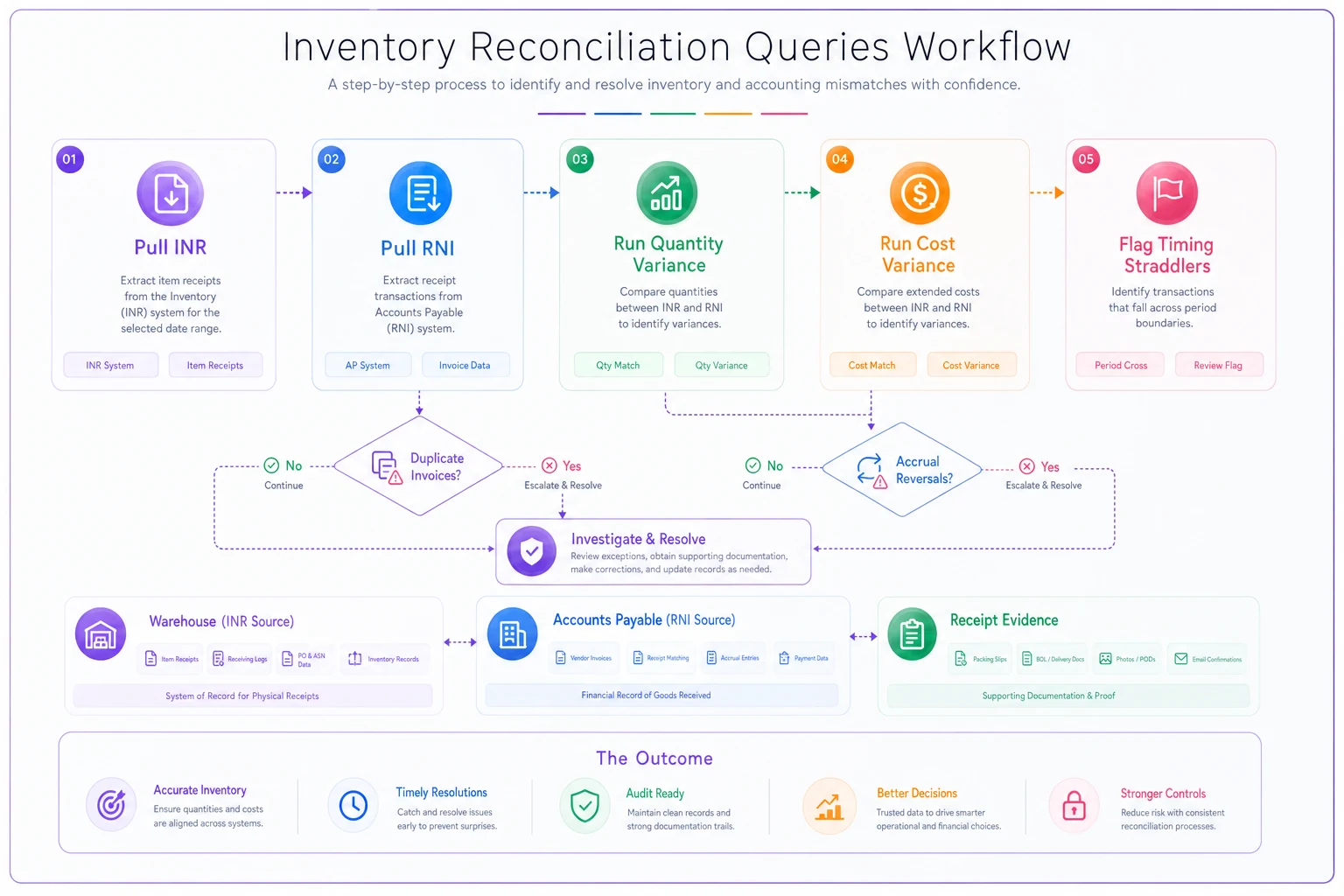
Doing INR before accruals means you catch duplicate invoices and potential fraud before they enter the ledger, not after. It's a small sequencing habit that has caught real problems.
Timing rules: when COGS actually recognizes
This is where operations and accounting talk past each other constantly. Operations thinks in terms of when it showed up. Accounting thinks in terms of when title transferred and when the sale happened. They're not the same thing, and the difference determines which month your COGS lands in.
Rule 1 — Inventory recognition follows title transfer, not dock arrival. If your terms are FOB shipping point, the inventory is technically yours the moment it leaves the supplier's dock, even if it's still on a truck at month-end. FOB destination means it's not yours until it arrives. Most small businesses ignore this and just book at receipt—which is defensible if you're consistent—but it will create period mismatches with suppliers who bill on ship date.
Rule 2 — COGS recognizes when you sell, not when you buy. The cost sits in inventory as a balance sheet asset until the item ships to a customer. That's when it moves to COGS. The failure mode here is booking a big purchase straight to COGS in the month you bought it, which craters that month's margin and inflates the next one's. Small teams do this more than they'd admit, usually to "keep it simple."
The interaction between these two rules and your costing method is where it gets real. Whether you're on FIFO or weighted average changes what dollar amount actually moves to COGS on each sale. If you haven't nailed down your costing approach, the reconciliation will never be clean because you're comparing inconsistent cost bases. Our breakdown on inventory costing shortcuts that change day-to-day ops walks through the FIFO vs. weighted-average decision in a way that connects directly to this—get that right first, or the month-end numbers will keep drifting.
The cutoff discipline nobody enforces
The single highest-leverage timing rule is a hard receiving cutoff. Pick a time—say, 2 PM on the last business day—after which everything received gets dated to the next period. Communicate it to the dock. Enforce it. A soft cutoff, where receiving keeps scanning until midnight and finance guesses at what belongs where, is the root cause of most straddler headaches.
Supplier disputes: shortships, damages, and credits
A big chunk of month-end variance isn't error—it's unresolved supplier issues. You received 480 of 500, the supplier invoiced 500, and until you either get a credit or agree to backorder, that 20-unit gap sits in your reconciliation indefinitely.
The mistake is treating each dispute as a one-off email written from scratch. The teams that recover supplier credits quickly have templated the whole thing and, critically, attach evidence up front. The RMA and vendor-credit side of this deserves its own deep look—our RMA-to-vendor runbook with templates and evidence checklists covers the returns and credit-recovery flow in detail, and it pairs directly with the dispute templates below.
Dispute email template — shortship
> Subject: Short shipment — PO [####] — [X] units short — credit or replacement requested > > Hi [Name], > > We received PO [####] on [date]. Ordered quantity was [Y], received quantity was [X], confirmed against your packing slip #[####] (attached) and our signed receiving log (attached). > > Your invoice #[####] bills for the full [Y] units. We're requesting either a credit memo for the [X-short] units at the PO unit cost of $[cost], or a confirmed replacement shipment with a firm date. > > Please confirm which by [date] so we can reconcile our period-end. Receiving photos available on request. > > Thanks, > [Name]
Dispute email template — damaged on arrival
> Subject: Damaged goods — PO [####] — [X] units — credit requested > > Hi [Name], > > [X] units on PO [####] arrived damaged and unsellable. Photos and the driver-signed BOL noting the condition are attached. These units are quarantined and not entered into sellable stock. > > Requesting a credit for [X] units at $[cost]. Let us know if you need them returned or if you'll authorize disposal on your side. > > Thanks, > [Name]
The reason these work is the evidence attached on the first email. Suppliers stall when they can push the burden of proof back onto you. When the packing slip, signed log, and photos are already in the thread, the conversation shifts from "prove it" to "how do you want your credit."
Track every open dispute in a simple aging list—supplier, PO, dollar amount, date opened, status. Anything over 30 days gets escalated. Anything that won't resolve becomes a documented write-off with a paper trail, not a mystery adjustment.
Minimal journal-entry mappings for small teams
You don't need forty account codes. A small team can run clean inventory accounting with a handful of entries, as long as everyone maps the same event to the same entry every time. Here's the minimal set:
-
Receive inventory (matched to invoice) Debit Inventory, Credit Accounts Payable
-
Receive inventory (no invoice yet — accrual) Debit Inventory, Credit Accrued Purchases (RNI). Reverse when the invoice arrives.
-
Sell inventory (COGS recognition) Debit COGS, Credit Inventory
-
Supplier credit for shortship/damage Debit Accounts Payable (or Cash), Credit Inventory or Purchase Returns
-
Cost variance (invoice ≠ PO) Debit/Credit Purchase Price Variance, offset to Inventory or AP
-
Physical count adjustment (shrink/found) Debit/Credit Inventory Adjustment, offset to Inventory
The entry small teams botch most is the accrual reversal. They book the RNI accrual to close the month, the invoice comes in next month, they book it fresh—and forget to reverse the accrual. Now inventory and payables are both doubled for that shipment. Build the reversal into the process: every accrual entry gets a scheduled reversal on day one of the next period, no exceptions.
Keep a mapping cheat sheet
Print a one-page table that says "when X happens in the warehouse, book Y." Tape it near whoever does the entries. The whole point of minimal mappings is that a non-accountant can execute them correctly. If every entry requires judgment, it won't stay consistent—and inconsistency is what breaks reconciliation. This sounds almost too simple, but the businesses that keep a clean close usually have something like this posted somewhere physical.
A real scenario: a specialty foods distributor
A regional specialty foods distributor—around 900 active SKUs, four people total, one handling both AP and the month-end close—was spending roughly two and a half days every month on inventory reconciliation. Variance was landing somewhere between $6k and $9k monthly in unexplained adjustments, most of it dumped into a generic "inventory shrink" line because nobody had time to trace it.
When they actually broke it down, most of that "shrink" wasn't shrink at all. Around 60% traced back to timing straddlers and unreversed accruals—shipments booked in the wrong period and a handful of double-counted invoices. Another chunk was supplier shortships that had never been disputed because the person running AP didn't have receiving evidence handy to make the case.
They changed three things. Set a hard 2 PM receiving cutoff. Started running the INR-then-RNI query sequence in a fixed order every month. Built the two dispute templates above with receiving photos attached at the dock. Within two cycles, the close dropped to under a day, and the unexplained adjustment shrank to a few hundred dollars—mostly genuine small discrepancies instead of process noise. They also recovered roughly $2k in supplier credits in the first quarter, simply because they were now asking with evidence instead of eating the shortships.
None of that required new headcount or new software. It required treating the handoff as a system with defined steps instead of a monthly scramble.
When to formalize this—and when not to bother
When this runbook is worth building: You're carrying enough inventory that a few percent variance is real money, you have more than a handful of suppliers, and your close is starting to eat multiple days. Roughly, once you're past a few hundred active SKUs or two or three receiving events a week, the informal approach stops working.
When it's overkill: If you're a small operation with two suppliers and fast stock turns, a rigid reconciliation runbook adds more overhead than it's worth. A monthly spreadsheet and the habit of checking invoices against receipts will do. Don't build a reconciliation machine for a problem you don't have yet.
Who should not DIY the timing rules: If you have consignment stock, complex multi-currency landed costs, or you're approaching a financing round or audit, get an accountant to set the timing and costing policy. You can execute the runbook in-house, but the policy—especially title transfer and COGS timing—should be set by someone who can defend it to a lender or auditor.
The system view: what breaks as you grow
At two locations with clean suppliers, reconciliation is a manual comparison you can mostly eyeball. The trouble is every part of this compounds. More SKUs mean more variance lines. More suppliers mean more invoicing conventions to normalize. More receiving volume means more straddlers near cutoff. More sales channels mean COGS recognizing across more transaction types.
The manual approach doesn't break suddenly—it just gets slower and less accurate until the close becomes the thing everyone dreads.
The businesses that stay clean as they scale treated the warehouse-to-finance handoff as a repeatable process early: defined evidence capture at the dock, fixed reconciliation queries in a fixed order, disciplined cutoffs, templated disputes, and a minimal set of journal mappings anyone can execute. That's what turns month-end from a forensic investigation into a checklist.
The variance will never be exactly zero, and honestly it shouldn't be—some of it is real and tells you something about your operation. The goal of a good inventory month-end reconciliation process for an SMB isn't perfection. It's knowing, every single month, exactly why the three sources disagree, catching the money that's actually recoverable, and closing the books without losing a week of your life to it.
Ready to optimize your inventory operations?
Join 2,000+ businesses using Listoly to reduce stockouts, save time, and improve order accuracy.