


Once you cross from one location to two, your inventory stops being a stock problem and becomes a routing problem. You're no longer asking "do I have enough?" You're asking "enough where, and who pays to move it when the answer is wrong?" That question gets harder with every location you add, and most SMBs never actually decide how to answer it. They just let the network drift into whatever the POS defaults and the founder's gut settled on three years ago.
The core tension is simple to state and painful to live with: pooling stock centrally lowers your total inventory and smooths demand variability, but it lengthens the distance between product and customer. Decentralizing puts stock close to demand and cuts fulfillment time, but it fragments your buffer, inflates total carrying cost, and multiplies your dead-stock exposure. Every SMB network sits somewhere on that spectrum, usually without having chosen the spot on purpose.
This is a decision guide, not a tips list. The goal is to give you a repeatable way to decide, SKU by SKU and location by location, when pooling wins and when it quietly bleeds you.
## The statistical reason pooling works (and why it stops working)
There's a real mathematical force behind pooling, and it's worth understanding because it tells you exactly where the strategy runs out of road.
When you consolidate demand from multiple locations into one pool, the combined demand is more predictable than any single location's demand. Ups in one store partially cancel downs in another. That means the safety stock you need to hit the same service level shrinks — roughly proportional to the square root of the number of pooled locations, assuming those locations are somewhat independent.
In plain terms: if one warehouse needs 100 units of safety stock, pooling four similar, independent locations doesn't need 400 units to hit the same service level. It needs closer to 200. That's the whole game. Pooling buys you the same protection with half the buffer.
The part that usually gets skipped: that math collapses when your locations aren't independent. If all four stores spike on the same Saturday because of the same regional weather event, the same payday cycle, or the same marketing email, their demand is correlated — and correlated demand pools terribly. You get almost none of the variability reduction, but you eat all of the added lead time.
So the first real question isn't "should I pool?" It's "how correlated is demand across my locations?" Two stores in the same metro serving the same customer base pool poorly. Two stores in different climates with different seasonality pool beautifully. Most owners never check, and they end up pooling the wrong SKUs while decentralizing the ones that would actually benefit from being consolidated.
## What actually breaks as the network grows
A single warehouse hides a lot of sins. The problems below don't exist at one location — they're born the moment you split stock, and they compound as you add sites.
Never run out of stock or overorder again.
Listoly streamlines inventory workflows to keep your business stocked and profitable.
- Real-time stock tracking
- Automated reorder alerts
- Supplier and purchase management
No credit card required
Phantom availability. Your system says you have 40 units of a SKU. Technically true. But it's 4 units across ten locations, and no single location can fill an order of 12. Aggregate inventory looks healthy; usable inventory is trash. This is the most common failure in decentralized networks and it's invisible on a total-on-hand report.
Transfer thrash. Location A runs low, pulls from Location B. Two days later B runs low and pulls from C. Then A's original demand didn't materialize and now it's overstocked while D is empty. Stock sloshes around the network, racking up shipping cost and labor, chasing demand that already moved on. Small networks can spend more on inter-store transfer freight than they would have spent on the extra safety stock that would have prevented the transfers entirely.
Coordination lag. At two locations, the manager texts the other manager. At five, nobody knows who has what without pulling a report, and the report is already a day stale. Decisions that used to take a text now take a meeting, and by the time the meeting happens the situation has changed.
Fragmented reorder logic. Each location reorders independently against its own min/max, so you place five small POs to the same supplier in the same week, missing freight breaks and MOQ efficiencies you'd hit easily if you ordered as a network.
That last one is where pooling and purchasing collide, and it's worth being deliberate about how transfers and reorders interact. The mechanics of deciding between moving stock you already own versus buying more get their own treatment in our transfer-vs-reorder-rules for 2–10 locations — that decision sits directly underneath everything in this article.
## The pooling policies, and where each one fits
There isn't one pooling decision. There's a spectrum of policies, and mature networks run several at once, applied to different SKU classes. Here are the four that actually get used by SMBs, with the trade-offs laid out plainly.
| Policy | How it works | Lead time impact | Carrying cost | Best for |
|---|---|---|---|---|
| Full centralization | All stock at one hub, ship direct to customer | Longest (hub-to-customer every order) | Lowest total inventory | Slow-movers, high-value, low-correlation demand |
| Forward-deploy + central buffer | Fast-movers held locally, safety buffer pooled centrally | Short for A-items, medium for the rest | Moderate | Mixed-velocity catalogs (most SMBs) |
| Full decentralization | Each location holds its own full range | Shortest | Highest total inventory | High-correlation demand, expensive shipping, local pickup |
| Virtual pooling | Stock stays physical-local but is managed as one pool with cross-fulfillment | Variable | Between central and decentralized | Networks with good visibility and cheap inter-site transfers |
Virtual pooling is the one most SMBs should be running and almost none are, because it requires something they usually don't have: a single, trusted, real-time view of stock across every location. Without that, virtual pooling turns into transfer thrash. With it, you get most of the carrying-cost benefit of centralization while keeping product close to demand. The bottleneck is almost never the strategy — it's the visibility.
## A decision process you can actually run
Here's the sequence to walk through for a 2–10 location network. Do this per SKU class, not for the whole catalog at once.
-
Classify by velocity and value. Split the catalog into A/B/C by movement, and flag anything high-value. Your A-items (fast, predictable) and your C-items (slow, unpredictable) need opposite treatment, so separating them is step zero.
-
Measure demand correlation across locations. Pull 12 months of weekly sales by location and look at how the lines move together. Do they spike on the same weeks? High correlation means pooling gives you little — keep it local. Low correlation means pool it.
-
Price the lead-time penalty. For each SKU, ask what a customer actually does when it's not immediately available. Do they wait two days? Fine — centralize. Do they walk to a competitor? Then local availability has real revenue attached, and that revenue goes into the math against carrying cost.
-
Cost the shipping delta. Compare hub-to-customer shipping against replenishment-plus-local-pickup. For heavy or bulky items, shipping cost often kills centralization outright regardless of what the inventory math says.
-
Set the policy per class. Fast + correlated + heavy → decentralize. Slow + independent + light → centralize. Everything in the middle → forward-deploy the fast movers, pool the buffer. Write it down.
-
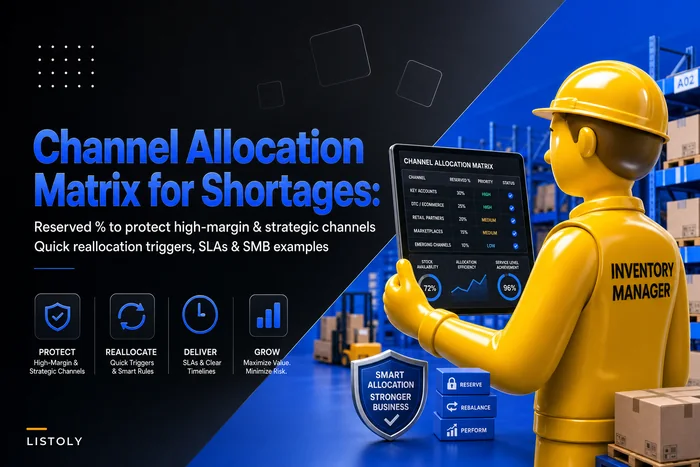
Define reallocation triggers. Decide in advance the stock level at which a location pulls from the pool, and how much it pulls. Reactive transfers are what create thrash. When demand outruns supply and you're deciding who gets what, the same discipline used for channel allocation during shortages applies to inter-location allocation — reserve percentages and pre-set triggers beat scrambling every time.
-
Set a review cadence. Correlation and velocity drift. Re-run steps 1–2 quarterly. A SKU that was slow last year might be your new top mover, and it could be sitting in the wrong policy.
Run the steps on SKU classes monthly for promotional seasons — correlation can spike during promotions and holidays.
The sequence above maps to a simple decision flow: classify, measure correlation, price lead-time, cost shipping, set policy, define triggers, and review. Use that flow as the operational checklist for each SKU class.
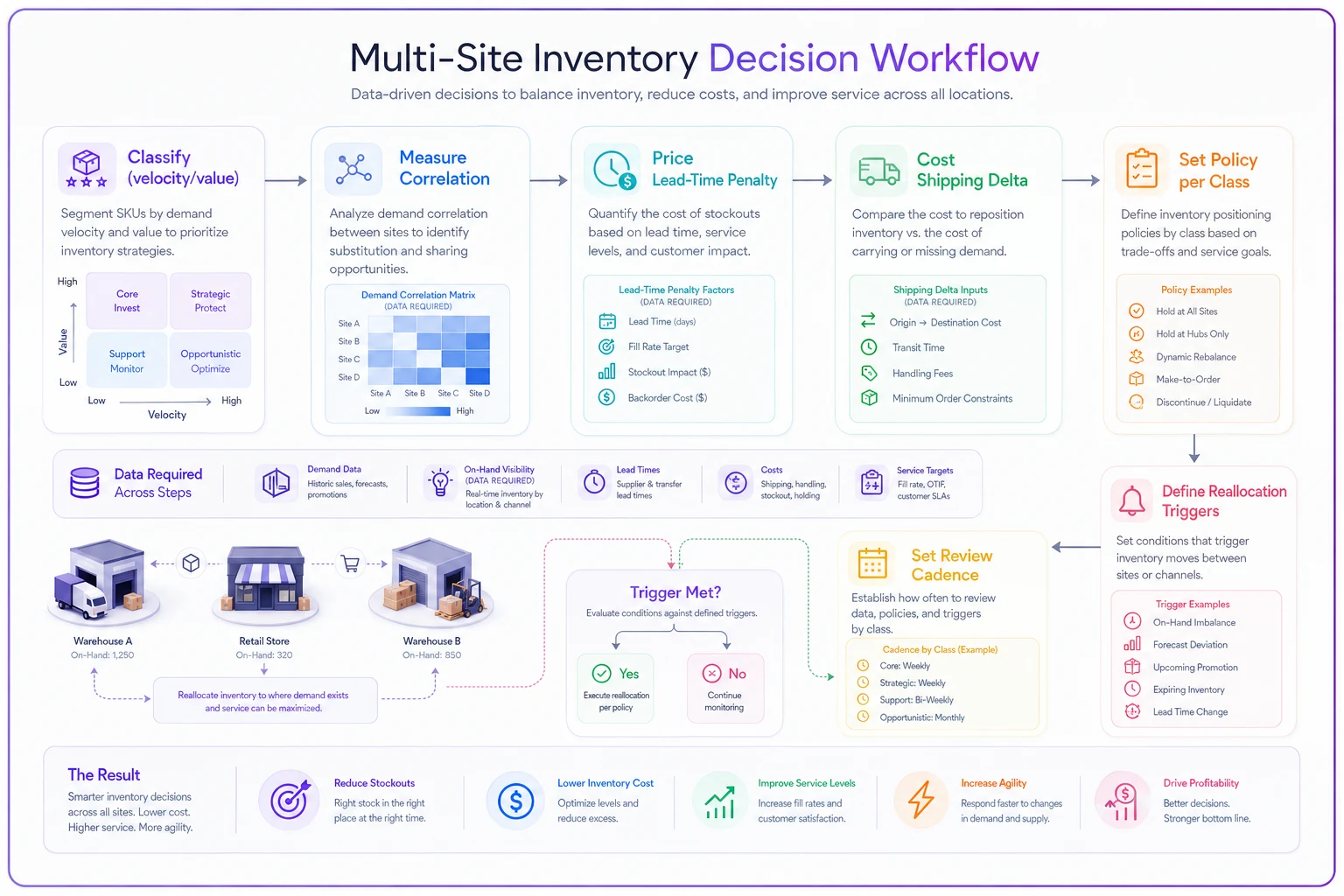
The diagram ties each step to the data inputs you need and the operational handoffs (transfers vs reorders).
## A real scenario: regional home-goods retailer, 4 locations
A home-goods and décor retailer running four stores across a mid-size region had drifted into full decentralization by accident — every store held the full catalog because that's how the first store operated and they just copied it three more times.
The symptoms were textbook. Total network inventory was running around $310k. Their slow-moving décor SKUs — seasonal stuff, higher-price items — were sitting in all four stores, most of it turning maybe two or three times a year per location. Meanwhile their fast-moving consumables (candles, small home basics) were performing fine. The dead weight was entirely in the slow, independent-demand tail.
They kept the fast movers local and pooled the slow tail into one store designated as the regional hub, shipping those items to customers or transferring on demand. Nothing else changed structurally.
Over the following two quarters, network inventory came down to somewhere around $250k–$260k — roughly a $50k reduction — with no measurable hit to service on the slow items, because those customers were already willing to wait a couple of days. The freed cash went into deeper stock on the fast movers, which actually improved in-store availability. The one real cost was a modest uptick in inter-store transfer shipping, a few hundred dollars a month, which was rounding error against the carrying cost they eliminated.
The lesson wasn't "pooling is better." It was that they'd been applying one policy to a catalog that needed two. The slow tail should never have been decentralized, and the fast movers should never have been touched.
## When pooling is a bad idea
Pooling has a certain marketing gravity to it — lower inventory sounds like an obvious win — so it's worth being direct about when it actively hurts you.
-
When shipping cost dominates. Bulky, heavy, or cheap-to-buy items where freight is a significant share of landed cost. Centralizing just means you pay to ship the same units twice.
-
When demand is highly correlated. If all your locations move together, you get almost none of the statistical benefit and all of the lead-time cost. Pure downside.
-
When local availability is the product. Same-day pickup, walk-in impulse categories, anything where "I need it now" is the reason the customer showed up. Centralizing these hands sales to competitors.
-
When your visibility is bad. If you can't trust your on-hand numbers across locations, virtual pooling and transfer-based fulfillment will generate more phantom stock-outs and thrash than the strategy is worth. Fix the data before you fix the strategy.
Fix the data before you fix the strategy.
## Who should not restructure yet
If your per-location stock accuracy is under around 95%, don't touch your pooling strategy. Every policy above assumes you can trust what your system says each location holds. Restructuring on top of bad data just moves the chaos around and makes it harder to see.
Same goes if you don't have a clean view of demand by location. You can't measure correlation, you can't set intelligent triggers, and you'll end up pooling by intuition — which is how networks end up overstocked and under-serving at the same time. Get the location-level visibility solid first. The strategy is only as good as the numbers underneath it.
## The coordination layer is the real bottleneck
The strategy itself is rarely the hard part. Deciding which SKUs to pool and which to keep local takes an afternoon with a spreadsheet. What breaks is the day-to-day coordination of actually running that strategy across locations — knowing in real time what's where, catching when a location is about to breach a trigger, placing consolidated reorders instead of five fragmented ones, and moving stock before a stock-out instead of after.
That coordination is where a shared operational system earns its keep — not because software makes the strategic decisions for you, but because it keeps every location working off the same live picture and flags the reorder and transfer triggers you defined before they become fire drills. The manual version of this — texts, spreadsheets, stale reports — is what quietly reintroduces all the failure modes above no matter how clean your policy looks on paper. A network that can see itself pools well. One that can't will thrash regardless of what the spreadsheet says.
## Bringing it together
Multi-site inventory isn't a single decision you make once. It's a policy you set per SKU class, price against real shipping and lead-time costs, and revisit as your demand patterns drift. The winning networks aren't the ones that pool the most or the least — they're the ones that pool deliberately, matching each part of the catalog to the policy its demand actually deserves.
Start with the two questions that decide everything: how correlated is demand across your locations, and what does a customer actually do when the item isn't immediately in front of them. Answer those honestly, SKU class by SKU class, and the pool-versus-local decision mostly makes itself. Everything after that is coordination — making sure the strategy on paper survives contact with a busy Saturday across five stores.
Start with the two questions that decide everything: how correlated is demand across your locations, and what does a customer actually do when the item isn't immediately in front of them. Answer those honestly, SKU class by SKU class, and the pool-versus-local decision mostly makes itself. Everything after that is coordination — making sure the strategy on paper survives contact with a busy Saturday across five stores.
Ready to optimize your inventory operations?
Join 2,000+ businesses using Listoly to reduce stockouts, save time, and improve order accuracy.