



Most small businesses that outsource fulfillment don't lose money to one big disaster. They lose it to a slow leak — $40 here, $120 there, a reweigh surcharge nobody caught, a "storage overage" that shows up three weeks after the fact. Each line looks too small to fight. Added up across a year, it's often the difference between a healthy margin and a flat one.
The problem isn't that 3PLs are crooked. Most aren't. The problem is that the standard 3PL billing model assumes the client won't check the math — and small teams usually can't, because they don't have the time, the baseline agreement, or the evidence trail to push back. This post is about closing that gap with a governance setup lean enough for a two-to-five person ops team to actually run.
We'll stay narrow on purpose: outsourced fulfillment chargebacks and billing disputes. Not warehouse selection, not carrier negotiation — just how to stop bleeding money through unchecked fees and how to win the disputes worth winning.
Where the money actually leaks
Before writing a single SLA clause, it helps to know what you're defending against. Across outsourced fulfillment relationships, the recurring chargeback and fee categories look remarkably similar regardless of industry:
| Fee / chargeback type | How it usually appears | Why SMBs miss it |
|---|---|---|
| Dimensional reweighs | Carrier "corrects" your declared box size; 3PL passes it through plus a handling markup | No one re-measures cartons; you trust the slip |
| Storage overages | Pallet or bin counts tick over a tier threshold mid-month | Billed in arrears, hard to tie to a specific date |
| Receiving / inbound exceptions | "Non-compliant ASN," missing labels, mixed cartons | 3PL defines "compliant," you never saw the spec |
| Special handling | Repack, re-label, kitting corrections | Shows as a lump sum with no line detail |
| Short-ship / damage claims | Units marked missing or damaged at receiving | You have no photo evidence from your side |
| Minimum / account fees | Monthly minimums, "active SKU" charges | Buried in the rate card addendum |
The pattern worth noticing: almost every one of these is winnable if you have your own record of what left your dock and when, and nearly impossible to win if you don't. Chargeback defense is 80% evidence capture and 20% argument. Teams that get burned usually have a great argument and no proof.
The SLA clauses that actually protect a small team
Big-company master service agreements run 40 pages because they're negotiated by legal teams with real leverage. You don't have that leverage, and you don't need most of those pages. You need a handful of clauses that shift the burden of proof and cap your exposure. If your 3PL contract is missing these, that's where to focus renewal conversations.
Never run out of stock or overorder again.
Listoly streamlines inventory workflows to keep your business stocked and profitable.
- Real-time stock tracking
- Automated reorder alerts
- Supplier and purchase management
No credit card required
1. Billing detail and line-item requirement. Every charge must appear as a dated, itemized line tied to a specific order, inbound receipt, or SKU. "Miscellaneous handling: $430" is not an invoice line — it's a blank check. Sample language:
> "Service Provider shall render all accessorial, handling, and exception charges as itemized line items referencing the applicable order number, ASN, or receipt ID and the date of occurrence. Charges rendered without such reference are not payable until substantiating detail is provided."
That last clause matters more than the first. It means an undocumented charge is parked, not owed, until they prove it.
2. Chargeback evidence standard. This is the one most SMB contracts lack entirely. It requires the 3PL to attach evidence for any exception fee they originate — a photo for damage, a scan log for a short-ship, a measurement for a reweigh.
> "For any damage, shortage, or non-compliance charge originated by Service Provider, supporting evidence (photographs, scan records, or measurement data) shall be provided within five (5) business days of the charge. Absent such evidence, the charge shall be reversed."
3. Dispute window — but make it mutual. 3PLs love a tight window for you to dispute their charges (often 15–30 days). Fine — accept it, but require the same window to run against them for errors you catch. And make the clock start when the itemized detail arrives, not when the invoice posts. Otherwise they can bury a charge in a summary line and run out your clock before you can decode it.
4. Inbound compliance spec as an exhibit. Half of all "non-compliant receiving" fees come from a standard the client never actually saw. Demand the carton, labeling, and ASN spec as a written exhibit to the contract. If it's not attached, non-compliance charges based on it aren't enforceable in practice. This ties directly into how your cartons arrive in the first place — if your inbound process is rough around the edges, working through a receiving and putaway playbook before you sign anything is worth the time, because a lot of "3PL fees" are really your own inbound discipline problems in disguise.
5. Rate-change notice. Peak surcharges and annual rate hikes should require 30–60 days written notice. Without it, you'll find out about a new "peak season handling fee" when you read October's invoice.
6. Audit and reconciliation right. A short clause letting you (or a rep) review the records behind any disputed charge. You'll rarely invoke it, but it changes the tone of every dispute because they know you can.
When to push hard vs. let it go
Not every clause is worth a fight. If you're a small account, you won't win a redline war on indemnification. Prioritize the evidence standard (#2) and the billing detail requirement (#1) — those two alone flip most of the leverage. Let the lawyers' favorite clauses slide if it means you get those two locked in.
A reconciliation cadence a small team can actually keep
The best SLA in the world does nothing if nobody checks the invoices against reality. The failure mode here is predictable: teams intend to audit "when things slow down," and things never slow down. So the cadence has to be lightweight enough to survive a busy week.
Daily (5–10 minutes):
-
Pull the previous day's outbound shipment count from your system and compare to the 3PL's confirmed ship count. A mismatch today is traceable; a mismatch found 30 days later is a mystery.
-
Flag any order marked "exception" or "hold" by the 3PL. These are future chargebacks in embryo.
-
Photo-log any outbound inbound you personally handle (more on evidence below).
Weekly (30–45 minutes):
-
Download the week's invoice lines and sort by charge type.
-
Compare accessorial charges against your order volume. A spike in "special handling" with flat order volume is a red flag.
-
Spot-check three to five reweigh charges against your actual carton dimensions.
-
Reconcile storage/billed units against your own on-hand count (even a rough count).
-
Log every questionable line in a running dispute tracker before the invoice is due.
The weekly pass is the core of the whole system. Everything else supports it.
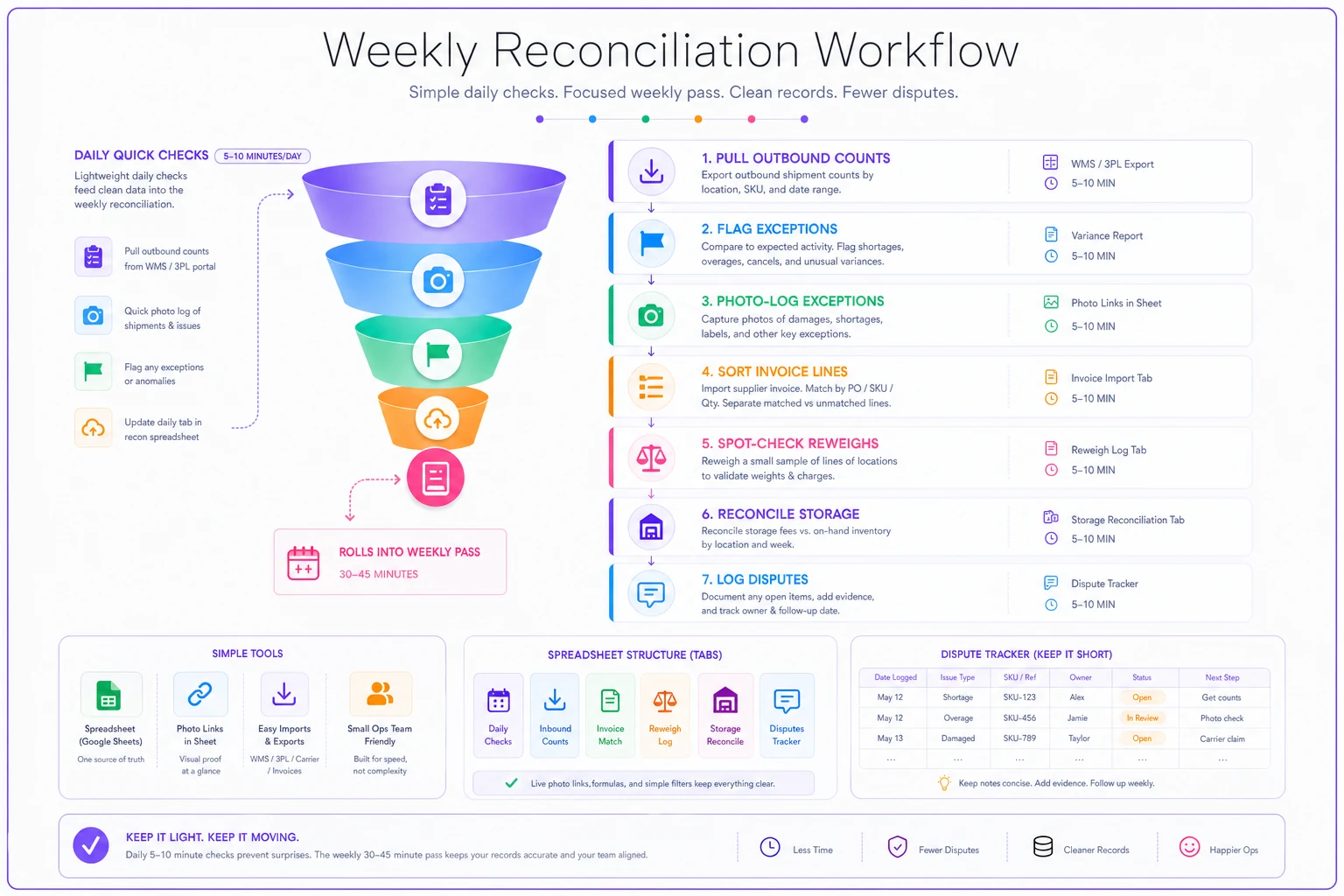
Use this as a checklist during the weekly pass.
Keep a single dated spreadsheet with photo links next to invoice rows so filing a dispute takes under a minute.
Why weekly beats monthly
Monthly reconciliation feels efficient but it's a trap. By month-end, the person who packed the order has forgotten it, scan logs may have rolled off, and you're often past the dispute window. A business doing roughly 1,200–1,800 orders a month that switches from monthly to weekly reconciliation typically starts catching the smaller $30–$80 charges they used to eat — and those are the bulk of the leak, not the occasional big claim.
Chargeback prevention: stop the fee before it exists
Disputing is expensive in time. Preventing is cheaper. A few operational habits remove entire categories of chargebacks:
-
Standardize and verify your own carton dimensions. Reweigh fees die when your declared dims match reality. Measure your top 10 cartons once, laminate the card, done.
-
Lock your ASN format to the 3PL's spec exhibit. Most inbound exceptions are formatting, not substance.
-
Pre-label at origin where you can. Fewer relabel charges, fewer "non-compliant" flags.
-
Audit SKU setup before go-live. Wrong dimensional data in the 3PL's system generates reweighs forever until someone fixes the master record.
-
Consolidate inbound intelligently. Erratic, mixed-carton inbounds trigger receiving exceptions. If you're juggling multiple suppliers, your PO discipline upstream matters — the logic in an SMB supplier scorecard and PO-rule playbook feeds directly into cleaner, compliant inbound shipments that don't rack up exception fees.
The mistake most teams make: they treat chargebacks as a billing problem. They're not. They're almost always upstream operational problems — bad master data, sloppy cartons, inconsistent inbounds — that surface as a fee at the end. Fix the operation and the fees shrink on their own.
The dispute playbook — built for the evidence you can actually capture
Here's the part most guides skip: a small team cannot capture the same evidence a big 3PL client can. You don't have receiving scanners on your dock or a WMS logging every touch. So your playbook has to be built around what you can realistically produce. Fight the disputes where your evidence is strong; concede the ones where it isn't, and fix the gap instead.
Evidence you can realistically capture:
-
Phone photos of outbound cartons with a visible label and a ruler for scale
-
Your own order records (what you told them to ship, when)
-
Carrier tracking showing delivery (counters "lost in transit" claims)
-
A dated dimension card for your standard cartons
-
Screenshots of your on-hand counts for storage disputes
The dispute workflow:
-
Triage by evidence strength, not dollar amount. A $45 reweigh you can disprove with a dimension photo is more worth your time than a $200 damage claim you have zero proof against. Win the winnable.
-
Pull the SLA clause that applies. Reference the evidence-standard clause for damage/shortage; the itemization clause for vague charges.
-
Write the dispute tight and factual. Order number, charge, what the contract requires, your evidence attached. No emotion. "Per Section X, damage charges require photographic evidence within 5 days; none was provided. Please reverse."
-
Log it and set a follow-up date. Disputes die from being forgotten, not denied.
-
Escalate on pattern. One bad reweigh is noise. Fifteen in a month is a systemic dimension-data problem worth a call, not fifteen separate emails.
A real scenario
A specialty housewares seller shipping around 1,400 orders a month through a regional 3PL was running fine on paper, but their fulfillment cost per order kept creeping up. When they finally sorted three months of invoice lines by charge type, roughly $1,900 of the quarter's charges were accessorials — reweighs and "special handling" — with no detail attached.
They put in two things: a dimension card for their eight standard cartons, and a weekly 40-minute invoice pass with a simple dispute tracker. Over the next quarter, reweigh charges dropped by more than half once the 3PL's SKU dimensions got corrected. Of the disputes they filed, they recovered somewhere in the $600–$800 range — mostly small charges that previously would have been invisible. Nothing dramatic per line, but annualized, it was a few thousand dollars that had simply been walking out the door.
The interesting part wasn't the recovery. The prevention — fixing dimensions — beat the disputes by a wide margin. The disputes trained the 3PL to tighten up; the data fix removed the problem at the source.
When this governance setup is overkill
If you're shipping 50 orders a month, don't build this. The reconciliation time will cost more than the leak. Just skim your invoices quarterly and move on. This system earns its keep somewhere north of a few hundred monthly orders, or whenever your accessorial charges start feeling unpredictable.
It's also the wrong focus if your 3PL relationship is fundamentally broken — chronic late shipments, constant stockouts, unreachable account manager. No SLA clause fixes a bad partner. Governance tightens a decent relationship; it doesn't rescue a failing one.
Keeping the evidence trail without a WMS
The practical bottleneck for small teams is evidence capture. You can't manually photograph every carton. The realistic move is to capture evidence systematically for the categories where disputes cluster — if reweighs are your problem, photo-log carton dims on a sample basis and keep the dimension card current. If damage claims are the issue, photograph high-value outbounds.
Keeping your order records, invoice lines, and dispute tracker in one place also pays off — not because you need fancy software, but because a dispute you can't substantiate in under a minute is a dispute you won't bother filing. Whether that's a shared spreadsheet with dated photo links or an operational platform that keeps order data and exception flags together, the goal is the same: when a questionable charge lands, the evidence is already sitting there, timestamped, instead of scattered across a packer's phone and three email threads.
The one habit that matters most
Reconcile weekly, and log disputes before the invoice is due.
The SLA clauses give you the right to push back. The evidence gives you the ammunition. But the cadence is what turns both into actual recovered dollars, because the whole game is catching small charges while they're still fresh enough to prove.
Outsourced fulfillment is supposed to save you time. A light governance layer is what keeps it from quietly eating your margin at the same time — a few clauses, a weekly pass, and the discipline to fight only the disputes you can win.
Ready to optimize your inventory operations?
Join 2,000+ businesses using Listoly to reduce stockouts, save time, and improve order accuracy.