

Most inventory problems people spend time chasing — miscounts, oversells, "we thought we had 40 of those" — actually get born at the receiving dock. A pallet comes in, someone signs for it, and then it sits. Half-checked, half-labeled, parked somewhere in the "we'll deal with it later" zone. Everything downstream inherits that mess.
The frustrating part is that receiving looks deceptively easy. Truck shows up, you count boxes, you put them away. But in a small warehouse the receiving function is doing three jobs at once — validating what the supplier actually sent, deciding how good it is, and getting it to a location where pickers can find it. When those three jobs blur together or happen on a "whenever we get to it" basis, the whole building slows down.
This is a systems piece, not a tips list. The goal is to show how a proper receiving putaway playbook for a small warehouse ties booking, inspection, and putaway into one flow, where each part breaks as you grow, and what a functioning version actually looks like.
Why inbound quietly becomes the bottleneck
Nobody plans for receiving to be the constraint. It becomes the constraint because it's the one part of the operation that's reactive by nature — you don't control when trucks show up, what condition the freight is in, or whether the supplier shorted you on line 7.
In practice this usually shows up as a pileup. Three deliveries land within an hour of each other on a Tuesday, one person is doing receiving, and now there's a wall of pallets blocking the aisle. The team starts "putting away" by shoving product into whatever open slot exists so the floor clears. That single shortcut — putaway based on convenience instead of logic — is where a huge chunk of downstream picking waste comes from.
-
Receiving with no appointment structure. Everything arrives at once because nothing is scheduled, so labor is either idle or drowning.
-
Inspection folded into putaway. Quality only gets "checked" when someone happens to notice a crushed box, which means damaged or wrong product enters sellable inventory.
-
Putaway decided by the person, not by the rule. Where something lands depends on who's working that day and how tired they are.
-
No system-of-record moment. Stock is physically in the building but not in the system for hours or days, so the numbers everyone trusts are already wrong.
That last one is the sneaky one. The gap between "it's on the shelf" and "the system knows it's on the shelf" is where oversells, phantom stockouts, and emergency reorders live.
The three jobs of inbound, and why they should stay separate
The mental fix that helps most is to stop treating inbound as one blurry task. It's three distinct decisions, and each one has its own failure mode.
Never run out of stock or overorder again.
Listoly streamlines inventory workflows to keep your business stocked and profitable.
- Real-time stock tracking
- Automated reorder alerts
- Supplier and purchase management
No credit card required
| Job | Real question it answers | What breaks when it's skipped |
|---|---|---|
| Booking | When does freight arrive and who's on it? | Labor pileups, blocked aisles, freight sitting overnight |
| QC sampling | Is what we received actually good and correct? | Damaged/wrong stock enters sellable inventory |
| Putaway | Where does it go so picking stays fast? | Slow picks, lost product, congested hot zones |
When a small team collapses all three into "get the truck unloaded," they optimize for the wrong thing — clearing the dock — instead of the thing that actually matters, which is accurate, findable, sellable inventory. Keeping the three jobs mentally separate, even if the same person does all three, is what lets you fix them independently.
Booking windows: control the one variable you actually can
You can't control demand and you can't fully control your suppliers, but you can shape when freight hits your dock. Booking windows are the cheapest, most underused lever in small-warehouse receiving.
The idea is simple: give suppliers and carriers defined slots instead of an open door. Even a rough version helps — morning window for your two biggest suppliers, an afternoon window for everyone else, and a hard cutoff after which today's arrivals become tomorrow's problem on purpose.
A typical example: a small e-commerce operation was taking whatever showed up, whenever. Their peak chaos was Monday, when three regular suppliers all delivered because Monday was "convenient" for the drivers. Two people spent the whole morning firefighting. After they asked their two largest suppliers to shift to a Tuesday/Thursday slot, Monday's inbound volume dropped by roughly a third and the same two people started clearing everything before lunch. Nothing about the volume changed — just the timing.
-
They flatten the labor curve so you're not swinging between idle and buried.
-
They create a predictable QC moment because you know roughly when inspection labor is needed.
-
They give you a reason to say no to a 4
45pm drop that would otherwise sit unprocessed overnight.
You don't need a portal or fancy scheduling software to start. A shared calendar and a standing note to your top five suppliers covers most of the benefit. The point is to convert "unpredictable" into "mostly predictable," because everything downstream is easier to staff and sequence once arrivals are.
Lightweight QC sampling: check enough, not everything
The reflex in small warehouses is either to inspect nothing (until a customer complains) or to inspect everything — which nobody actually sustains past the first busy week. Neither works. The answer is sampling with rules attached.
Full inspection of every unit is a fantasy for a small team, and 100% receiving inspection usually just becomes 0% inspection two weeks later when volume picks up. So you build a tiered rule based on risk:
-
Trusted supplier, non-fragile, good history spot-check. Open and verify a handful of cartons per pallet, confirm counts on those, move on.
-
New supplier or new SKU heavier sample. Check a larger share and log what you find, because you're building a track record.
-
Known-problem supplier or fragile/high-value goods tight sampling plus a documented pass/fail before anything moves to putaway.
-
Lot-controlled or dated product always capture lot and date at receiving, no exceptions.
That last point connects directly to traceability. If you're not capturing lot and expiry information at the receiving step, you'll pay for it later during any kind of recall or quality event — the front-door data is what makes backward tracing possible. This is exactly why receiving and recall readiness are linked; a solid inbound process feeds directly into a working lot-traceability and recall runbook.
The insight most people miss with QC: the value isn't only catching a bad pallet today. It's the supplier signal you build over time. When you log defects and shortages consistently, you start seeing which suppliers cost you rework, and that data changes how you negotiate and how tightly you inspect going forward. Inspection without logging is just busywork; inspection with a running record is an actual quality program.
Log defects consistently — inspection without logging is just busywork.
When heavy inspection is a bad idea
Don't over-inspect a supplier who's given you clean deliveries for two years — you're spending labor to confirm something you already know. Sampling intensity should follow risk and history, and it should decrease as a supplier earns trust. A rule that never relaxes is a rule your team will quietly abandon.
Rapid putaway heuristics: fast decisions beat perfect ones
Putaway is where "we'll optimize it later" goes to die. In a small warehouse, the person putting stock away needs a decision they can make in a couple of seconds, not a slotting analysis. So you give them heuristics — simple, defensible defaults that get product to a sensible location fast.
-
Velocity first. Fast movers go to the closest, most accessible pick faces. Slow movers go up high or to the back. If you don't know velocity, default to "near the outbound door" for anything that ships daily.
-
Like-with-like. Same SKU family or same supplier goes to the same zone so pickers build muscle memory.
-
Weight and safety. Heavy on the bottom, light up top — non-negotiable, overrides convenience.
-
Overflow rule. When the primary location is full, put the excess in a designated overflow zone and record it, instead of tucking it somewhere random.
That fourth rule is the one that saves you. The single most common putaway failure isn't a bad location — it's a location nobody wrote down. Product physically exists but functionally doesn't, because the only person who knew where it went is off that day.
Rapid putaway also has a direct downstream effect on picking and kitting accuracy. When product is where the rule says it should be, pickers stop guessing, and component-level errors drop. If you're assembling or kitting, disciplined putaway feeds straight into fewer missing-part problems at pack-out — the same discipline behind a good kit-validation checklist at pick/pack.
How the whole inbound flow connects
Put the three jobs in sequence and the workflow reads like this: Freight is booked into a window, so your team knows it's coming and staffs for it. When it arrives, it goes to a staging area — not straight to the shelf. In staging, QC sampling happens according to the risk tier for that supplier and SKU, and lot/date data gets captured. Only product that passes QC becomes eligible for putaway, where the person applies the heuristic stack and — critically — records the location in the system at the moment of putaway, not later.
Here's a quick visual of that flow.
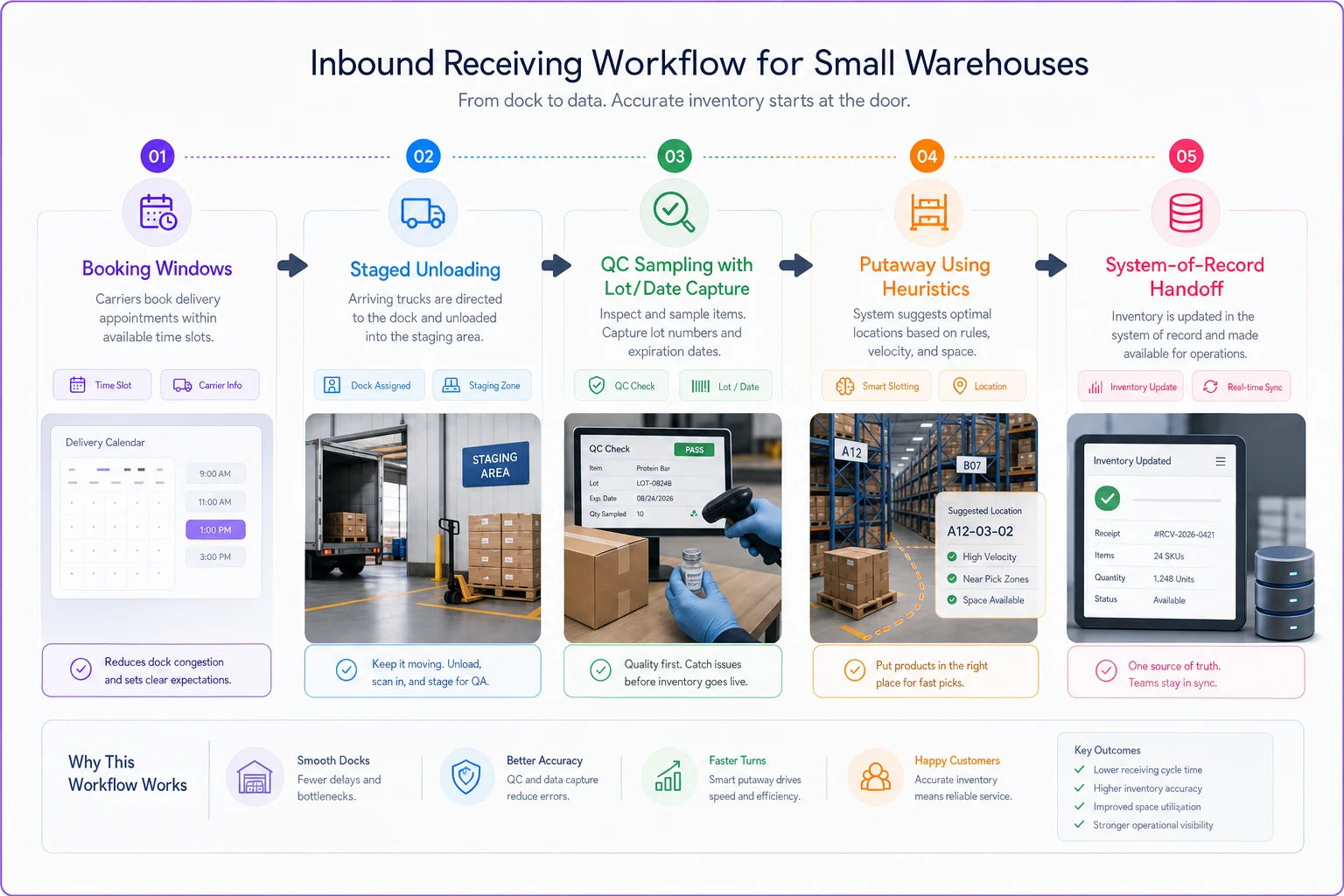
The reason this order matters: staging creates a buffer where bad product can be caught before it contaminates your sellable numbers. Skip staging, and QC becomes something you do on the shelf, which means damaged or wrong stock is already live and pickable.
Notice where the system-of-record moment sits — at putaway, tied to a specific location. That's the handoff point where physical reality and digital reality get synced. Get that moment consistent and most of your "the count is wrong again" problems quietly disappear.
What breaks as you scale
The version above works at low volume even if it's done on paper. It stops working at specific growth thresholds, and knowing where the cracks appear lets you get ahead of them.
-
One receiver becomes the single point of failure. Early on, one experienced person holds all the putaway logic in their head. Grow past a few dozen inbound lines a day and their knowledge becomes a bottleneck and a risk. The fix is writing the heuristics down so anyone can execute them.
-
Paper putaway logs stop keeping up. A location scribbled on a clipboard is fine at ten putaways a day. At a hundred, transcription lag means your system is hours behind reality during your busiest windows — exactly when accuracy matters most.
-
QC-by-memory falls apart across multiple people. When two or three people share receiving, "I usually check the fragile ones" isn't a plan. Sampling rules have to be explicit and tiered, or every receiver invents their own standard.
-
Overflow zones metastasize. Growth means more overflow, and undocumented overflow is where inventory goes to hide. Past a certain volume you need overflow locations tracked as real, named locations — not a vague "back corner."
The common thread: everything that lived in someone's head has to become a written rule and a recorded transaction as you scale. This is where lightweight software earns its place — not as a magic fix, but as the thing that captures the location and lot data at the moment of putaway so the system-of-record moment actually happens in real time instead of hours later. The playbook is the logic; the tooling just keeps the record honest when volume outpaces memory.
A real scenario: before and after
A small home-goods distributor — around a dozen staff, several hundred active SKUs — had a receiving process that was basically "unload and stack." Freight went straight to the floor, putaway happened whenever someone had a spare minute, and locations were remembered rather than recorded.
Before: Their inbound-to-sellable lag was routinely a full day, sometimes two. During that lag, the website was selling product the system didn't know existed yet, and pickers were hunting for product the system thought was there but couldn't be found. A slow but steady stream of damaged goods kept showing up at the pick face — stuff that should've been caught at receiving, logged against the supplier, and turned into a credit conversation.
What changed: They introduced two booking windows, a small staging area, a two-tier QC sample (light for trusted suppliers, heavier for two problem suppliers and all new SKUs), and a rule that putaway wasn't "done" until the location was recorded. No new headcount.
After: Inbound-to-sellable lag dropped to same-day for almost everything. Pick-face hunting fell off noticeably because product was where the heuristic put it. Damaged-goods surprises largely moved back to the dock, where they belong — caught during QC instead of discovered mid-pick. The individual numbers weren't dramatic, but the compounding effect across every order was the real win.
When this playbook isn't worth the effort
If you're receiving a handful of deliveries a week and one person handles everything comfortably, don't build heavy structure for its own sake. A single trusted receiver with a good memory genuinely works at very low volume, and forcing booking windows on two suppliers who deliver twice a month is overhead you don't need.
The playbook starts paying off when any of these are true: inbound volume is enough that pileups happen, more than one person shares receiving duties, you carry lot-controlled or dated product, or you sell across channels where oversells hurt. Below that threshold, keep it simple. The mistake is building the full machine before the volume justifies it — the same way the bigger mistake is not building it once the volume clearly does.
The takeaway
Inbound isn't a chore to get through — it's the control point that decides whether your inventory numbers can be trusted for the rest of the day. Booking windows shape when the work arrives, QC sampling decides what's allowed to become sellable, and putaway heuristics decide whether pickers spend their time picking or hunting. Keep those three jobs distinct, sync the system-of-record at the moment of putaway, and write the logic down before your busiest person becomes your biggest operational risk.
Ready to optimize your inventory operations?
Join 2,000+ businesses using Listoly to reduce stockouts, save time, and improve order accuracy.