



Most short-dated write-offs aren't a demand problem. They're a coordination problem. Buying happens on one calendar, picking happens on another, and promotions get planned by a completely separate person who has no idea a pallet is 40 days from expiry sitting in the back of aisle 6. Each function is doing its job. The stock still dies.
That's the frustrating part about shelf-life losses in an SMB. The write-off shows up in the P&L as one clean number at month-end, but the actual cause is scattered across four or five decisions made weeks apart by people who never talked to each other. You can't fix that by yelling at the receiving team or tightening the markdown rules. You have to treat shelf-life as something that gets governed across the whole flow — from PO to pick face to promo calendar to markdown ladder.
This is what shelf life governance SMB operations actually need: portfolio-level rules that connect procurement, picking, promotions, and markdown sequencing to defined shelf-life buckets, plus a way to measure what you avoided losing, not just what you lost.
Why short-dated stock slips through even when everyone's competent
Walk the flow and you'll see the same handoff gaps regardless of industry — grocery, cosmetics, pharma, pet food, craft beverages, whatever.
Procurement buys to a landed-cost target and an MOQ. Nobody's wrong to do that, but the moment you accept a case pack that covers 90 days of demand on a product with a 120-day shelf life, you've already baked in risk. There's no room for a supplier delay, a soft sales week, or a competing promo. Receiving takes it in, dates it (maybe), and slots it wherever there's space.
Picking is where the second break happens. Most small warehouses pick by proximity or by whatever's easiest to grab, not by date. So the freshest cases go out the door because they're stacked on top, and the older stock sinks to the bottom. Six weeks later someone finds it. This has nothing to do with forecasting — it's pure physical flow, and it's probably the most common failure in short-dated operations.
Then promotions. Marketing plans campaigns around margin and calendar events, not around what's aging. So the promo that could have cleared a short-dated lot gets pointed at a fresh, full-margin SKU instead. Two departments, two goals, zero shared visibility into remaining shelf-life.
By the time markdowns kick in, it's usually too late to recover much. The stock is inside the "nobody buys it even at 50% off" window, and you're just choosing between a deep discount and a disposal fee.
The pattern underneath all of this: nobody owns the product across its shelf-life timeline. Each function owns a slice.
Bucket the portfolio first — everything else hangs off this
You can't govern shelf-life with a single blanket rule because a 14-day yogurt and a 24-month canned good need completely different handling. The starting move is sorting your SKUs into shelf-life buckets, then attaching different procurement, picking, and markdown behavior to each one.
Never run out of stock or overorder again.
Listoly streamlines inventory workflows to keep your business stocked and profitable.
- Real-time stock tracking
- Automated reorder alerts
- Supplier and purchase management
No credit card required
| Bucket | Total shelf-life | Buy horizon cap | Pick rule | Markdown trigger (days left) | Promo priority |
|---|---|---|---|---|---|
| Ultra-short | Under 21 days | Max 40–50% of shelf-life in one buy | Strict FEFO, enforced daily | At ~35% remaining | Highest — clear proactively |
| Short | 21–90 days | Max ~60% of shelf-life | FEFO, checked at pick | At ~30% remaining | High |
| Medium | 90 days–12 mo | Cover to reorder point normally | FEFO on receipt, spot checks | At ~20% remaining | Medium |
| Long | 12 mo+ | Standard reorder logic | FIFO acceptable | At ~15% remaining | Low, opportunistic |
The buy-horizon cap is the part people skip, and it's the highest-leverage rule in the table. If you never let a single PO cover more than half the shelf-life on an ultra-short item, most of your downstream rescue work disappears before it starts. You're solving the problem at the checkbook instead of at the clearance rack.
FEFO (first-expiry-first-out) matters more than FIFO here because received-date and expiry-date aren't always in the same order — a later shipment can have an earlier expiry if the supplier rotated their own stock poorly. If you're picking by receipt date, you'll still ship the wrong units.
The procurement-to-pick handoff that actually prevents loss
Governance lives or dies in the handoff. Here's the workflow that keeps short-dated stock moving instead of sinking.
At receiving, every short and ultra-short bucket item gets an expiry captured — not just a receipt date. If the case shows a date that puts it into the markdown window before your realistic sell-through, that's a receiving-time flag, not a month-end surprise. Some SMBs push the case back to the vendor at that point; a lot of them just don't realize they're allowed to.
At put-away, short-bucket items get slotted so the pick face always exposes the earliest expiry. In a small operation this can be as simple as a "front-load the oldest" rule and a taped date label facing the aisle. You don't need a WMS to do this. You need someone to own the rule and a physical layout that makes the right action the easy action.
At pick, the system (or the pick sheet) tells the picker which lot to pull. When you're tracking lots at all, this connects directly to broader traceability discipline — the same lot-level control that matters for recalls also drives correct FEFO picking. If you haven't set that up, a lightweight lot-traceability and recall runbook is the foundation shelf-life picking sits on top of.
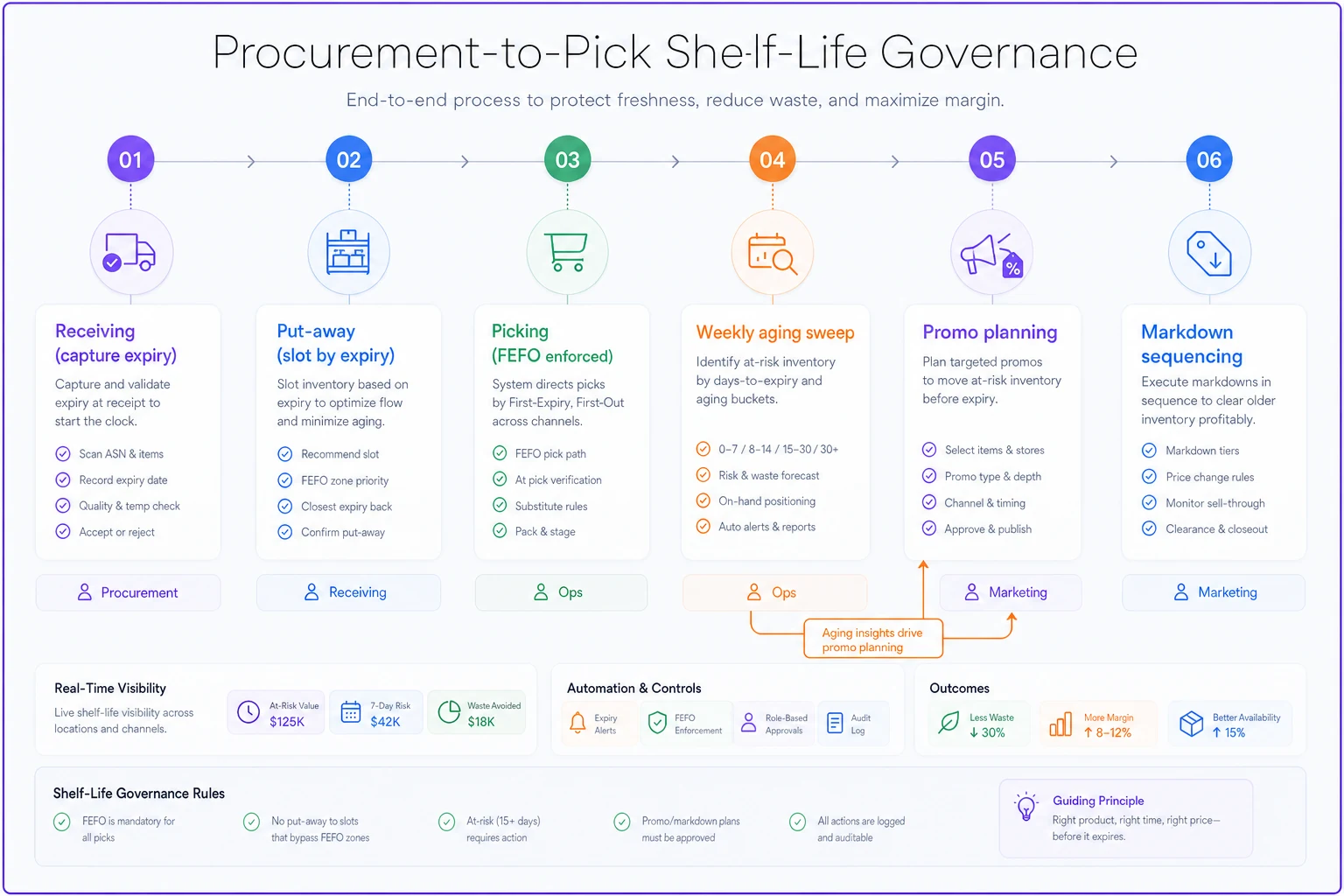
Then there's a weekly aging sweep. Someone pulls a report (or walks the racks) and identifies everything crossing into its markdown-trigger window in the next 7–14 days. That list is the input for promotions and markdowns — it's the connective tissue between operations and marketing.
The loop, in order, because this is the part worth getting exactly right:
-
Capture expiry at receipt for short/ultra-short buckets.
-
Flag any received lot already inside its markdown window → decide vendor return or immediate action.
-
Slot to expose earliest expiry at the pick face.
-
Pick by FEFO, enforced by the pick sheet or system.
-
Run a weekly aging sweep 7–14 days ahead of each markdown trigger.
-
Feed the aging list to promo planning before markdowns, then to markdown sequencing if promo can't clear it.
-
Record the outcome for avoidance-of-loss measurement (below).
This diagram shows the handoff steps and who acts at each stage.
Pro tip: Tape the expiry date to the case front so pickers can FEFO without full system support.
Sequencing promotions and markdowns so you don't leave money on the table
The mistake almost everyone makes: treating markdown as the first tool instead of the last. Once you cut price, that margin is gone. The smarter sequence uses your free levers first.
The order that recovers the most margin:
-
Promo placement first. If an item's entering its aging window, point an already-planned promo at it instead of a fresh SKU. Same marketing spend, but now it's clearing risk instead of discounting healthy stock. This is exactly the overlap zone where promo timing and replenishment collide — the same coordination discipline behind promo-safe replenishment applies here in reverse: you're using the promo to drain stock rather than protect against overselling it.
-
Placement and merchandising second. Move the aging lot to a higher-traffic shelf, an endcap, a bundle. Costs nothing but labor.
-
Staged markdown third. Don't jump to 50%. A ladder — say 15% → 30% → 50% — timed against remaining days, captures more margin than one deep cut. The trick is starting the ladder early enough that the first, shallow step has time to work.
-
Channel shuffle fourth. Push to a clearance channel, a discount partner, staff sale, or a food bank/donation for the tax treatment if it's food.
The failure that shows up constantly: businesses start the markdown ladder at 20% remaining shelf-life, which is far too late for the shallow steps to matter, so they crash straight to the deep discount and recover almost nothing. Move your first markdown trigger earlier and the whole ladder gets more valuable.
When aggressive markdown is actually the wrong call
If an item is a repeat-purchase staple and you deep-discount it every cycle, you're training customers to wait for the sale. That's a bad idea for anything with predictable, steady demand — you're not rescuing stock, you're eroding your own price. For those SKUs, fix the buy quantity instead. The markdown ladder is for genuinely aging, unpredictable, or overbought lots, not as a standing crutch.
Measuring avoidance-of-loss (not just loss)
Here's the measurement gap that keeps shelf-life governance from getting funded internally: you can measure write-offs easily, but you can't easily measure the write-offs you prevented. So the whole discipline looks like a cost center with no visible upside. You need to make the saves visible.
The core idea: for every unit that entered its markdown window, estimate the loss that would have occurred, subtract the recovery you actually got, and log the difference as avoided loss.
A simple avoidance-of-loss log per rescued lot:
-
SKU / lot / expiry date
-
Units at risk (entered markdown window)
-
Unit cost
-
Baseline loss if unsold (units × cost, or cost + disposal fee)
-
Rescue path used (promo / placement / markdown step / channel)
-
Recovery value (units sold × net price after discount)
-
Avoided loss = recovery value credited against would-be write-off
-
Margin sacrificed (full-price margin − realized margin) — so you're honest about the cost of rescue
Track two roll-up numbers monthly:
-
Shrink rate from expiry (units or dollars written off ÷ units or dollars at risk). This should trend down as governance tightens.
-
Recovery rate on at-risk stock (dollars recovered ÷ baseline loss dollars). This should trend up.
A real-shaped example: a regional specialty grocer with roughly 900 perishable SKUs was writing off somewhere around $6k–$8k a month on short-dated stock. When they dug in, most of it came from two behaviors — over-buying ultra-short items on vendor deals, and picking by convenience so old stock sank. They capped ultra-short buys at around 45% of shelf-life, moved to FEFO at the pick face, and started the aging sweep two weeks ahead of markdown triggers.
Write-offs didn't go to zero — they never do. But within about a quarter, monthly expiry losses were closer to $2.5k–$3.5k, and the avoidance log showed roughly $3k–$4k a month in stock that got cleared through promo placement and staged markdowns instead of the dumpster. The margin sacrificed on those rescues was real, but it ran well under what a full write-off would've cost. The number that actually changed behavior internally was the recovery rate — once marketing could see they'd cleared aging stock, the weekly aging list stopped getting ignored.
Where this breaks as you grow — and how the system has to change
At one location with a couple hundred SKUs, you can govern shelf-life with a whiteboard and one attentive person. The rules above run on labels and a weekly walk. That works right up until it doesn't.
-
Two-plus locations. A short-dated lot at Store A could be sold at Store B, but nobody knows because visibility is siloed. Transfers become part of your rescue toolkit — but only if you can see aging stock across sites.
-
More SKUs, mixed velocity. The weekly manual sweep gets too big to do by eye. Things fall through. You need the aging report to generate itself and flag only what's crossing a trigger.
-
More promo activity. When you're running several overlapping campaigns, aligning them to the aging list by hand becomes a scheduling mess, and the whole point — clearing risk with planned spend — quietly stops happening.
This is where a workflow platform earns its place. Not because the rules change — the FEFO logic, the buy-horizon caps, the markdown ladder stay exactly the same — but because coordination becomes the bottleneck instead of the rules themselves. When receiving, picking, aging alerts, and the promo calendar all read from one inventory picture, the weekly sweep becomes an automatic flag, the aging list routes itself to whoever plans promos, and cross-location rescue becomes a suggestion instead of a lucky discovery. AI-assisted operational software mostly helps here by watching expiry windows across the whole catalog and surfacing the handful of lots that need a decision this week, so a person isn't manually scanning hundreds of dates. The judgment stays human. The tracking stops depending on someone remembering to walk the aisle.
The tell that you've outgrown the manual version: your write-offs start creeping back up even though your rules are good. That almost always means the rules are fine but the coordination is failing under volume.
Putting it together
Shelf-life governance isn't a markdown policy or a picking rule in isolation — it's the thread that runs from the buy decision all the way to the clearance shelf, with each stage handing off to the next. Cap the buy horizon so you don't over-commit. Slot and pick by expiry so old stock surfaces instead of sinking. Sweep ahead of your markdown triggers so promotions get first crack at aging lots. Sequence your rescue levers from free to expensive. And measure the losses you avoided, not just the ones that hit the P&L, so the discipline earns its keep internally.
The businesses that get this right aren't the ones with the strictest markdown rules. They're the ones where procurement, picking, and promotions are actually looking at the same aging picture — and acting on it a couple weeks before the write-off would've happened, instead of a couple weeks after.
Ready to optimize your inventory operations?
Join 2,000+ businesses using Listoly to reduce stockouts, save time, and improve order accuracy.