


Most small warehouses don't lose inventory in dramatic ways. There's no forklift driving out the back door loaded with product. It's slower and quieter than that — a few units here, a miscount there, a return that never got scanned back in, a case that got crushed and tossed without anyone logging it. By the time the annual count rolls around, you're staring at a $9k gap and nobody can tell you where it came from.
That's the frustrating part about shrink in small facilities. It's rarely one big problem. It's twenty tiny leaks spread across receiving, picking, packing, returns, and the trash bin behind the building. And because you've got maybe four to eight people running the whole operation, nobody owns loss prevention as a job. It's just something that's supposed to happen on top of everything else — which means it mostly doesn't.
So instead of talking about cameras and locked cages (helpful, but expensive and slow to pay off), this is about building a loss-prevention system that runs on the staff and space you already have. Zoning, end-of-day checks, a mystery-shop-style audit cadence, and reconciliation templates that take minutes, not hours. The goal isn't to catch a thief. It's to make the leaks visible fast enough that they can't compound.
Why shrink hides so well in small operations
The core issue is that small facilities blend responsibilities. The same person who receives the truck also picks orders, handles returns, and sometimes rings up a will-call customer. When one person touches inventory at five different points, there's no natural checkpoint where a discrepancy has to surface.
Bigger operations have product physically moving between zones controlled by different teams, and each handoff creates a natural audit point. Receiving counts it in, putaway confirms it, pickers pull against it. If the numbers don't match at a handoff, someone notices. Small warehouses skip most of those handoffs, so errors flow straight through to the count with nothing to stop them.
A few patterns come up repeatedly:
-
Returns are the biggest silent leak. Product comes back, gets set on a shelf "to deal with later," and either never gets scanned in or gets scanned in wrong. Then it's picked, and now your system shows stock you physically don't have — or the reverse.
-
Damage never gets logged. A staff member finds a crushed carton, tosses it, and moves on. Perfectly reasonable in the moment. But that's a shrink event that never touched the system, so your count will be short with no explanation.
-
Miscounts at receiving quietly poison everything downstream. If you receive 48 and log 50, you're already short two units before a single order ships. Nobody caused it on purpose and nobody will ever find it.
Worth saying plainly: most small-facility shrink isn't theft. It's process gaps. Which is actually good news, because process gaps are cheap to fix once you can see them. If your system numbers and your shelf numbers keep drifting apart in ways that don't add up, that's worth troubleshooting on its own — we walked through a prioritized approach for that in fixing POS vs warehouse inventory mismatches.
Zoning: the cheapest control you're probably not using
Zoning sounds like a slotting or efficiency topic, but it's also your first loss-prevention tool. The idea is simple: divide the facility into a small number of accountability zones, and assign each zone to a person or a shift. Not physical walls — just clear boundaries and clear ownership.
Never run out of stock or overorder again.
Listoly streamlines inventory workflows to keep your business stocked and profitable.
- Real-time stock tracking
- Automated reorder alerts
- Supplier and purchase management
No credit card required
When a zone has an owner, discrepancies in that zone have a name attached. Not to punish anyone — to ask the right question. If Zone B keeps coming up short, the problem is probably something structural in Zone B: a confusing bin layout, a spot where returns pile up, two SKUs that look identical sitting next to each other.
A practical way to think about zone design for a small facility:
| Zone | What it holds | Shrink risk | Control focus |
|---|---|---|---|
| Fast-movers / A-items | Top 15–20% of SKUs by volume | High (touched constantly) | Daily spot counts |
| Bulk / reserve | Backstock, full cases | Low-medium | Weekly cycle count |
| Returns / quarantine | Anything coming back or in question | Very high | Same-day processing rule |
| High-value / small | Expensive, pocketable items | High per-unit | Restricted access, weekly count |
| Damage / disposal | Write-offs before they leave | Hidden | Log-before-toss rule |
The two zones that quietly cause the most trouble are returns and damage/disposal. Most small warehouses don't treat those as real zones at all — they're just "over there somewhere." Giving them a defined spot and an owner is often the single highest-return change you can make, because that's where product disappears without ever generating a record.
Don't over-zone; four to six zones is usually the sweet spot.
Fewer zones that people actually respect beat a perfect map nobody follows.
End-of-day checks: catch drift while it's still small
The single most effective habit in small-facility shrink prevention is a short, structured end-of-day check. Not a full count — that's the mistake people make. They try to count everything, it takes two hours, they do it once, and never again.
The whole point of an end-of-day check is that it's fast enough to actually happen every day. Ten to fifteen minutes. You're not counting the whole warehouse; you're checking the handful of things that drift fastest and confirming the day closed clean.
A workable end-of-day check for a small team:
-
Zero out the returns zone. Every returned item that came in today should be either scanned back into stock or moved to quarantine with a reason. Nothing sleeps in "to deal with later."
-
Confirm damage/disposal was logged. Anything thrown out today has a matching write-off entry. If the disposal bin has product in it with no log, that's your gap.
-
Spot-count 3–5 fast-moving SKUs. Rotate which ones. This is your early-warning system — fast-movers drift first, so if something's off, you'll usually see it here before the monthly count.
-
Reconcile will-call / walk-out sales. Any product that left without a normal pick-and-ship needs a matching transaction. This is where a lot of small operations quietly bleed.
-
Flag anything weird. A shelf that looks lighter than it should. A bin that's out of order. Write it down; don't fix it in your head and forget about it.
Daily beats thorough. A tiny check every day surfaces problems while they're still one or two units. A perfect count once a quarter just tells you how badly you've been bleeding for three months — with no way to trace it back to a cause.
Keep the check on paper or a shared sheet if that's what gets it done. The format matters far less than the consistency. A messy check that happens 300 days a year is worth more than a beautiful one that happens four times.
A quick visual of the end-of-day check workflow helps teams learn the routine.
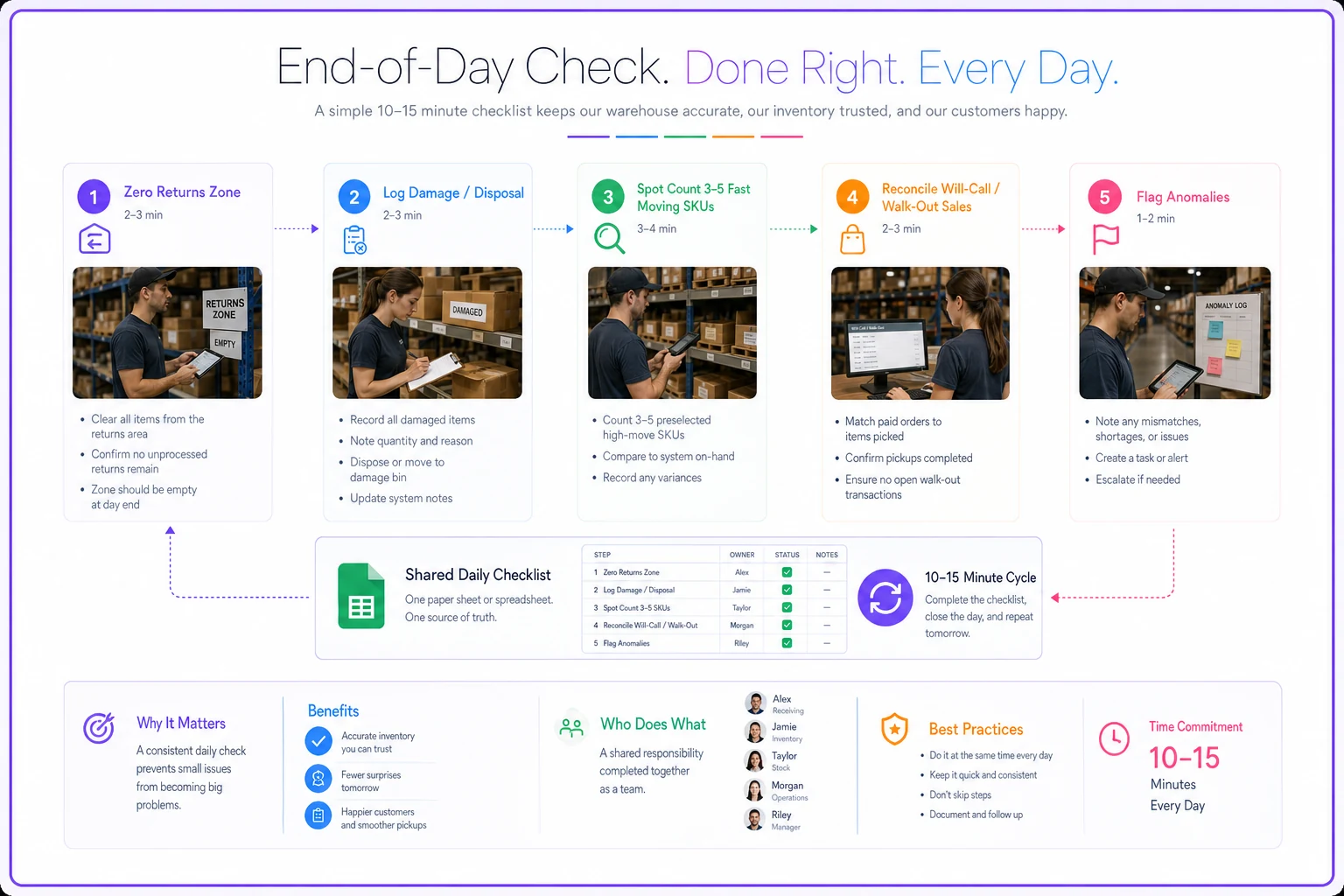
Ten to fifteen minutes. You're not counting the whole warehouse; you're checking the handful of things that drift fastest and confirming the day closed clean.
Mystery-shop audits: testing the system, not the people
This concept is borrowed from retail and almost no small warehouse uses it: the mystery-shop audit. Instead of announcing "we're counting Zone B today," you run occasional unannounced probes to test whether your controls actually hold up under normal conditions.
This isn't about catching staff off guard to punish them. It's about testing the process. Announced audits always look clean, because people tidy up when they know you're checking. Unannounced probes tell you what's actually happening on a normal Tuesday.
Some probes worth running:
-
Pick a random SKU and trace it fully. Does the system quantity match the shelf? Do recent movements have matching records? Pick one SKU a few times a week.
-
Follow one return end to end. Grab a return that came in yesterday. Can you prove where it went? Restocked, quarantined, written off — is there a trail?
-
Test the damage log. Look in the disposal area. Is everything there accounted for in write-offs? Or is there mystery product?
-
Time-check a fast-mover. Count one A-item at open and again at close against expected sales. Big unexplained gaps point to either miscounts or something leaving unrecorded.
On cadence, keep it unpredictable but regular. Roughly two or three probes a week, rotating zones and SKUs, works well for a small facility. Predictable audits get gamed; too-frequent audits burn out a small team. A light, rotating rhythm keeps the system honest without becoming a burden.
One pattern worth naming: if the same zone or the same SKU keeps failing probes, stop treating it as a counting problem and start treating it as a design problem. Recurring failures almost always mean the layout, the labeling, or the workflow in that spot is set up to produce errors.
Simple reconciliation templates that don't eat your week
Reconciliation is where good intentions go to die. Everyone agrees you should reconcile regularly. Then the template someone built has forty columns, takes an afternoon, and gets abandoned by week three.
The reconciliation you'll actually keep up is embarrassingly simple. For each SKU or zone you're checking, you want just enough to answer one question: does expected match actual, and if not, why?
A minimal reconciliation line looks like this:
-
SKU / zone
-
Expected quantity (system)
-
Actual quantity (counted)
-
Variance (the difference)
-
Likely cause (miscount, damage, return error, unknown)
-
Action (adjusted / investigating / resolved)
Six fields. The magic isn't in the template — it's in the "likely cause" field. That column is what turns reconciliation from a bookkeeping chore into a diagnostic tool. Over a month, if you tally causes, a pattern jumps out. Maybe 60% of your variance traces to returns, or one supplier's cartons keep arriving short. Now you know exactly where to spend your fixing energy instead of guessing.
Run it on a cadence that matches risk. Fast-movers and high-value items weekly. Bulk/reserve monthly. Everything else on your normal cycle count. You're not reconciling the whole warehouse at once — you're spreading small, focused reconciliations across the month so nothing goes unchecked for long and no single day gets swallowed.
Returns deserve their own reconciliation line, because they're both a shrink source and a fraud source. When your return volume climbs and your variance climbs with it, some of that gap may not be honest mistakes — it can be return abuse slipping through. We covered practical, low-cost ways to spot that in heuristics to detect and stop returns fraud, and it pairs naturally with a tight returns-zone process.
A real scenario: the 3PL-adjacent small distributor
A regional distributor running around 3,500 SKUs out of a single facility with six warehouse staff kept hitting a shrink number they couldn't explain. Their annual physical count came in roughly $11k–$13k short two years running. Insurance covered a sliver of it, but mostly it just came off the bottom line, and nobody could say where it went.
When they mapped where product actually touched hands, two things stood out. Returns were being stacked on a "return shelf" and processed in batches whenever someone had time — sometimes days later — so system and shelf constantly disagreed. And damaged goods were just being tossed with no log, because logging felt like extra work when the trash can was right there.
They didn't buy cameras. They did four things: defined a returns zone with a same-day-processing rule, added a log-before-toss rule for damage, started a 12-minute end-of-day check, and ran two unannounced probes a week. The end-of-day check alone caught a receiving miscount pattern with one supplier within the first month — cartons labeled 24 that consistently held 22 or 23.
By the next annual count, the unexplained gap was down to somewhere around $3k–$4k, and most of what remained now had a cause attached instead of being a black hole. Same staff, no new hardware, maybe fifteen minutes of added routine a day. The win wasn't catching a culprit — it was making the leaks visible early enough to plug them.
When this system makes sense — and when it doesn't
This approach works well in specific conditions. If you have under roughly 15 warehouse staff and no dedicated LP role, your shrink is showing up as unexplained gaps at count time rather than obvious theft, returns and damage are handled informally, and you've got basic inventory tracking but weak daily discipline around it — this is probably the right place to start.
It's the wrong focus when you have evidence of actual theft. That's a security and HR problem, not a cadence problem. It also won't help if your core inventory records are so broken that expected quantities are meaningless — reconciling against garbage numbers just produces confident-looking nonsense. Fix the data foundation first.
If you're so short-staffed that even a 12-minute daily check genuinely can't happen, the honest move is to shrink the scope rather than pretend a full routine will stick. Check only returns and one or two high-value zones. Something small and consistent beats an ambitious system that runs for two weeks.
Very early operations with a few hundred SKUs and one or two people probably don't need most of this yet. At that size you can more or less see all your inventory, and the overhead of formal zoning and probes outweighs the benefit. Wait until the facility gets big enough that no single person can hold the whole picture in their head — that's when these controls start earning their keep.
Where software quietly helps — without replacing the habits
None of this requires software to start. Paper checklists and a shared spreadsheet will get you most of the way. But there's a point, usually as SKU count and staff grow, where doing this manually starts to break down — variance tracking spread across sheets nobody consolidates, end-of-day checks that get skipped with no visibility into whether they happened, cause-codes that never get tallied into a real pattern.
That's where AI-powered operational software starts to matter. The useful version isn't flashy: it flags when a fast-mover's count drifts outside its normal range, nudges staff when a returns zone hasn't been cleared by end of day, and quietly rolls up reconciliation cause-codes so the pattern shows itself instead of waiting for you to notice. It handles the remembering and the tallying — the parts a busy small-facility team reliably drops — so everyone can focus on the physical work.
The order matters, though. Build the habits first. Software amplifies a working system; it doesn't create one. If you automate a broken process, you just get broken results faster and with a nicer dashboard.
Pulling it together
Shrink prevention in a small warehouse isn't a security project — it's an operating rhythm. Zoning gives every part of your inventory an owner and a natural checkpoint. End-of-day checks catch drift while it's still one or two units. Mystery-shop probes test whether your controls actually hold up on a normal day. Reconciliation templates turn scattered variance into a diagnosable pattern with a cause you can act on.
The businesses that get shrink under control aren't the ones that spent the most on cameras and cages. They're the ones that made loss visible fast, assigned it a name, and built a few small daily habits that a stretched team could actually sustain.
Start with your returns zone and a ten-minute end-of-day check this week — that's usually where the biggest, quietest leaks are hiding, and it's the cheapest place to start plugging them.
Ready to optimize your inventory operations?
Join 2,000+ businesses using Listoly to reduce stockouts, save time, and improve order accuracy.