


Most SMBs don't fail at external signals because they ignore them. They fail because they notice a signal, nod at it, and then do nothing structured with it. Someone sees a cold snap coming, mentions it in the morning huddle, and the reorder still goes out at the same quantity it always does. The signal existed. The response didn't.
The gap is almost never a data problem. It's a translation problem. You have a signal in one language — a weather forecast, a Google Trends bump, a carrier telling you the ship is two days late — and you need it in another language: how many cover days do I carry this week, and when do I release the next tranche of a pre-buy? Nobody owns that translation step, so it doesn't happen consistently.
This post is about closing that one gap. Not building a demand-sensing engine. Just a clean, repeatable way to take the three signals that actually move short-term cover for small businesses — external demand signals for SMB inventory work best when they're boiled down to this — and turn each into a concrete adjustment you can act on the same day.
The three signals worth reacting to
Plenty of external data exists. Very little of it changes what you do this week. For short-term cover and pre-buy timing, three signals carry most of the weight for small operations:
-
Search trend movement — Google Trends, marketplace search-term reports, or your own site search spikes. Leading, noisy, but fast.
-
ETA drift — the gap between the lead time you planned and the lead time your inbound POs are actually running. Lagging slightly, but very reliable.
-
Weather — not "it's going to rain," but specific demand-shifting or delivery-disrupting events with a 3–10 day horizon.
Everything else — interest rates, macro headlines, competitor moves — matters for quarterly planning, not for "do I bump cover this week." Keep the short-cycle list short on purpose. The moment you're tracking eight signals, you're tracking none of them well.
The mistake most businesses make: they weight search trends too heavily and ETA drift too lightly. Search is exciting and visible. ETA drift is boring and buried in your PO notes. But ETA drift is the one that quietly turns a healthy stock position into a stockout three weeks later, because it compounds across every open order at once.
Signal catalog: what each one maps to
Here's the core of it — a direct mapping from signal to action. The point isn't that these exact numbers fit your business. The point is that every signal has a pre-decided response so you're not improvising under pressure.
Never run out of stock or overorder again.
Listoly streamlines inventory workflows to keep your business stocked and profitable.
- Real-time stock tracking
- Automated reorder alerts
- Supplier and purchase management
No credit card required
| Signal | What you're watching | Trigger threshold | Cover-day adjustment | Tranche / pre-buy effect |
|---|---|---|---|---|
| Search trend up | Category search or site search, 7-day vs prior 7-day | +25% sustained 3+ days | +2 to +4 cover days on affected SKUs | Pull next tranche forward by ~1 week; don't increase total commit yet |
| Search trend down | Same, declining | −25% sustained 5+ days | −2 cover days, let it drift down naturally | Delay next tranche; hold commit |
| ETA drift (slipping) | Avg actual vs planned lead time, rolling 4 POs | +3 days or more | +1 cover day per extra lead-time day | Release next tranche early to cover the lengthened pipeline |
| ETA drift (improving) | Same, faster | −3 days sustained | Trim safety cover modestly | Push tranche later; capture the shorter pipeline as free buffer |
| Weather — demand event | Event 3–10 days out affecting category | Named event + relevant category | +3 to +7 cover days on weather-sensitive SKUs only | One-off top-up buy, not a standing increase |
| Weather — delivery disruption | Storm/heat affecting inbound or outbound | Carrier advisory or route risk | +1 to +2 cover days as delivery buffer | Pull tranche forward to beat the disruption window |
A few things worth saying about this table.
The cover-day adjustments are intentionally small. A single signal almost never justifies a big swing. Over-reacting to one search spike is how you end up with a garage full of product nobody wanted by the time your order landed. Small, additive moves let you stack signals — if search is up and ETA is drifting, you add both adjustments, and now you have a real reason to move.
The tranche column matters more than the cover column for pre-buys. For a seasonal or planned pre-buy, you've usually already decided roughly how much to commit. Signals shouldn't blow up that total week to week — they should move the timing of your releases. Pull a tranche forward when the pipeline is lengthening or demand is accelerating. Push it back when things are calming down. This is the same logic behind split-buy tactics in a compact seasonal pre-buy playbook — you keep optionality by not firing all your buys at once.
Why search trends mislead small teams (and how to use them anyway)
Search movement is the signal people trust most and understand least. The problem is that search leads demand by an inconsistent amount and it's wildly category-dependent. A spike in search for a $12 impulse item converts to sales within days. A spike for a considered purchase might convert over weeks, or not at all.
The useful filter in practice: only act on search trends for SKUs where you can already see early sell-through confirming the trend. Search says something's warming up; your own last-72-hours units say whether it's real. When both agree, you move. When only search is moving, you flag it and watch — you don't buy.
A common example: a small outdoor-gear seller sees category search for a specific jacket style jump roughly 30% week over week. Tempting to pre-buy hard. But their own units on that SKU are flat. Two weeks later search normalizes — it was an influencer post driving browsing, not buying. Had they mapped "search up, own sell-through flat" to watch, don't buy, they'd have saved themselves the commitment. That's the whole value of a pre-decided mapping: it protects you from your own excitement.
For SKUs with thin history where you can't lean on sell-through confirmation, you're better off anchoring to a structured low-data approach rather than chasing search noise. The logic in a low-data inventory forecasting framework gives you a base to adjust from, instead of treating every search blip as new information.
ETA drift: the signal that compounds while you're not looking
Here's the pattern that burns people. Your planned lead time on a supplier is 21 days. Over the last month your actual receipts have been landing at 25, 26, 24, 27 days. Nobody updated the planning number. Every reorder placed in that window was calculated against 21 days, so every one of them is structurally short by about a week of cover.
That's not one stockout. That's a cluster of stockouts across a whole group of SKUs from the same supplier, all landing at roughly the same time — which is exactly when it hurts most.
ETA drift is worth tracking precisely because it's boring and invisible. The fix is almost embarrassingly simple:
-
Pull your last four receipts per supplier (or per lane if you import).
-
Calculate the average actual lead time.
-
Compare it to the planned lead time sitting in your reorder math.
-
If the gap is 3+ days, add one cover day per extra lead-time day to that supplier's SKUs.
-
If you're mid-pre-buy, release the next tranche early — the pipeline just got longer, so your buffer has to cover more transit.
Run the ETA check by supplier or lane to surface compounding drift early.
The subtle thing most teams miss: ETA drift should adjust your cover days, not just your reorder point. Reorder point tells you when to order; cover days tell you how much to carry. A lengthening pipeline attacks both, so you want the adjustment feeding both numbers.
Weather: separate demand events from delivery events
The biggest weather mistake is treating all weather as one thing. There are two completely different weather signals and they call for opposite responses in different parts of your catalog.
Demand-shifting weather changes what customers buy. A heatwave moves fans, electrolytes, and cooling gear. A cold snap moves heaters and specific apparel. The response is a short, targeted cover bump on the weather-sensitive SKUs only — and critically, a one-off top-up, not a permanent increase. The event ends; the demand resets. If you convert a weather spike into a standing cover change, you'll be overstocked the moment the weather turns.
Delivery-disrupting weather doesn't change demand at all — it threatens your inbound and outbound flow. A storm sitting over a carrier hub delays receipts whether or not customers are buying more. The response here is a modest delivery buffer and pulling a tranche forward to beat the disruption window, applied broadly rather than to specific SKUs.
The failure case is mixing them up: a business sees "big storm coming," panic-buys weather-sensitive product, then gets caught when the same storm delays the inbound order they rushed. Keeping the two weather responses on separate lines in your catalog stops that from happening.
The rapid-check decision template
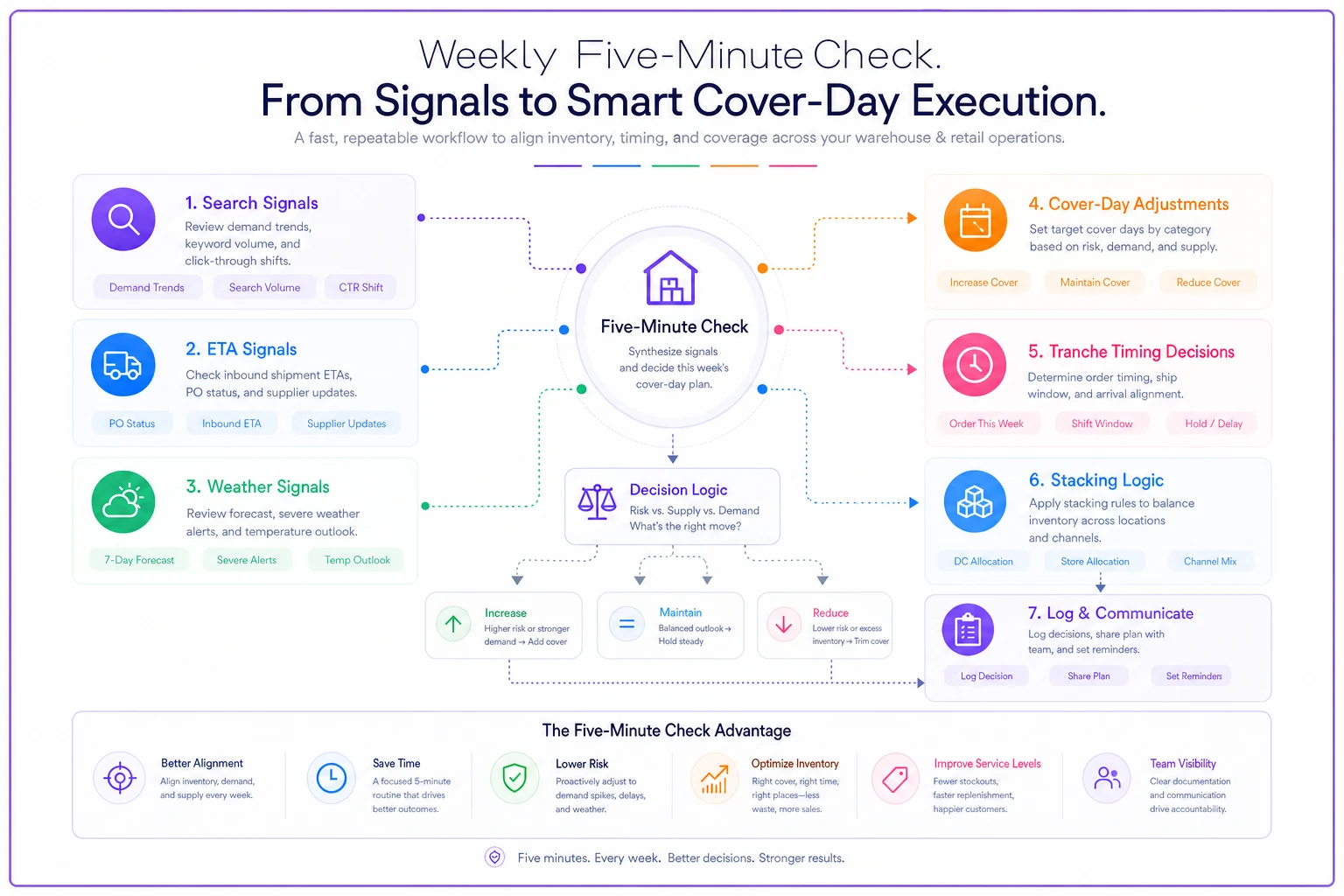
This is the part that makes the whole thing actually run. Once a week — and any day something obvious breaks — run a five-minute check. No tooling required. A notebook or a single spreadsheet tab is enough.
-
Search Is any tracked category up or down 25%+ over the trailing week? → Check own sell-through on those SKUs. Both moving? Apply the cover/tranche adjustment. Only search moving? Flag and watch.
-
ETA For each active supplier, is the last-4-receipt average 3+ days off the planned lead time? → Add one cover day per extra day. Release next tranche early if slipping.
-
Weather Any named event 3–10 days out? → Classify as demand event or delivery event (or both, separately). Apply the matching response to the right SKU set.
-
Stack Did two or more signals point the same direction on the same SKUs? → Combine the adjustments. This is your strongest buy signal.
-
Log Write down what you changed and why, in one line. Next week you check whether the signal actually paid off.
Here's a simple visual of the five-minute check flow.
That last step is the one people skip — and the one that makes you better over time. Logging "pulled tranche forward on SKU-44 because ETA drifted +4 days" means that in a month you can see whether the drift was real and whether your reaction was right-sized. Without the log, you're guessing forever.
When this makes sense — and when it doesn't
When it works well: businesses with genuine short-cycle volatility — seasonal categories, weather-sensitive products, imported goods with real lead-time variability, or anything with fast-moving search-driven demand. If your signals actually move your sales, a mapping like this pays for itself in avoided stockouts and avoided dead stock.
When it's a bad idea: slow, stable, intermittent-demand SKUs. Reacting to short-term signals on a product that sells a handful of units a month just adds noise and whipsaw. Those SKUs want steady reorder-point discipline, not weekly twitching.
Who should skip this entirely: if your core problem is that your on-hand numbers are wrong — mismatches between POS and warehouse, uncounted receipts, phantom stock — fix data accuracy first. Reacting to external signals on top of unreliable inventory data just means making confident wrong decisions faster. Signals amplify whatever foundation you have. Make sure it's solid.
A real scenario
A regional home-and-garden retailer — two stores plus a small online channel, around 1,200 active SKUs — kept getting caught on seasonal transitions. Their pattern: react to weather after it already hit, scramble for emergency POs, eat air freight or lose the sale.
They didn't buy anything new. They built a one-tab signal sheet and ran the five-minute check every Monday, plus any day a storm or heat advisory came through. Two mappings did most of the work: weather-demand bumps on roughly 40 weather-sensitive SKUs, and ETA-drift cover adjustments on their two slowest suppliers, who had quietly drifted from about 18 to 23 days on lead time without anyone noticing.
Over the following season, emergency POs dropped from somewhere around 9–10 per month at peak down to a handful. Stockouts on core seasonal lines fell noticeably, and they weren't sitting on nearly as much leftover product when the weather turned — because the weather bumps were one-off top-ups instead of standing increases. Nothing dramatic month to month. Just fewer fire drills and a cleaner end-of-season position. The win wasn't precision. It was consistency: the signal always produced an action, instead of a shrug.
The one habit that makes all of this stick
If you take nothing else from this: pre-decide the response before the signal arrives. The reason external signals get wasted isn't that small businesses can't see them. It's that in the moment, under pressure, with a dozen other things happening, nobody has the bandwidth to work out what a +4-day ETA drift actually means for cover. By writing the mapping down ahead of time, you turn a judgment call into a lookup. The judgment already happened, calmly, when you built the table.
Keep the signal list short. Keep the adjustments small and stackable. Separate demand weather from delivery weather. Let ETA drift move your cover days, not just your reorder timing. Log every change so the system teaches you what's actually worth reacting to. That's the entire discipline — and it runs on a spreadsheet and five minutes a week, long before you ever need anything fancier.
Keep the signal list short. Keep the adjustments small and stackable. Separate demand weather from delivery weather. Let ETA drift move your cover days, not just your reorder timing. Log every change so the system teaches you what's actually worth reacting to. That's the entire discipline — and it runs on a spreadsheet and five minutes a week, long before you ever need anything fancier.
Ready to optimize your inventory operations?
Join 2,000+ businesses using Listoly to reduce stockouts, save time, and improve order accuracy.