


Most SMBs don't lose integration battles in some dramatic outage. They lose them slowly — a marketplace that pushes an order with no SKU mapped, a 3PL feed that drops the unit of measure, a POS that resends the same sale twice during a flaky night sync. Nothing crashes. The numbers just drift until someone notices you oversold a bestseller by 40 units or that your month-end count is off by an amount nobody can explain.
The hard part is that these problems don't announce themselves. By the time a human catches them, the bad data has already flowed into reorder calculations, finance exports, and channel allocation. So this isn't really a "fix the sync" problem. It's a question of whether your integrations have an agreed-upon contract about what good data looks like — and whether you can see when that contract gets violated.
That's what this article is about: building lightweight inventory data contracts for SMB systems, plus the observability and remediation habits that keep small-team integrations honest without hiring a data engineer.
Why integrations drift even when "nothing changed"
A data contract is just a written agreement about the shape and meaning of data moving between two systems. What fields are required. What they mean. What format they're in. What happens when something's missing.
The reason SMBs skip this is understandable — most integrations start as a one-time setup. You connect Shopify to your inventory tool, map a few fields, confirm a test order came through, and move on. It works on day one. The problem is that every system on the other end of your integrations is a moving target. Marketplaces change payload formats. A supplier switches their EDI provider. Someone on your team adds a new sales channel and the field mapping was never updated to include it.
In real operations, drift usually shows up in a few predictable ways:
-
A channel starts sending orders with a SKU that doesn't exist in your master catalog, so the deduction silently fails
-
Two systems disagree on units — one speaks "cases," the other "eaches" — and nobody notices until a count is 12x off
-
A retry mechanism resends an order and you double-count a sale
-
A feed goes quiet for six hours and your "real-time" stock is actually stale
None of these are exotic. They're the normal failure modes of connecting systems that were never designed to talk to each other. The contract is what turns "we hope the data is clean" into "we reject and flag data that isn't."
This connects tightly to how you manage your catalog in the first place. If your inventory master data governance is loose — duplicate SKUs, inconsistent UOM, stale product records — then no data contract will save you, because the receiving system doesn't even know what "valid" means. Contracts and master data are two halves of the same discipline.
The required-fields layer: what every inbound message must carry
The first and cheapest thing to lock down is a required-field policy per integration. The rule is simple: if a message is missing a required field or fails a basic validation, it gets quarantined and flagged — it does not silently pass through and partially update your stock.
Never run out of stock or overorder again.
Listoly streamlines inventory workflows to keep your business stocked and profitable.
- Real-time stock tracking
- Automated reorder alerts
- Supplier and purchase management
No credit card required
Here's a practical baseline for an inbound order or inventory movement:
| Field | Required | Validation rule | What breaks if missing |
|---|---|---|---|
event_id | Yes | Unique, non-null | Can't dedupe; double-counting |
sku | Yes | Must exist in master catalog | Deduction fails silently |
quantity | Yes | Integer, > 0 | Zero/negative stock moves |
uom | Yes | Enum: each / case / pallet | 12x or 24x stock errors |
location_id | Yes (multi-site) | Known location code | Stock moves against wrong site |
timestamp | Yes | ISO-8601, not future-dated | Ordering/reconciliation breaks |
source_system | Yes | Known source enum | Can't trace origin of error |
unit_cost | Optional | Decimal ≥ 0 | Costing/landed-cost gaps |
A minimal valid payload for a sale might look like this:
{ "eventid": "shopify-2024-11-03-00184423", "eventtype": "sale", "sku": "TSHIRT-BLK-M", "quantity": 2, "uom": "each", "locationid": "STORE-01", "timestamp": "2024-11-03T14:22:07Z", "sourcesystem": "shopify", "unit_cost": 6.40 }
The insight most teams miss: the optional fields are where silent degradation lives. People validate the obvious ones — SKU, quantity — and let costing or location slide because "it usually comes through." Then three months later a finance handoff is off by a few thousand dollars and the trail goes cold. Decide explicitly what's optional versus required, and log when optional fields go empty. That log is often your first early warning that something upstream changed.
Idempotency keys: the one thing that prevents double-counting
If you take only one concept from this article, make it this one. An idempotency key is a unique identifier on every message that lets the receiving system say "I've already processed this — ignore the duplicate."
This matters because retries are everywhere in SMB integrations. Network blips, webhook timeouts, a scheduled sync that overlaps with a manual one. Without a key, a retried message looks identical to a brand-new event, and you deduct the same sale twice.
-
Message arrives with
event_id -
System checks
have I seen this ID before?
-
If yes → acknowledge success, do nothing else (this is the critical part — you still respond "OK" so the sender stops retrying)
-
If no → process it, record the ID, then acknowledge
The common mistake is generating the key on your side after receipt. That defeats the purpose — a retry from the source would generate a second key and look new. The key has to come from the source system and stay stable across retries. If a channel won't give you a stable ID, you can build a synthetic one from a combination of fields (order number + line item + SKU), but that's a fallback, not a first choice.
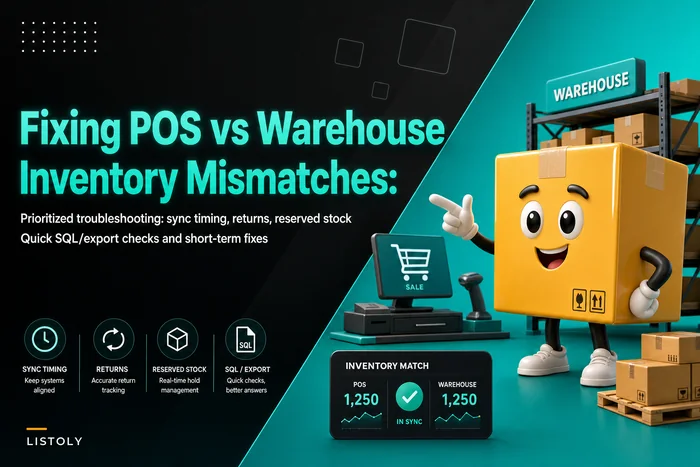
A lot of the POS-versus-warehouse mismatches teams spend hours chasing are actually idempotency failures wearing a disguise. If you're constantly reconciling store sales against warehouse stock and finding phantom deductions, it's worth working through a structured POS vs warehouse mismatch troubleshooting checklist before assuming the counts themselves are wrong — often the data was fine and the processing wasn't.
Reconciliation cadences: catch drift before it compounds
Contracts and idempotency prevent obvious errors. Reconciliation catches the quiet ones — the slow divergence between what two systems think is true. The question is how often you check, and against what.
-
Real-time (per message) validation and idempotency checks. Rejects bad payloads immediately.
-
Hourly count of messages received per source vs. expected volume. Catches a feed that went silent.
-
Daily stock-on-hand reconciliation between each sales channel's reserved quantity and your source-of-truth inventory. Catches oversell risk early.
-
Weekly movement reconciliation — sum of all sales/receipts/adjustments per SKU across systems should net out. Catches slow drift.
-
Monthly full financial reconciliation tied to your finance handoff and physical count samples.
The pattern worth internalizing: cheaper checks run more often, expensive checks run less often. A message-count check costs almost nothing, so run it hourly. A full SKU-level movement reconciliation is heavier, so weekly is usually enough to catch problems before they cost real money.
Run lightweight message-count checks hourly and reserve heavier SKU reconciliations for weekly cadence to catch issues without excessive cost.
A simple reconciliation rule in plain terms: For each SKU, (opening balance + receipts − sales − adjustments) should equal closing balance within a tolerance of zero units. Any SKU outside tolerance gets flagged with its contributing events for review. Tolerance of zero sounds strict, but in unit-level inventory it should be zero — a one-unit discrepancy is a real signal, not noise.
Observable metrics: what to actually watch
You can't remediate what you can't see. The goal isn't a fancy dashboard — it's four or five numbers that tell you whether your integrations are healthy. For most SMBs these are the ones that matter:
-
Latency — how long between an event happening and it landing in your system. If your Amazon feed normally lands in under 2 minutes and suddenly it's 40, your stock is stale and oversell risk is climbing.
-
Error / rejection rate — percentage of messages failing validation. A baseline of near-zero that jumps to 3–5% almost always means an upstream format change.
-
Drift — the gap found at each reconciliation. Track it as a count of out-of-tolerance SKUs over time, not a single pass/fail.
-
Volume anomalies — messages per source vs. expected. Zero messages from a normally-chatty channel is often the earliest sign something broke.
-
Duplicate-caught rate — how many messages your idempotency check rejected as already-seen. A spike here tells you a source system is misbehaving on retries.
One thing worth noting from watching small operations: the error rate is the metric people watch, but the volume anomaly is the one that actually saves them. A channel sending malformed data at least tells you it's alive. A channel sending nothing looks exactly like "a quiet sales day" until you're two days into stale stock. Alert on silence, not just errors.
Lightweight remediation playbooks
When a check fails, the worst outcome is a flag nobody knows how to act on. Each alert needs a short, repeatable response. The point is that a part-time team member can execute it without escalating every time.
Playbook: SKU not found in catalog (validation rejection)
-
Message is auto-quarantined, not processed
-
Check whether the SKU is new/unmapped or a typo variant of an existing one
-
If new → add to master catalog with full attributes, then reprocess from quarantine
-
If a bad variant → correct the mapping at the source channel, reprocess
-
Log the root cause so repeat offenders get escalated to a mapping fix
Playbook: feed went silent (volume anomaly)
-
Confirm the source system status (is it down, or is it genuinely quiet?)
-
Check the integration auth/token hasn't expired — this is the most common cause
-
Manually pull the missing window if the connector supports backfill
-
Once restored, run a daily stock reconciliation for affected SKUs before trusting live numbers again
Playbook: drift over tolerance (reconciliation failure)
-
Pull the contributing events for the flagged SKU
-
Check for a missing adjustment (manual count, damage, transfer) first — it's the most common cause
-
Check for duplicate or missing sale events (idempotency gap)
-
Correct the source-of-truth balance and document the adjustment reason
-
If the same SKU drifts repeatedly, treat it as an integration defect, not a counting error
The checklist that keeps all of this functional:
-
[ ] Every integration has a documented required-field list
-
[ ] Every inbound event carries a stable, source-provided idempotency key
-
[ ] Bad payloads are quarantined, never silently partially-applied
-
[ ] Reconciliation runs at defined cadences with a written tolerance
-
[ ] Four or five health metrics are visible and alert on thresholds
-
[ ] Every alert type maps to a one-page remediation playbook
-
[ ] A named person owns reviewing the quarantine queue daily
A named person owns reviewing the quarantine queue daily
A real scenario
A home-goods seller running Shopify, an eBay store, and a small 3PL warehouse kept overselling on their top two SKUs — the kind that end in refunds and damaged marketplace metrics. They were counting physically every week and still couldn't keep numbers straight. Roughly 15–20 oversell incidents a month, each costing a cancelled order plus a hit to their seller rating.
The root cause wasn't counting. Their 3PL feed sent shipment confirmations without a stable ID, so a retried confirmation occasionally double-deducted stock. And their eBay connector was pushing a couple of SKUs that had never been mapped — those sales just vanished from the deduction logic entirely.
The fix was unglamorous: a required-field check that quarantined unmapped SKUs, a synthetic idempotency key built from shipment number plus SKU, and a daily channel-reservation reconciliation on their top 30 SKUs. Within about two months, oversell incidents dropped to two or three a month, and most of those were genuine count issues rather than integration ghosts. No new software category, no data team — just a contract and a cadence.
When this is worth it (and when it isn't)
This level of rigor makes sense once you're running two or more sales channels or a 3PL, because that's when silent divergence starts costing real money and real marketplace penalties. If you're a single location with one POS and no outside feeds, full data contracts are overkill — a weekly count and basic sanity checks are enough.
Where it gets non-negotiable: multi-site operations, marketplace sellers where oversells trigger account penalties, and any business where inventory numbers feed directly into finance or lending decisions. The cost of drift there isn't just a wrong count — it's a bad reorder, a blown allocation, or a reconciliation that fails at month-end.
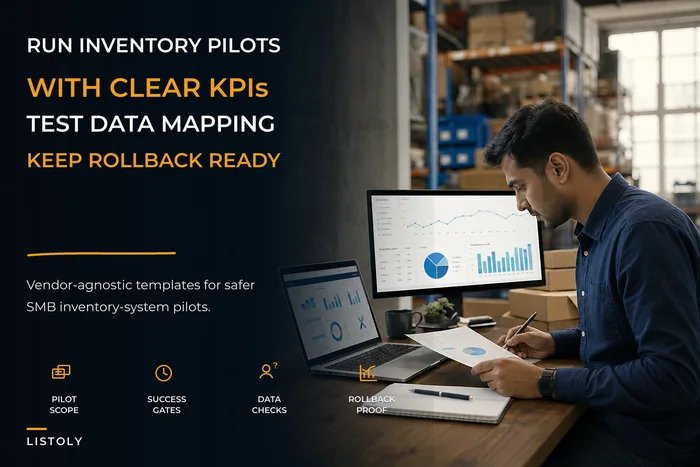
If you're about to evaluate a new system to handle any of this, resist the urge to trust vendor demos on data integrity. Build the contract and reconciliation checks into the trial itself — run real, messy data through it and watch what gets caught. A structured approach to running inventory-system pilots with real KPIs and rollback gates will tell you far more than any sales call about whether a platform actually enforces data quality or just hopes for it.
The system view
These pieces aren't separate tactics — they're one loop. Required fields define what "good" means. Idempotency keys prevent the most common corruption. Reconciliation cadences catch what slips through. Observable metrics tell you when something changed. And remediation playbooks turn every alert into a routine action instead of a fire drill.
Here's a simple workflow showing how the pieces fit together.
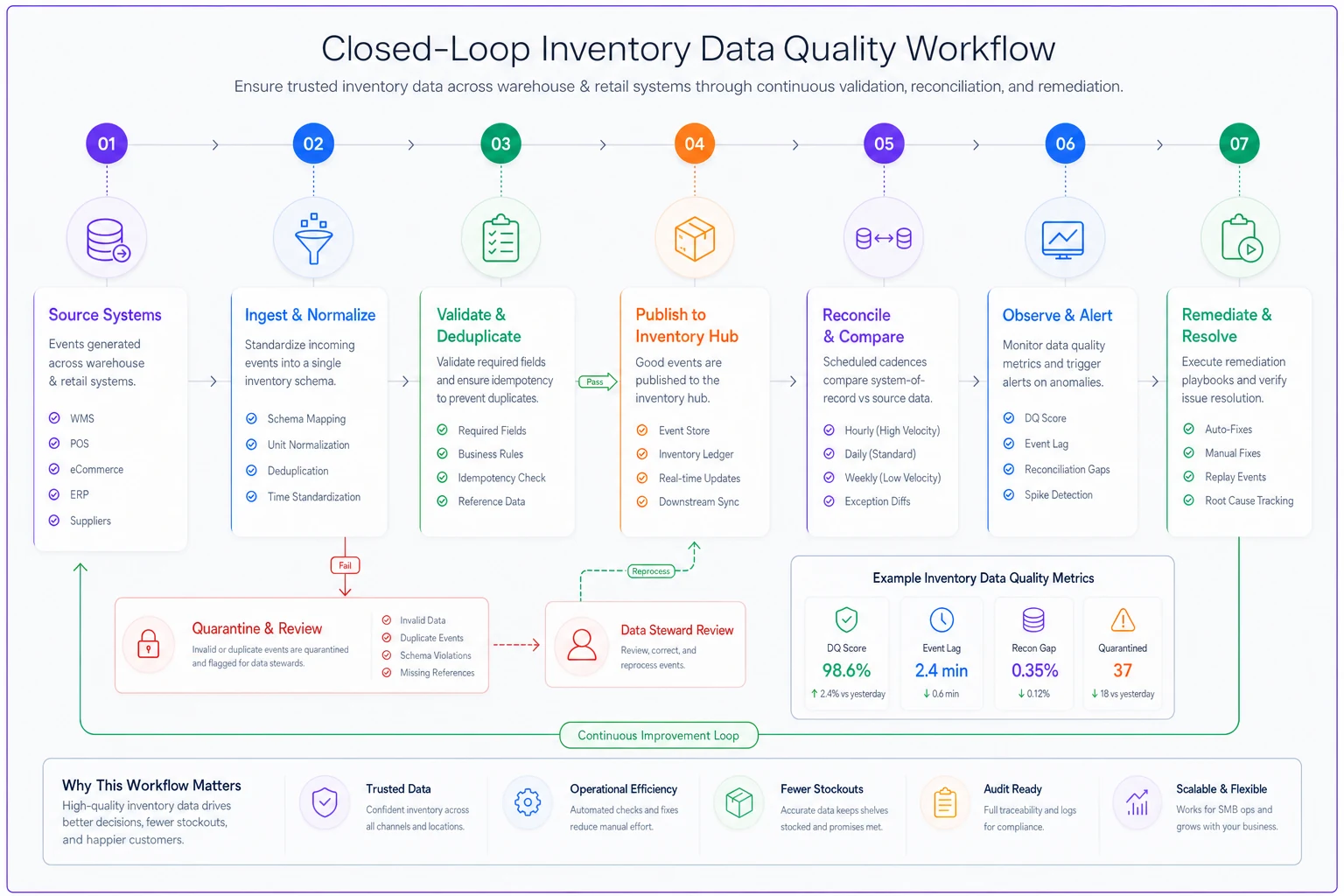
Skip any one piece and the others get weaker. Validate fields but ignore idempotency, and you'll still double-count. Reconcile monthly but watch no live metrics, and you'll catch problems four weeks too late. The businesses that keep their numbers trustworthy as they add channels aren't the ones with the fanciest tools — they're the ones who treated their integrations like a contract with consequences instead of a one-time setup assumed to keep working forever. Good data isn't something you achieve once.
It's something your system defends continuously, quietly, in the background — which is exactly where you want this work to live.
Ready to optimize your inventory operations?
Join 2,000+ businesses using Listoly to reduce stockouts, save time, and improve order accuracy.