

Most small businesses don't have an inventory problem. They have a stage problem.
The thing breaking in your operation right now isn't random. It's almost always a predictable symptom of the maturity level you're operating at — and the fix that works for a business one stage ahead of you will probably make things worse for you, not better. Plenty of owners buy forecasting software when their real issue is that two people are counting the same shelf differently. The tool isn't wrong. The timing is.
So instead of another "best practices" list, this is a staged model. Four stages — Ad-hoc, Repeatable, Managed, Predictable. You figure out where you are, check the capability gaps for your current stage, and build a 12–24 month roadmap that fixes things in the right order. The order matters more than almost anything else, and that's the part nobody really talks about.
Start with a quick diagnostic, then go stage by stage.
Quick self-assessment: which stage are you in?
Answer these honestly. Not how you want it to work — how it works on a bad Tuesday.
-
If I asked three different people how much of SKU X we have, would I get the same number?
-
When someone who handles receiving quits, does the process survive, or does it leave with them?
-
Do we find out we're out of stock from the system, or from a customer / an empty shelf?
-
Can I tell you our inventory accuracy percentage without guessing?
-
Do reorder decisions follow a rule, or someone's gut?
-
When demand shifts, do we react in days or in weeks?
Rough scoring:
-
Mostly "no / from a customer / someone's gut" → Ad-hoc
-
Processes exist but live in people's heads, numbers are roughly right → Repeatable
-
You measure accuracy, decisions follow rules, handoffs are documented → Managed
-
You're forecasting, buffering by risk, and reacting to signals before they hit → Predictable
The uncomfortable pattern: most SMBs think they're one stage higher than they are. The gap between "we have a process" and "the process works when I'm on vacation" is the whole game.
| Stage | How decisions get made | What breaks | Typical inventory accuracy | What growth exposes |
|---|---|---|---|---|
| Ad-hoc | Memory, gut, firefighting | Everything, randomly | 60–75% | Any SKU count above ~200 |
| Repeatable | Informal rules, one key person | Knowledge loss, inconsistency | 75–88% | A second location or channel |
| Managed | Documented rules + metrics | Slow reaction, data silos | 90–96% | Demand volatility, seasonality |
| Predictable | Signals, forecasts, buffers | Over-engineering, drift | 97%+ | Complexity for its own sake |
The uncomfortable pattern: most SMBs think they're one stage higher than they are. The gap between "we have a process" and "the process works when I'm on vacation" is the whole game.
Stage 1 — Ad-hoc: the operation runs on heroics
Every Ad-hoc operation has a hero. Usually the owner, sometimes one tenured employee, and the whole system works because that person remembers things. They know the supplier takes an extra week in July. They know bin 4 is actually where the overflow lives. They know not to trust the count on that one fast-moving SKU.
Never run out of stock or overorder again.
Listoly streamlines inventory workflows to keep your business stocked and profitable.
- Real-time stock tracking
- Automated reorder alerts
- Supplier and purchase management
No credit card required
It feels like it's working. That's the trap. Revenue's fine, customers are mostly happy, and the chaos feels like normal small-business hustle.
Where it actually breaks: the hero takes a two-week vacation, or leaves, and suddenly nobody can answer basic questions. A specialty food distributor with around 350 SKUs ran entirely off the owner's knowledge. He went out for minor surgery, was gone eleven days, and in that window they over-ordered three slow movers into spoilage and stocked out on two top sellers. The loss wasn't catastrophic — somewhere in the $4k–$6k range — but it was the first time anyone realized the "system" was one person.
Capability checklist to graduate from Ad-hoc
People
-
[ ] At least one backup person who can run receiving and reorders
-
[ ] Basic roles written down (who orders, who receives, who counts)
Process
-
[ ] A single source of truth for on-hand quantities (even a clean spreadsheet counts)
-
[ ] A consistent receiving routine — same steps every time
-
[ ] A reorder trigger that isn't "when it looks low"
Tech
-
[ ] Stock counts live in one place, not scattered across notebooks, POS, and memory
-
[ ] Barcodes or SKUs that are actually unique and consistent
The goal at this stage is not sophistication. It's repeatability. You're trying to get the operation out of one person's head and into something another human can follow.
Stage 2 — Repeatable: it works, but only the way one person does it
Repeatable is where most SMBs actually live, and it's a weirdly dangerous stage because it feels stable. Processes exist. People follow them. Numbers are mostly right. But the processes aren't written so much as habitual, and every person does them slightly differently.
The classic Repeatable failure is drift. Two receivers, two interpretations of "damaged." One counts a dented box as sellable, the other quarantines it. Neither is technically wrong, but your data now has two definitions baked in and your reports slowly stop meaning anything.
What growth exposes here: a second location or a second sales channel. The moment you can't physically see all your stock, informal knowledge stops scaling. This usually surfaces when a retailer opens a second store or adds a marketplace and discovers that "we just know" doesn't work across a 30-mile gap.
This is also the stage where writing things down actually sticks — if you do it right. Documentation fails in Repeatable operations not because people are lazy but because the SOPs get written once and never maintained. The change-management side matters as much as the content; a lightweight approach to SOP rollouts that actually stick will save you from the "nice binder nobody opens" outcome.
Capability checklist to graduate from Repeatable
People
-
[ ] Cross-trained staff — at least two people per critical task
-
[ ] Clear definitions everyone agrees on (damaged, returnable, quarantined, etc.)
Process
-
[ ] Documented SOPs for receiving, counting, reorders, and returns
-
[ ] A cycle-count cadence instead of once-a-year panic counts
-
[ ] Reorder points with actual numbers, even if rough
Tech
-
[ ] Inventory system that updates in near real time across locations/channels
-
[ ] Separation between "on hand," "available," and "committed"
The leap out of Repeatable is about consistency you can measure. Which is also the first thing the next stage demands.
Stage 3 — Managed: you measure it, so you can trust it
Managed is where inventory stops being a feeling and becomes a number you believe. You know your accuracy. You run regular cycle counts. Reorder decisions follow documented rules. Handoffs between teams — receiving to stocking, warehouse to finance — are defined, so month-end doesn't turn into a forensic investigation.
The unlock here isn't any single tool. It's that decisions are repeatable regardless of who makes them. A new hire following the rule reorders about as well as your ten-year veteran. That's enormous. It's also the first time you can safely delegate without quality falling off a cliff.
Where Managed operations get stuck: reaction speed and data silos. You know you're low, but the information sits in a report someone reads on Thursday, and by then the window closed. Or your POS says one thing, your warehouse system says another, and reconciling them eats hours. The data is accurate — it's just trapped in separate places moving at different speeds.
A 2-location hardware/supply operation with around 1,800 SKUs running at 93% accuracy is a good example. Solid numbers. But they were still reacting to stockouts several days late because inventory data and purchasing lived in different systems that didn't talk. The fix wasn't more data — it was connecting what they already had so the signal reached the decision-maker in hours, not days.
Capability checklist to graduate from Managed
People
-
[ ] A clear owner for inventory accuracy (someone's actual job, not "everyone's")
-
[ ] Defined handoffs between ops and finance
Process
-
[ ] Regular accuracy measurement and root-cause review on misses
-
[ ] Rules-based reordering with documented safety stock logic
-
[ ] A monthly cadence that turns inventory signals into actual decisions
Tech
-
[ ] Systems that share data instead of living in silos
-
[ ] Dashboards that surface exceptions, not just raw numbers
-
[ ] Some automation on repetitive, rules-based tasks (reorder flags, low-stock alerts)
Pilot automation on low-risk SKUs before rolling it out across critical items.
Before automating anything at this stage, decide what should be automated and who's accountable when it misbehaves. Automation without guardrails just lets you make mistakes faster. A sane approach to inventory automation governance for small teams is the difference between "the system handles reorders" and "the system quietly ordered 400 units of a dead SKU and nobody noticed for a month."
Stage 4 — Predictable: you see it coming
Predictable operations aren't magic, and they're rarer among SMBs than vendors want you to believe. The defining trait: you act on signals before they turn into problems. You forecast with enough confidence to buffer by risk instead of buffering everything equally. You adjust short-term cover when external signals shift — a supplier delay, a demand spike on one channel, weather.
The quiet danger at this stage is over-engineering. Once you've got forecasting and automation humming, there's a pull toward adding complexity because you can, not because it earns its keep. Predictable operations that drift usually have five dashboards nobody reads and a forecasting model tuned to three decimal places on SKUs that move twice a year.
The best Predictable-stage SMBs are almost boring. They've automated the routine, they intervene only on exceptions, and they spend their human attention on the 10% of decisions that actually need judgment. Everything else runs on rules they trust.
Capability checklist to stay healthy at Predictable
People
-
[ ] Team focused on exceptions and strategy, not data entry
-
[ ] Clear escalation paths when forecasts or rules break
Process
-
[ ] Demand forecasting feeding replenishment
-
[ ] Risk-based safety stock (not one-size-fits-all buffers)
-
[ ] Regular review that prunes complexity, not just adds it
Tech
-
[ ] Automated replenishment with human override
-
[ ] Signal integration (sales velocity, lead-time shifts, seasonality)
-
[ ] Proactive alerting before thresholds are breached
The best Predictable-stage SMBs are almost boring. They've automated the routine, they intervene only on exceptions, and they spend their human attention on the 10% of decisions that actually need judgment. Everything else runs on rules they trust.
The part everyone gets wrong: sequencing
You cannot skip stages.
An Ad-hoc business that buys a forecasting platform is trying to forecast off data it doesn't trust. A Repeatable business that automates reordering is automating inconsistency. The investments only pay off when the stage beneath them is solid.
-
Months 0–3 (any stage)
Stabilize your single source of truth.
If your counts aren't trustworthy, nothing above this matters. Fix definitions, consolidate where quantities live. -
Months 3–9
Build repeatability.
Document the SOPs, cross-train, establish cycle counts. This is cheap and high-leverage. -
Months 9–15
Add measurement.
Start tracking accuracy, reviewing misses, moving to rules-based reordering. -
Months 15–21
Connect and automate the routine.
Integrate systems so signals reach decisions fast. Automate the boring, rules-based stuff — with governance. -
Months 21–24+
Layer in forecasting and signal-based buffering.
Only now, once the foundation holds.
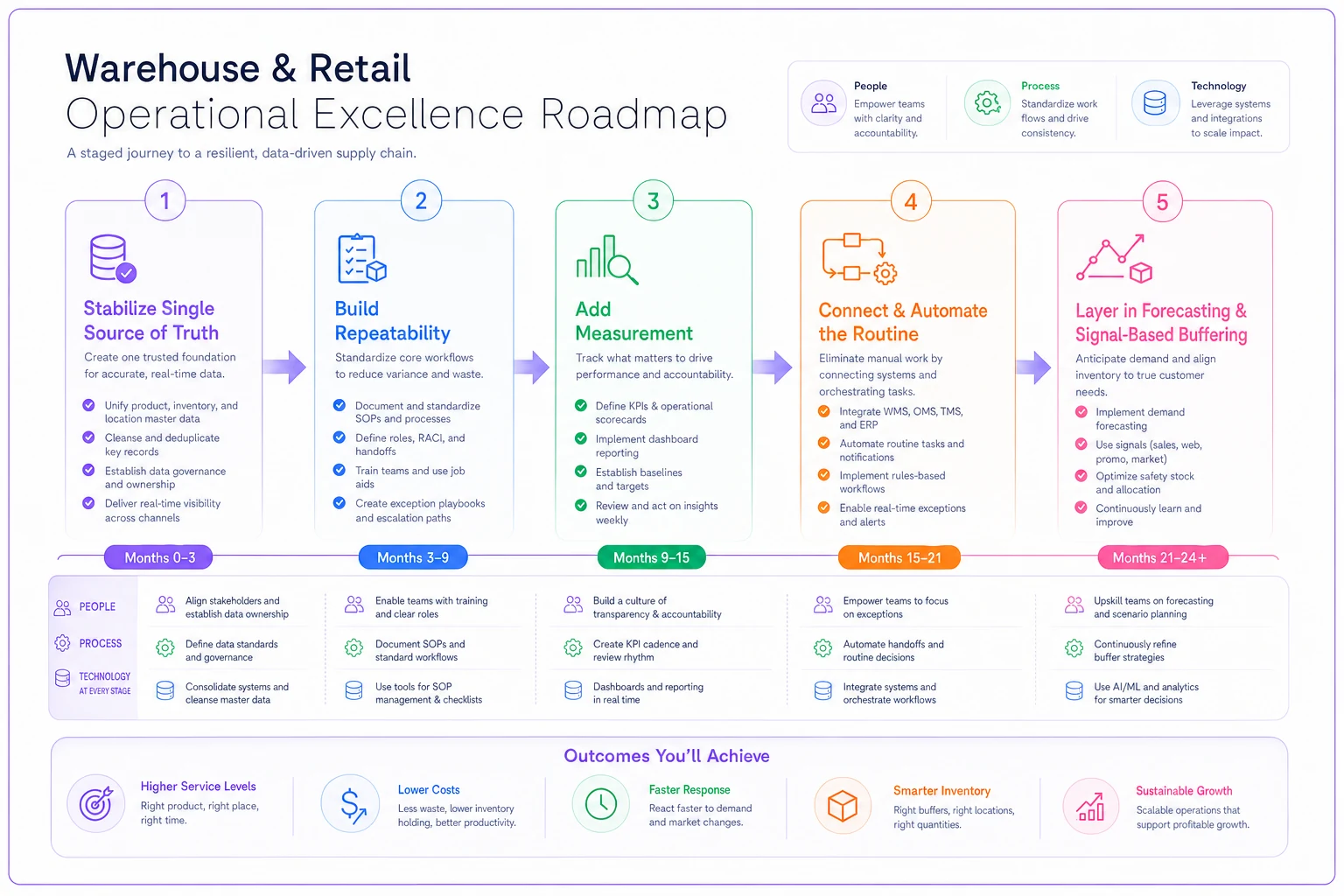
If you're in Ad-hoc, you might only get through steps 1–3 in 24 months — and that's a win. Rushing to step 5 is how businesses waste money on tools they can't support.
When moving up a stage is actually a bad idea
Progress isn't always the right call. A few honest cases:
-
When your SKU count and volume are genuinely low. A business with 80 SKUs and steady demand may not need anything past solid Repeatable. Forcing Managed-level machinery onto it is pure overhead.
-
When you're mid-crisis. Don't re-architect your inventory system during peak season or right after a disruption. Stabilize first.
-
When the real bottleneck is elsewhere. Sometimes inventory feels broken but the actual constraint is cash flow or a bad supplier. Maturing inventory won't fix a sourcing problem.
Who should not chase the Predictable stage: micro-operations where the owner can still see every shelf. If you can physically eyeball your entire inventory in ten minutes, forecasting software is a solution looking for a problem.
Building the business case for each tier
Every stage jump needs a business case, and the honest ones look different at each tier. Rough template:
-
Ad-hoc → Repeatable Cost is mostly time (writing SOPs, cross-training). Payoff is risk reduction — you're buying insurance against the hero leaving. Value: avoided stockouts and spoilage, continuity.
-
Repeatable → Managed Cost includes a real inventory system and measurement discipline. Payoff is accuracy and labor — fewer emergency orders, faster month-end, less reconciliation time. Quantify the hours currently lost to firefighting.
-
Managed → Predictable Cost is forecasting capability and integration. Payoff is working capital — right-sized buffers free up cash tied in excess stock while cutting stockouts. This is the tier where the ROI math gets genuinely compelling, often freeing up a meaningful chunk of carrying cost.
When you do make a system investment, run it as a pilot with clear success metrics and a rollback plan — don't bet the whole operation on a big-bang switch. The template-driven approach in this guide to running vendor-agnostic inventory system pilots keeps you honest about whether the tool is actually earning its cost.
A real scenario: moving one stage, not four
A regional apparel and accessories retailer — three small stores, around 2,400 SKUs — came in frustrated. They'd tried to jump straight to a forecasting tool and it flopped. Forecasts were garbage because their on-hand data was off by double digits in places. Classic skip-a-stage failure.
They dropped back a level. Spent about four months on the unglamorous stuff: one source of truth, consistent definitions of damaged vs. sellable, a weekly cycle-count rotation, and documented reorder rules. Inventory accuracy went from somewhere in the high 70s to around 92%. Then they reconnected their POS and purchasing data so low-stock signals reached the buyer same-day instead of in a Thursday report.
Results after roughly eight months weren't dramatic on paper, but they mattered: emergency reorders dropped by more than half, month-end reconciliation went from a two-day slog to an afternoon, and the recurring stockouts on top sellers stopped. The forecasting tool they'd originally wanted? They finally turned it on in month ten — and this time it worked, because it was running on data it could trust.
The lesson isn't "forecasting is bad." It's that they finally moved one stage at a time, in order.
How to actually use this
Pull up the self-assessment, score yourself honestly, and resist the urge to round up. Find your stage, work the capability checklist for that stage only, and sequence your roadmap so each investment lands on a foundation that can hold it.
The businesses that get inventory right aren't the ones with the fanciest systems. They're the ones that matched their capabilities to their actual stage — and then grew into the next one deliberately, one layer at a time, instead of buying the destination and skipping the road to get there.
Ready to optimize your inventory operations?
Join 2,000+ businesses using Listoly to reduce stockouts, save time, and improve order accuracy.