


Most small buyers approach suppliers from a position they think is weak. You're ordering 40 cartons a month while the supplier's biggest account orders 4,000. So the mental model becomes: take what you're given, accept the lead times, don't make noise.
That model quietly costs you money every single week. Not in some dramatic blow-up, but in the small frictions — the extra two days of lead time you accept because nobody asked, the forecast you never shared so the supplier buffers against you, the quality issue that gets handled by email ping-pong instead of a standing conversation.
The buyers who actually improve their supplier relationships aren't the ones with volume leverage. They're the ones who run small, structured cooperation experiments that make the supplier's life easier while extracting better terms for themselves. No master service agreements. No procurement department. Just a few lightweight moves repeated consistently.
This is the supplier partnership playbook SMB buyers can actually run — built around quick-win pilots, simple scorecards, a governance rhythm that fits a 3-person team, and incentive structures that work when you don't have big volume to dangle.
Why cooperation stalls between small buyers and suppliers
The friction usually isn't hostility. It's that nobody owns the relationship on either side.
On the supplier end, a small account gets assigned to a rep managing 80 others. You're a line item. They don't know your seasonality, your growth plans, or which SKUs actually matter to you. So they treat every order the same way — safe, generic, buffered.
On your end, there's usually no single person who "owns" the supplier. Purchasing happens reactively. Someone places orders when stock gets low, someone else chases a late shipment, and the owner only gets involved when something breaks. The supplier never experiences you as a coherent, predictable partner — they experience three different people sending inconsistent signals.
What shows up repeatedly across small operations is that this fragmentation is the real tax. The supplier isn't gouging you. They're pricing in uncertainty — uncertainty you created by never giving them anything to plan around.
A typical pattern: a buyer complains that a supplier's lead time is 21 days. But when you dig in, the buyer has never shared a forecast, orders in unpredictable bursts, and changes quantities at the last minute. The supplier's 21 days includes a hidden buffer for exactly that chaos. Remove the chaos and the real lead time is closer to 12.
That's the opening. Cooperation isn't about being nice — it's about reducing the supplier's uncertainty in ways that come back to you as better terms.
The progressive path: why you start small on purpose
When people finally decide to "fix supplier relationships," the instinct is to go big. Draft a partnership agreement, request volume discounts, propose a VMI arrangement, ask for exclusivity. All of that triggers legal review, finance sign-off, and a slow death by committee — on both sides.
Never run out of stock or overorder again.
Listoly streamlines inventory workflows to keep your business stocked and profitable.
- Real-time stock tracking
- Automated reorder alerts
- Supplier and purchase management
No credit card required
The progressive path inverts this. You start with the smallest possible cooperation that requires zero legal overhead, prove it works, then stack on the next one. Each pilot is reversible, time-boxed, and small enough that nobody needs to escalate it.
Here's the general sequence that tends to work:
| Stage | Cooperation move | Legal overhead | What you're proving |
|---|---|---|---|
| 1 | Share a rolling forecast | None | You're predictable |
| 2 | Data exchange (stock levels, sell-through) | None | Visibility pays off |
| 3 | Lead-time reduction test | None | Cooperation = speed |
| 4 | Simple joint scorecard | None | You measure fairly |
| 5 | Standing governance call | None | The relationship has an owner |
| 6 | Incentive/consignment pilot | Light | Shared upside is real |
The first five stages involve no contracts at all. They're operational, not legal. That's the whole point — you build trust and a track record before anything needs a signature. By the time you get to stage six, the supplier already sees you as a low-risk, high-communication account, and the conversation is completely different.
The mistake people make is skipping to stage six because it's the one with obvious money. But a consignment pilot with a supplier who doesn't trust your forecasts yet is a negotiation. The same pilot after six months of clean data exchange is almost a formality.
Quick-win pilot #1: The forecast exchange
This is the lowest-effort, highest-return move, and almost nobody does it.
You commit to sending the supplier a rolling forecast — even a rough one — on a fixed cadence. Monthly is fine. It doesn't need to be accurate to be useful; it needs to be consistent and honest about its own uncertainty.
A workable forecast exchange for a small buyer contains:
-
Expected order quantities by SKU for the next 8–12 weeks
-
A confidence note (firm / likely / speculative)
-
Any known events — a promo, a seasonal spike, a new location opening
-
A flag on anything you're unsure about
The part people underestimate: you explicitly tell the supplier "this is a forecast, not a commitment." That one sentence removes their fear that sharing creates obligation, and it removes your fear of being held to numbers. The forecast becomes a planning aid, not a contract.
What tends to happen after two or three cycles is subtle but real. The supplier starts holding a little stock against your pattern. Lead times on your repeat SKUs quietly shorten because they're no longer starting from zero when your PO lands. You didn't negotiate anything. You just stopped being a surprise.
Quick-win pilot #2: Two-way data exchange
Forecast exchange is you giving the supplier visibility. Data exchange makes it mutual — and that's where the relationship starts feeling like a partnership instead of a transaction.
The data worth exchanging is small and specific:
-
You share current on-hand for their SKUs, sell-through rate, and reorder triggers
-
They share their on-hand/production status for your SKUs, realistic ship dates, and early warnings on shortages or allocations
The operational win is that you stop learning about stockouts after they hit you. A supplier who tells you "we're tight on SKU 4471, you might want to pull your next order forward" just saved you a stockout — and they only did it because you'd built a channel where that kind of heads-up flows naturally.
Assign one person to keep the shared sheet current so the supplier keeps trusting the exchange.
In practice this doesn't require fancy integration. A shared spreadsheet updated weekly works for most small buyers. The point isn't the tool, it's the habit. Teams that make this stick usually have one person responsible for keeping their side of the data current, because the moment your numbers go stale, the supplier stops trusting the exchange and it quietly dies.
If you want to go further on the incoming side — having the supplier manage replenishment against the visibility you've shared — that's where a consignment/VMI pilot becomes a natural next stage rather than a cold ask.
Quick-win pilot #3: The lead-time reduction test
Once forecasts and data are flowing, you've earned the right to run a lead-time test — and now it's a collaboration instead of a demand.
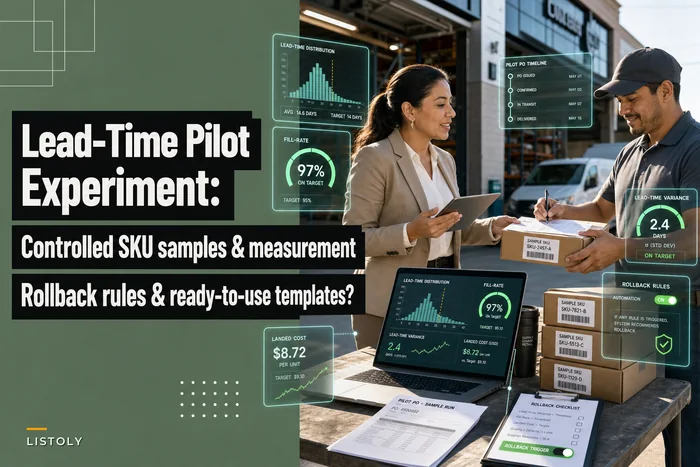
The structure is simple. Pick two or three high-volume, stable SKUs. Propose a small, bounded experiment: "If I give you firm orders 10 days earlier and commit to a steadier order pattern on these SKUs, can we test shaving the lead time from 21 days to 14 for 60 days?"
You're trading something concrete (predictability, earlier commitment) for something concrete (speed). That trade is what makes it work. A lead-time ask with nothing offered in return is just pressure. Bundled with better inputs, it's a fair deal.
The experiment needs rollback rules baked in — a point where, if the shorter lead time causes misses or quality issues, both sides revert without drama. Running this as a disciplined, time-boxed test with clear metrics and an exit path is exactly the kind of approach covered in this short-run pilot to test supplier lead-time reductions, and it keeps the whole thing from turning into a vague open-ended request nobody ever closes out.
One thing worth keeping in mind: suppliers often say no to a permanent lead-time change but yes to a 60-day test. The word "test" lowers the stakes for them. Many "permanent" improvements started as pilots that simply never got rolled back because they worked.
Building a scorecard a small team will actually use
Supplier scorecards fail in SMBs for one predictable reason: they're too complicated to maintain. Someone builds a 20-metric dashboard, fills it in twice, and abandons it.
A scorecard that survives contact with a busy small team tracks four or five things, no more:
-
On-time delivery — did it arrive within the promised window?
-
Order accuracy — right items, right quantities?
-
Quality / defect rate — what percentage arrived usable?
-
Responsiveness — how fast do they answer problems?
-
Lead-time trend — is it getting better, worse, or flat?
Score each on a simple 1–5 or red/yellow/green. That's it. The goal isn't precision, it's a shared, consistent view you can put in front of the supplier.
The scorecard's real value isn't evaluation — it's conversation. When you show a supplier they're yellow on responsiveness, you're not accusing them. You're giving them a specific, fixable target. Suppliers almost always improve the thing you measure and discuss, because now they know it's being tracked by an account that pays attention.
Keep the scoring fair. If your own forecasts were garbage that month and caused a miss, note it. A scorecard that only ever blames the supplier gets ignored. One that occasionally admits your own mistakes earns the credibility to push on theirs.
The governance cadence: giving the relationship an owner
Everything above falls apart without a rhythm. Pilots drift, scorecards go stale, data exchange lapses — unless there's a standing moment where the relationship gets attention.
For a small buyer, this doesn't need to be heavy. A 30-minute call once a month with your top two or three suppliers covers it. The agenda is the same every time, which is what makes it sustainable:
-
Review the scorecard (5 min)
-
Walk through the forecast for the next period (10 min)
-
Flag any upcoming events, risks, or shortages (10 min)
-
Decide on or review any active pilot (5 min)
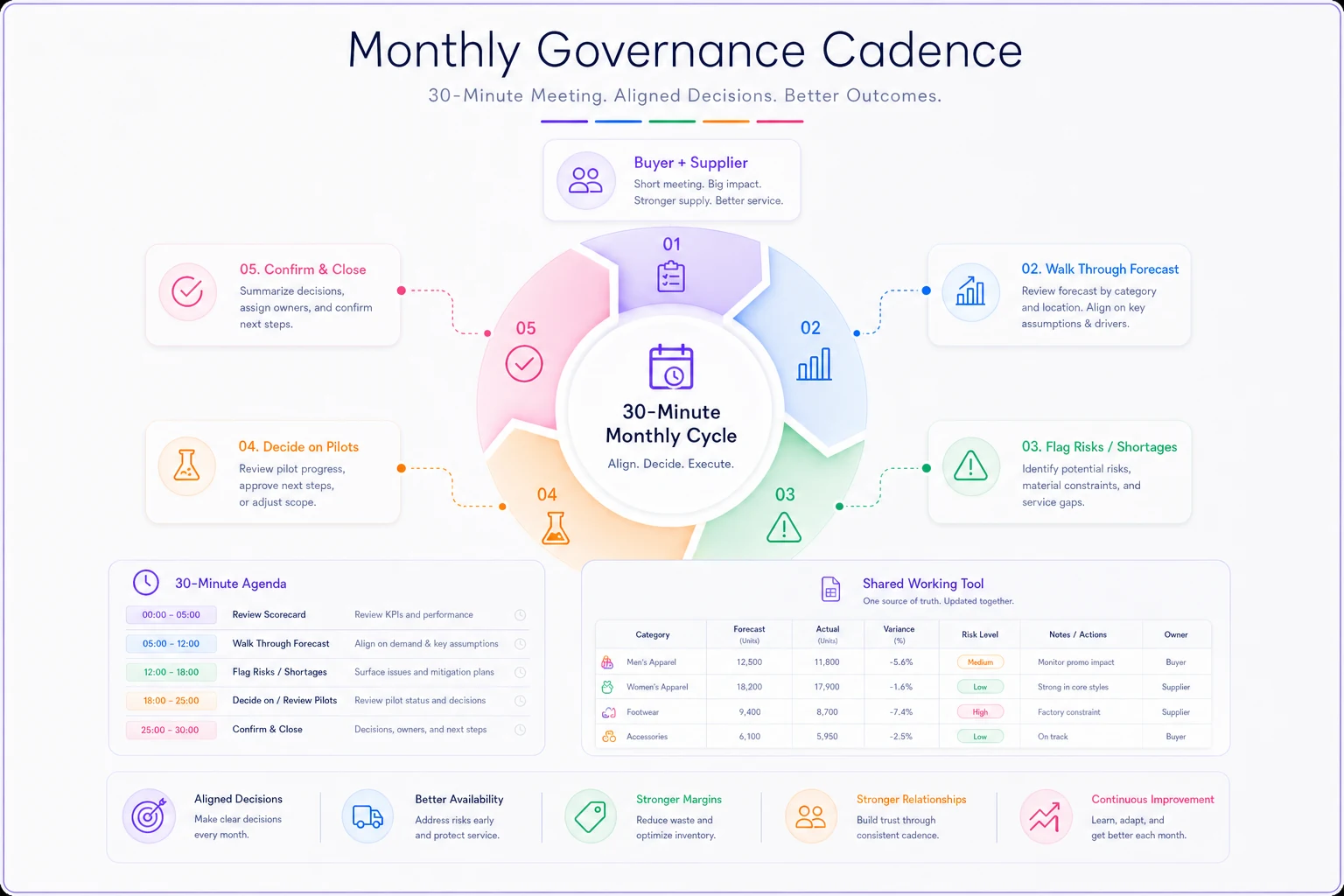
A simple visual of the cadence helps keep the agenda consistent.
The discipline is in the cadence, not the length. A predictable monthly touchpoint changes how the supplier perceives you. You go from "that small account that emails when something's wrong" to "the account with a standing call and a scorecard." That perception shift is worth more than most volume discounts you'd ever negotiate.
This governance rhythm also connects naturally to risk work. The same call where you review scorecards is the right place to pressure-test backup options and triggers — the kind of structured thinking covered in supplier contingency planning for SMBs. Cooperation and contingency aren't opposites; the suppliers you partner most closely with are also the ones whose failure would hurt most, so they deserve both a partnership plan and a backup plan.
Incentive templates that work when you lack volume
Big buyers incentivize suppliers with volume. You don't have that. So your incentives need to be built on things that actually reduce the supplier's cost and risk — which, conveniently, you're well-positioned to offer.
Things small buyers can offer that suppliers genuinely value:
-
Earlier firm commitments — lets them plan production and buy materials with confidence
-
Steadier order patterns — smoother demand is cheaper to fulfill than spiky demand
-
Faster payment — offer to pay in 15 days instead of 30 in exchange for a small discount or priority
-
A testimonial or reference — real currency for suppliers trying to land accounts like yours
-
Consolidated orders — fewer, larger POs reduce their handling cost
A workable incentive frame: "If you hit 95%+ on-time for the next quarter, we'll move all our eligible SKUs to you and commit to earlier ordering." You're not promising more money — you're promising predictability and share-of-wallet, which for a small supplier is often more attractive than a one-time volume bump.
The mistake to avoid is offering incentives before you've proven you can deliver on them. If you promise faster payment and then pay late, every future negotiation gets harder. Only put on the table what your operation can reliably execute.
A real scenario: a specialty foods distributor
A regional specialty foods distributor — roughly $2M in annual revenue, buying from about a dozen producers — was fighting constant stockouts on their top imported SKUs. Lead times ran 18–25 days, forecasts were never shared, and ordering was reactive. They were carrying heavy safety stock on everything just to cover the uncertainty.
They ran the progressive path over about four months. Started with monthly forecast exchange to their three biggest producers. Added a weekly shared sheet with on-hand and sell-through. Then proposed a 60-day lead-time test on six stable SKUs, offering firmer, earlier commitments in return.
By the end, lead times on the pilot SKUs had come down to the 12–14 day range, and two producers started proactively flagging tight stock before it became a problem. Because lead times tightened and the relationship got more predictable, they trimmed safety stock on those SKUs noticeably — freeing up somewhere in the $20k–$25k range of cash that had been sitting on shelves as a buffer against uncertainty.
No contracts changed. No legal review happened. The entire gain came from making themselves predictable and giving the relationship a rhythm.
When this approach makes sense — and when it doesn't
This works well when:
-
You buy repeatedly from a small set of suppliers (not one-off purchases)
-
Those suppliers have some flexibility in how they serve you
-
You can realistically keep up your side — consistent forecasts, timely payment, a standing call
-
There's enough margin in the relationship that cooperation produces shared upside
This is a poor fit when:
-
You're buying commodity items from suppliers you switch constantly on price
-
The supplier is so large you genuinely are a rounding error and can't get a rep's attention
-
Your own ordering is too chaotic to make any commitment you'd keep
-
The relationship is short-term or transactional by nature
Who should NOT start here: if your internal purchasing is still ad hoc — different people ordering, no clear forecast, inconsistent data — fix that first. You can't offer a supplier predictability you don't have. The partnership playbook amplifies whatever operational discipline already exists; it won't manufacture discipline that isn't there.
Keeping it all coordinated as you grow
The quiet challenge with running multiple supplier pilots is coordination. One supplier's in a lead-time test, another's in a forecast exchange, a third has a scorecard review coming up. With two suppliers you can hold it in your head. With ten, you can't — things slip, cadences get missed, and the whole system degrades back toward reactive chaos.
This is where having supplier terms, lead times, scorecards, and order history in one place instead of scattered across inboxes and spreadsheets starts to matter. When your supplier data lives alongside your actual inventory and purchasing activity, the forecast you share is pulled from real numbers, the scorecard reflects real delivery performance, and the monthly call runs off current data instead of someone's best recollection. AI-assisted operational platforms that bring purchasing, supplier records, and inventory signals together mostly just remove the manual work of keeping all these threads current — so the cooperation habits you've built actually survive as you add more suppliers.
But the software is downstream of the behavior. The behavior is what works: be predictable, share what you know, measure fairly, keep a rhythm, and trade things you can actually deliver on. Do that consistently and the "weak" small-buyer position turns out to be surprisingly strong — because suppliers would rather have ten predictable, communicative small accounts than one large one that treats them like a vending machine.
Start with one supplier and one pilot. Prove it. Stack the next one. The leverage builds quietly, and six months in you'll be getting terms you were told small buyers never get.
Start with one supplier and one pilot. Prove it. Stack the next one. The leverage builds quietly, and six months in you'll be getting terms you were told small buyers never get.
Ready to optimize your inventory operations?
Join 2,000+ businesses using Listoly to reduce stockouts, save time, and improve order accuracy.